

文稿:Elizabeth Nixon-Shapiro, Samantha McBundy, Marisa Pedron, Emma Solar, Viviana Popa;
翻译:itsmelan;编辑:戈 长时;
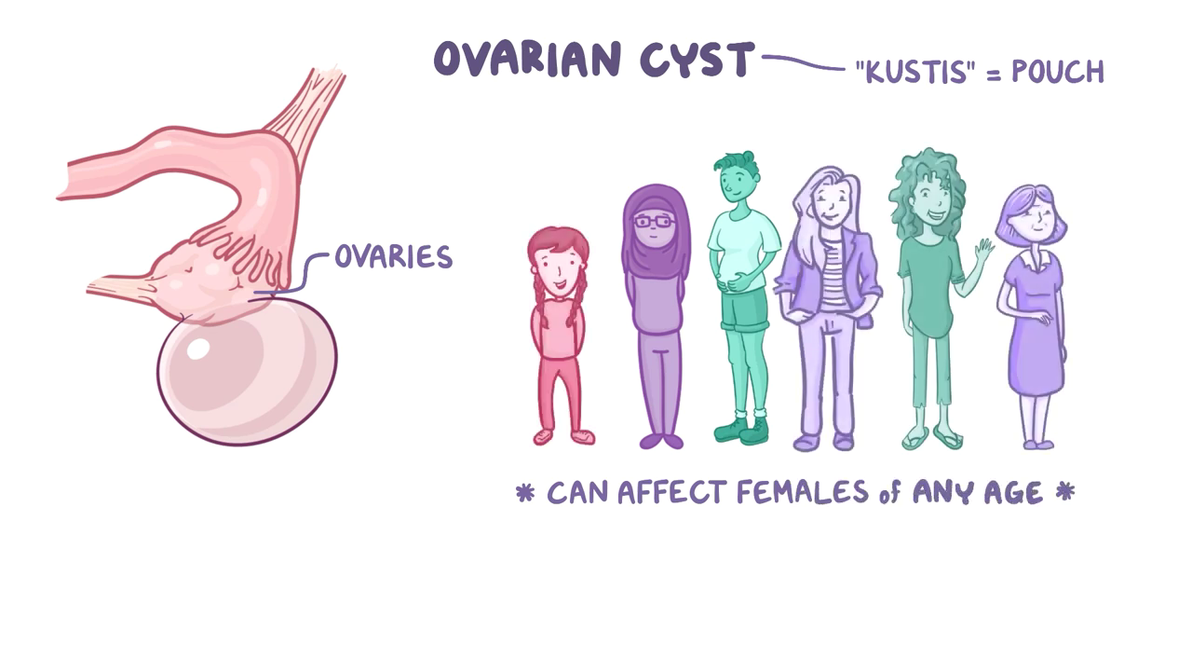
“Cyst” comes from kustis, which means “pouch”, so ovarian cysts are fluid-filled sacs on or in the ovaries. They are very common in females of reproductive age, but can affect females of any age.
“Cyst”由“kustis”演变而来,指“囊袋”,所以,“卵巢囊肿”指的就是卵巢表面或内部的液囊。常见于育龄期女性,但各个年龄段均可发病。
【1】卵巢
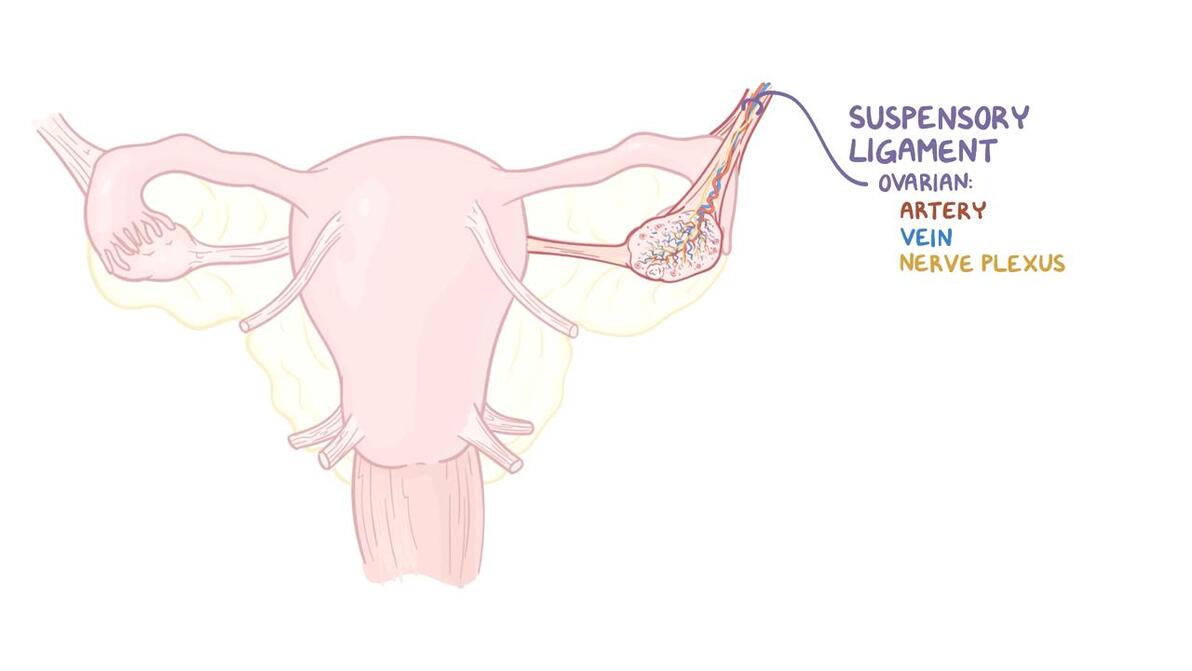
The ovaries are a pair of white-ish organs about the size of walnuts. They’re held in place, slightly above and on either side of the uterus and fallopian tubes by ligaments. Specifically, there’s the broad ligament, the ovarian ligament, and the suspensory ligament. And the suspensory ligament is particularly important because the ovarian artery, ovarian vein, and ovarian nerve plexus pass through it to reach the ovary.
卵巢是一对核桃大小的乳白色器官,被韧带固定在子宫和输卵管的两侧;具体而言,有阔韧带、卵巢韧带、悬韧带。其中,悬韧带尤其重要,因为卵巢动脉、卵巢静脉和神经丛从其中穿过并延伸到卵巢。
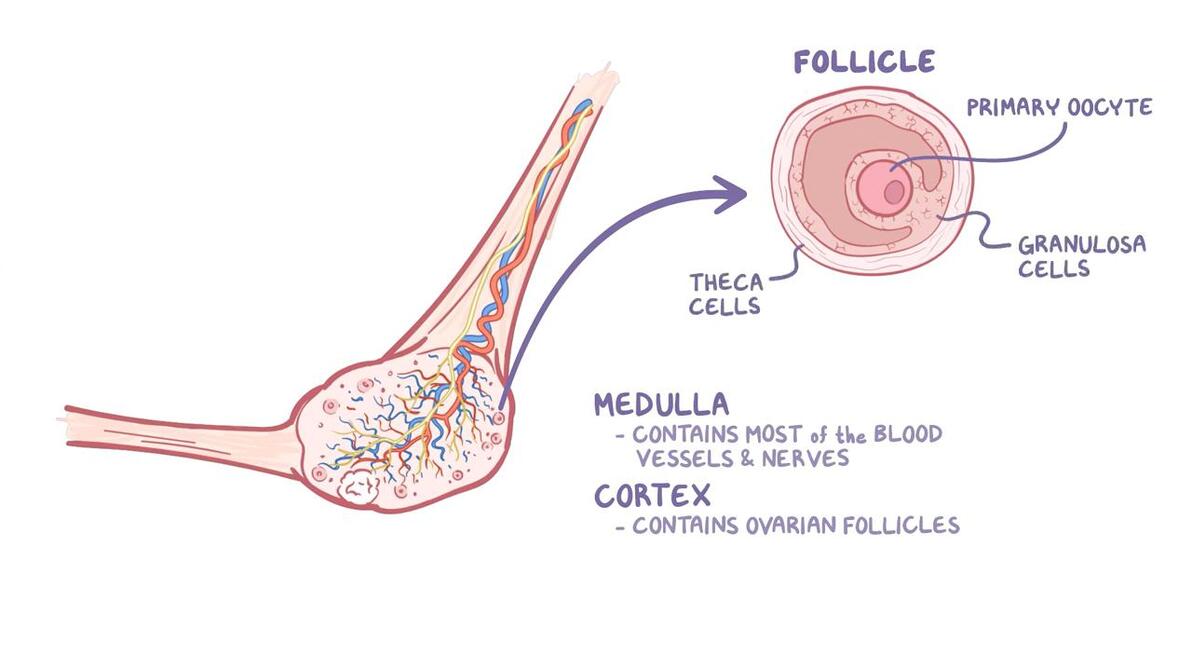
If you slice the ovary open and look at it (don’t try this at home), there’s an inner layer called the medulla, which contains most of the blood vessels and nerves and an outer layer called the cortex, which has ovarian follicles scattered throughout it. Each follicle is initially made up of an immature sex cell, or primary oocyte, which is the female sex cell, and layers of theca and granulosa cells surrounding the oocyte.
如果你把卵巢切开来看(别试窝~),这个里层叫做髓质,包含大部分的血管和神经;外层则叫皮质,分布着卵泡。每个卵泡最初是由未成熟的生殖细胞:初级卵母细胞(即女性生殖细胞) 和卵母细胞外层的鞘细胞、颗粒细胞组成。
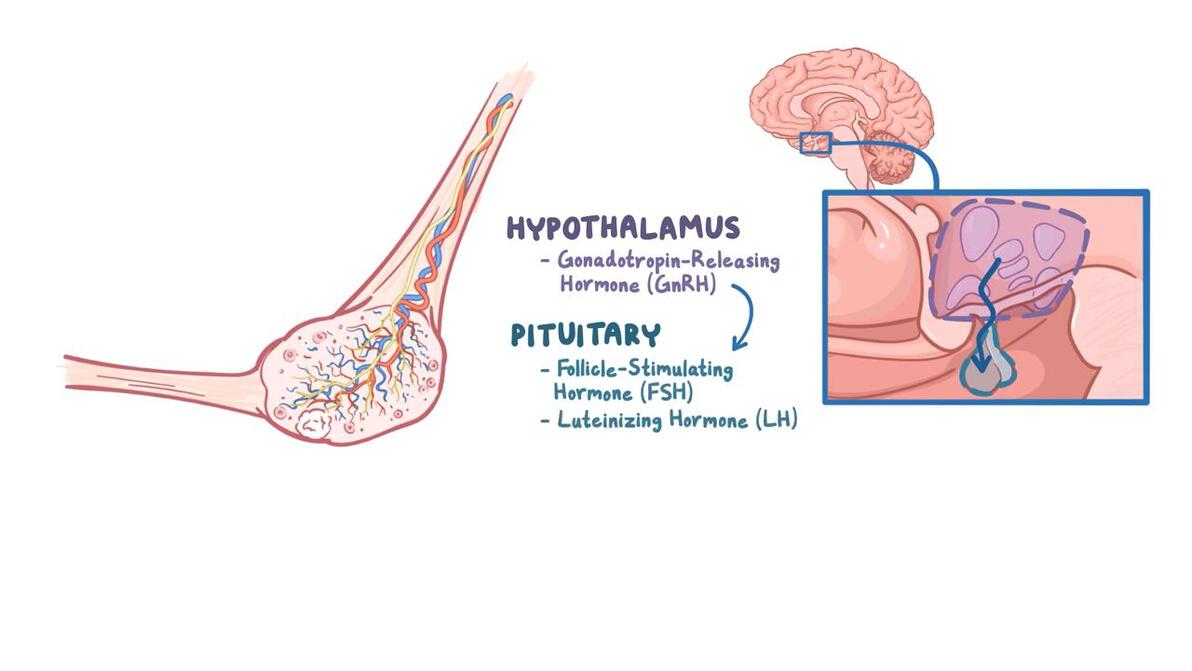
Now, there’s actually loads going on with the ovaries throughout the menstrual cycle, which is controlled by the hypothalamus and the pituitary up in the brain. The hypothalamus secretes gonadotropin-releasing hormone, or GnRH, which makes the nearby anterior pituitary gland release follicle-stimulating hormone, or FSH, and luteinizing hormone, or LH.
在月经周期中,卵巢不停运转;这由脑部的下丘脑和垂体控制。下丘脑释放促性腺激素释放激素,即GnRH,它可以使附近的垂体前叶释放卵泡刺激素(即FSH)和促黄体素(即LH)。
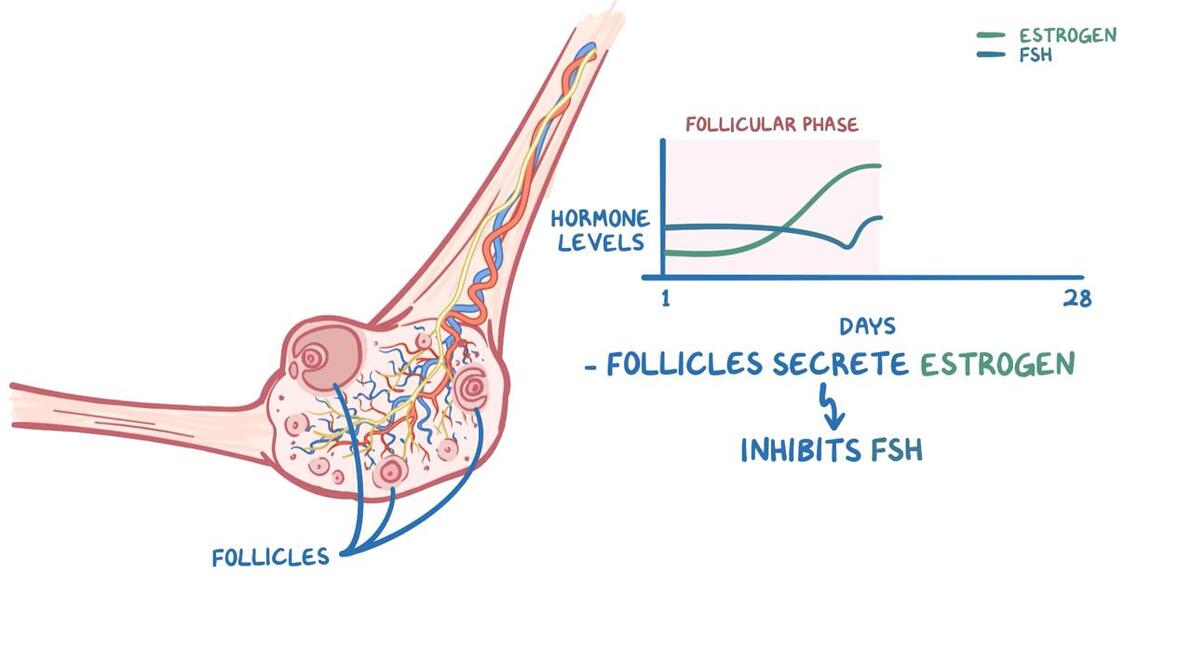
In the first two weeks of an average 28-day cycle, the ovaries go through the follicular phase, meaning that out of the many follicles scattered throughout the ovaries, a couple of them enter a race to become the dominant follicle, that will be released at ovulation, while the rest regress and die off. All the developing follicles secrete loads of estrogen, which negatively inhibits pituitary FSH, and they also make a few androgens like testosterone.
平均28天的月经周期前两周,卵巢处于卵泡期,意味着在卵巢众多的卵泡中,几个卵泡会在竞争中成为优势卵泡,并在排卵时释放,其余则会退化闭锁。发育中的卵泡都会分泌雌激素,以负反馈抑制垂体FSH,同时产生少量雄性激素(如睾酮)。
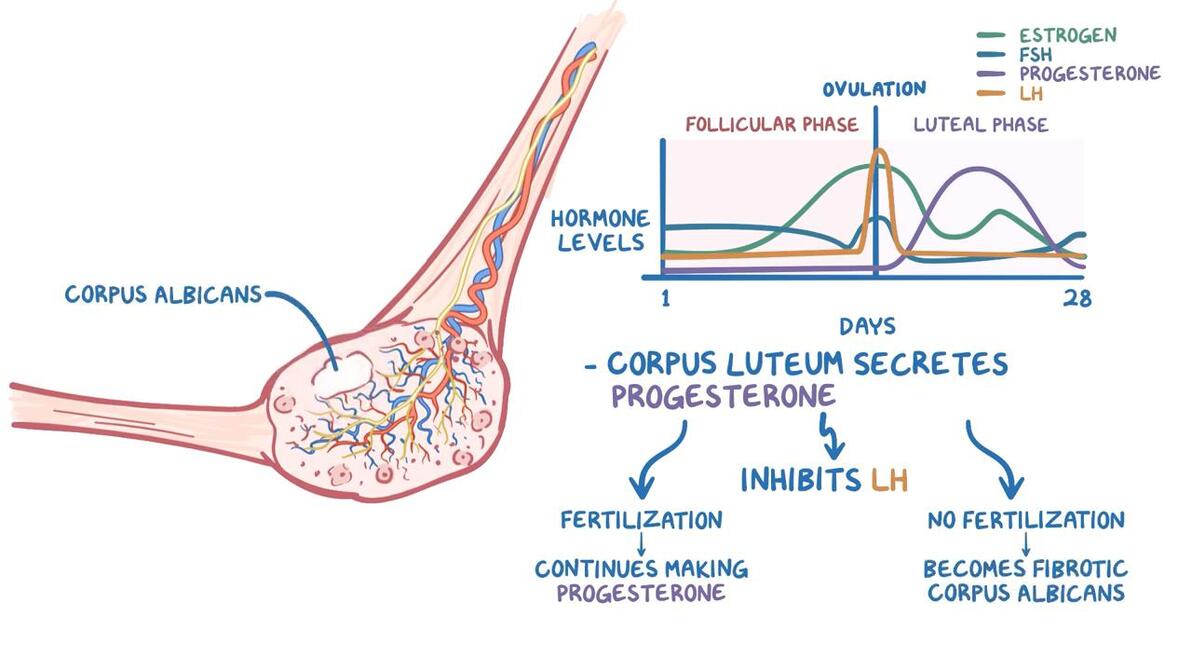
At ovulation, the oocyte is released into the fallopian tube, and the luteal phase begins - which lasts for the last 2 weeks of an average 28-day cycle. During the luteal phase, the remnant of the ovarian follicle, called the corpus luteum, makes progesterone, which negatively inhibits pituitary LH. If fertilization occurs, then the corpus luteum continues making progesterone until the placenta forms. If fertilization doesn’t happen, then the corpus luteum stops making hormones after approximately 10 days, becomes fibrotic, and is called the corpus albicans.
排卵时,卵母细胞被释放入输卵管,然后黄体期就开始了,它会占据月经周期的后两周。黄体期中,卵泡的残余物,又称黄体,会产生黄体激素,负反馈抑制垂体LH。如果受精发生,黄体会持续释放黄体激素直到胎盘形成;如果未受精,黄体会在大概10天后停止生成激素,并纤维化变成白体。
【2】功能性囊肿
So as far as ovarian cysts go, there are 2 broad categories.
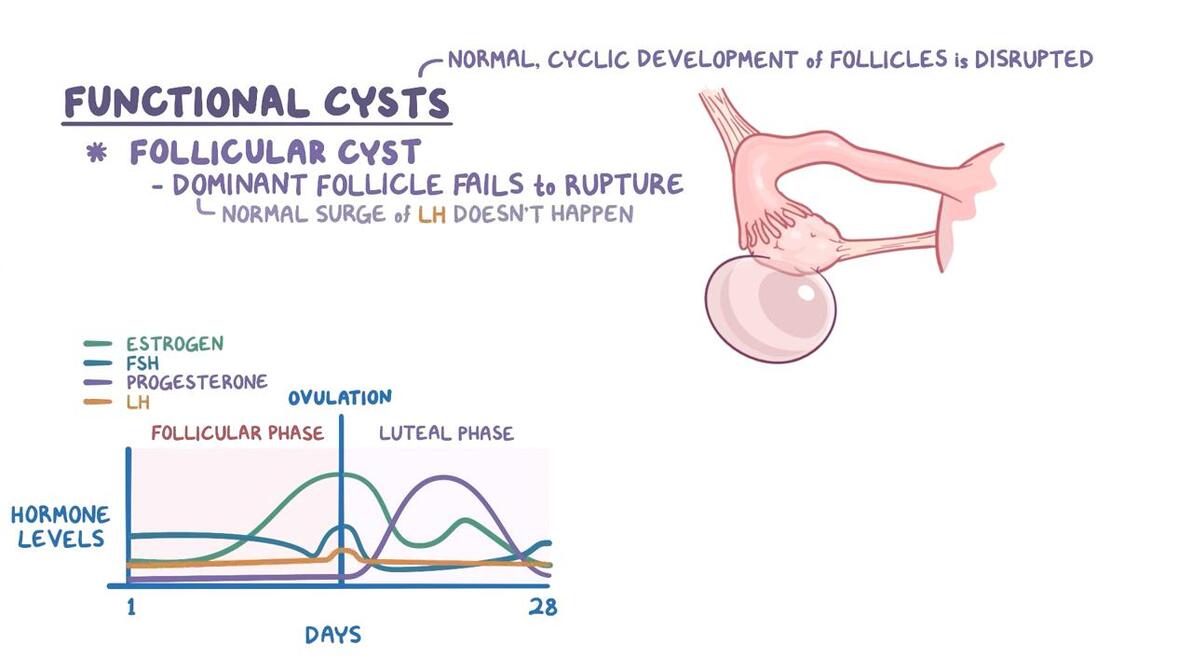
First, there are functional cysts, which result when the normal, cyclic development of the ovarian follicles is disrupted. One type of functional cyst that can form before ovulation is a follicular cyst, which is a dominant follicle that fails to rupture and keeps growing. This can happen, if say, the normal surge of LH that causes ovulation just doesn’t happen during a given menstrual cycle.
有关卵巢囊肿的形成,大致可以分为两种:
首先,是功能性囊肿,由于正常、周期性的卵泡发育过程被打乱。其一是在排卵前形成的滤泡囊肿,是优势卵泡未破裂而继续生长形成的。如果月经周期中可促进排卵的促黄体素没有形成正常量的波峰,就可能导致这一类囊肿。
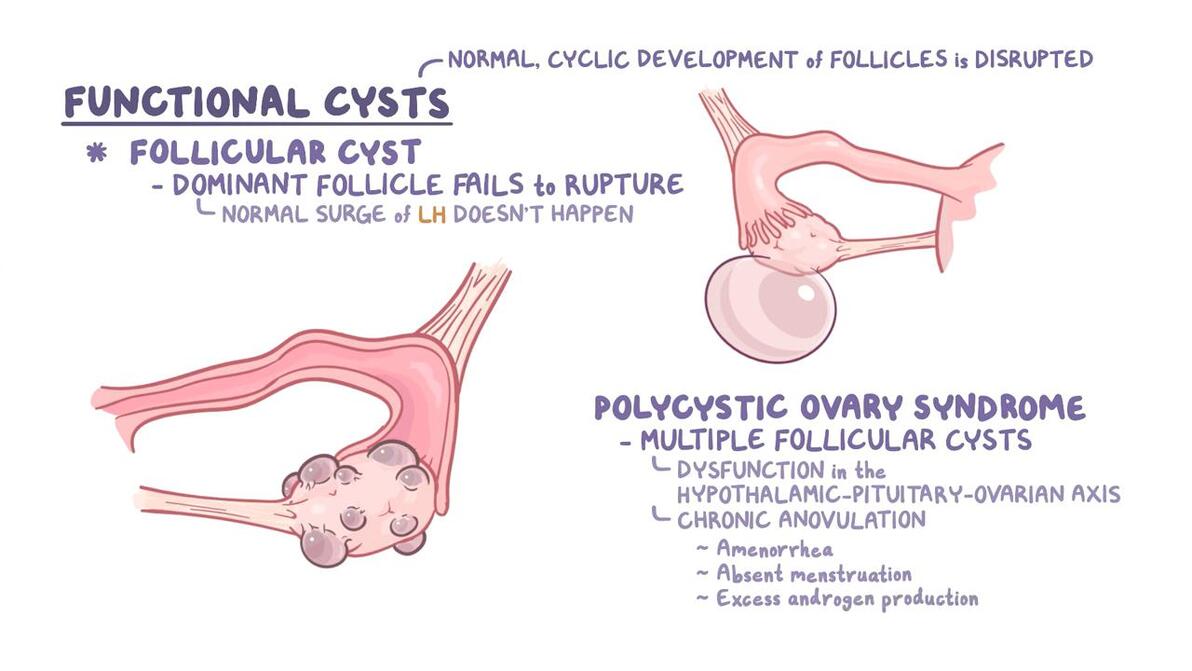
A condition where you might have multiple follicular cysts is polycystic ovary syndrome, which is caused by a dysfunction in the hypothalamic-pituitary-ovarian axis that causes chronic anovulation, which may lead to amenorrhea, or absent menstruation, and excess androgen production.
而患多囊卵巢综合征(PCOS)时,可能会有多个滤泡囊肿产生;由于下丘脑-垂体-卵巢轴功能失调,导致长期无排卵,进而可能引起闭经(月经次数减少)和雄激素生成过量。
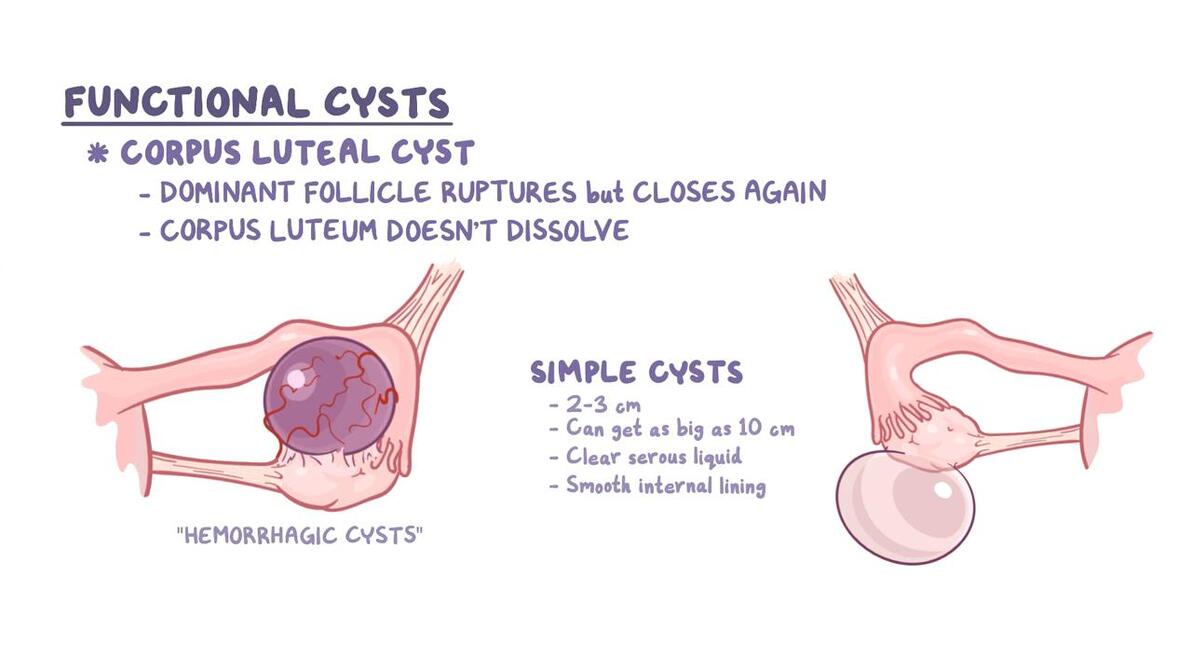
Alternatively, if the dominant follicle ruptures but then closes up again after ovulation, this is called a corpus luteal cyst. In this case, the corpus luteum doesn’t dissolve but instead continues to grow. As it grows, the arteries nourishing it can rupture and hemorrhage into the cyst, which is why corpus luteal cysts are also called hemorrhagic cysts. Both follicular and corpus luteal cysts are usually around 2 to 3 centimeters, but they can get as big as 10 cm in diameter, they contain a clear serous liquid, and have a smooth internal lining - so they are referred to as “simple cysts”.
还有一种情况,优势卵泡破裂了,但在排卵后再次闭合,形成黄体囊肿。此时,黄体不会溶解而会继续增长。随着它不断变大,滋养它的动脉会破裂并在囊肿内形成积血,这也是黄体囊肿被称为积血性囊肿的原因。滤泡囊肿和黄体囊肿一般大小为2-3厘米,但也可能长到10厘米(直径),它们包裹着清澈的浆液,且有光滑的内表面因此又被称作单纯性囊肿。
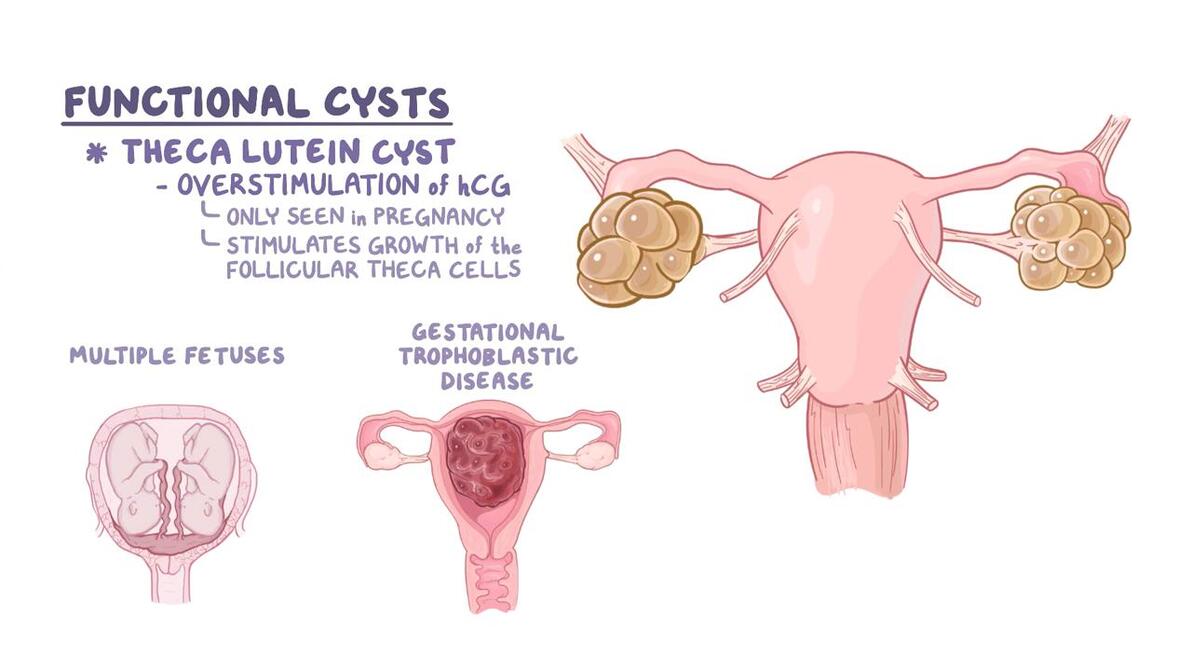
The last kind of functional cysts are theca lutein cysts. These are caused by overstimulation by human chorionic gonadotropin or hCG, a hormone that’s produced by the placenta, so they’re only seen in pregnancy. hCG stimulates growth of the follicular theca cells, so these cysts are usually bilateral, since resting follicles can be found on both ovaries. Theca lutein cysts are more likely to develop when there’s more hCG than usual, like when there are multiple fetuses, or with gestational trophoblastic disease, where tumours made up of placental cells causes higher than normal hCG levels.
最后一种功能性囊肿,是卵泡膜黄体囊肿,是由人体绒毛膜促性腺激素(即hCG)过度刺激导致的;这种激素是由胎盘释放的,因此仅见于怀孕期间。hCG可刺激卵泡鞘细胞的生长,由于双侧卵巢都有静息状态的卵泡,这种类型的囊肿一般是双侧的。卵泡膜黄体囊肿一般发生于hCG较正常高的情况,如多胎妊娠或患有妊娠滋养细胞疾病时 (患此病时由胎盘细胞组成的肿瘤会导致hCG较高)。
【3】赘生性囊肿
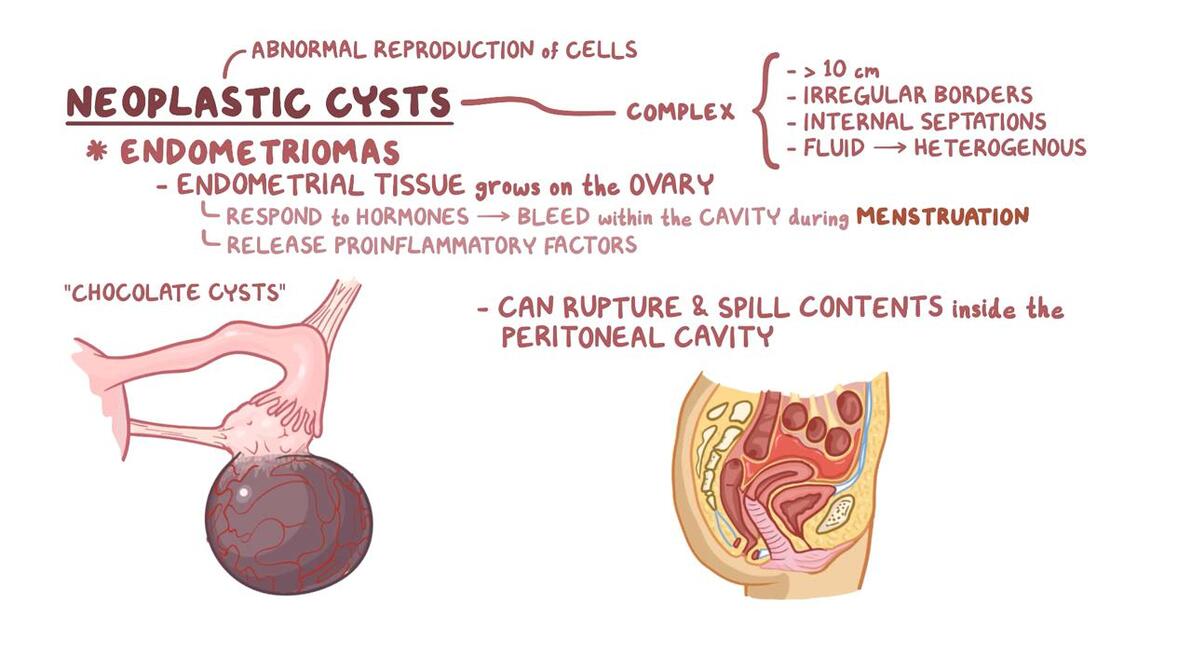
Ok, now, the second category of cysts are neoplastic cysts - which is not to say all of them are cancer, but rather that they’re caused by the abnormal reproduction of cells on or in the ovaries, which can result in a benign or malignant mass. Broadly speaking, neoplastic cysts are usually complex, meaning that they’re larger than 10 centimeters, have irregular borders, and have internal septations creating a multilocular appearance. The fluid inside these cysts tends to be heterogeneous, meaning there’s something other than fluid inside it.
好,那么第二种囊肿是赘生性囊肿,但并不是说所有的都是癌症,而是指它们是由卵巢内部或表面的细胞异常增殖形成的良性或恶性的肿块。一般来说,赘生性的囊肿比较复杂,大小会超过10厘米,边界不清;内部有隔断,形成多房状的外观。囊内容物也比较混杂,即里面除了液体外还有别的东西。
Benign neoplastic cysts include endometriomas, which occur in endometriosis, and it’s where endometrial tissue from the uterus grows on the ovary. Because they’re functionally the same as the endometrium inside the uterus, endometriomas respond to hormones just like the uterus would. Because of this, endometriomas tend to bleed within the cyst cavity during menstruation, and over time, they fill up with old, dark blood and shed tissue - hence why they’re sometimes also called “chocolate cysts”. Endometriomas also release proinflammatory factors which cause inflammation, which leads to cyst growth. When they get too large, they can rupture and spill their contents inside the peritoneal cavity.
良性的赘生性囊肿包括子宫内膜异位症囊肿,它是长在卵巢上的子宫内膜组织。由于它们具有和正常子宫内膜一样的功能,子宫内膜异位症囊肿也会和子宫一样,对激素有应答。因此,在经期内,它的囊腔内可能会出血;久之囊内就充满了陈旧、暗黑色的血和脱落组织,这也是它们又被称为巧克力囊肿的原因(还能直视巧克力不)。子宫内膜异位症囊肿也会释放致炎因子导致炎症,使囊肿进一步增大。当它们体积过大就会破裂,内容物流向腹腔。
【4】卵巢肿瘤
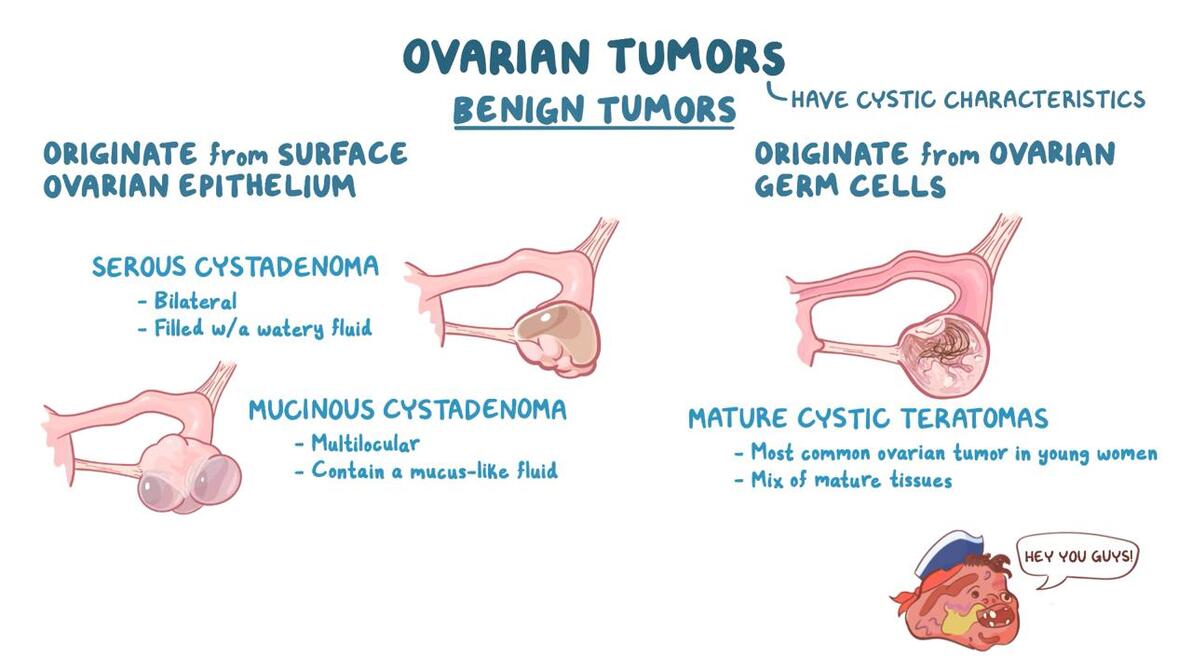
Ok, now let’s switch gears and look at ovarian tumors - since they also have cystic characteristics, they’re also included under the umbrella term of neoplastic cysts.
First, there’s benign tumors. Some originate from surface ovarian epithelium, such as serous cystadenomas, which are often bilateral and filled with a watery fluid, and mucinous cystadenomas, which tend to be multilocular and contain a mucus-like fluid. Some originate from ovarian germ cells, such as mature cystic teratomas, also called dermoid cysts. Mature cystic teratomas are the most common ovarian tumors in young women and usually contain a heterogeneous mix of mature tissues that come from two or three of the germ cell layers. So they can contain fat, muscle, teeth, nails, hair - they’re pretty much the Frankenstein’s monster of tumors.
好,接下来让我们看看卵巢肿瘤:它们也有囊肿的特征,也是赘生性囊肿的一种。
首先,是良性肿瘤: 其中有的是卵巢上皮起源的,例如卵巢浆液性囊腺瘤,常发病于双侧卵巢,充满水样液体;以及黏液性囊腺瘤,一般为多房,内含黏液;有的起源于卵巢生殖细胞,例如成熟的囊性畸胎瘤,又名皮样囊肿。成熟囊性畸胎瘤是年轻女性中最常见的卵巢肿瘤,内容物常为多种成熟组织的异质混合物,分别由两个或三个胚层的生殖细胞分化而来,所以含有脂肪、肌肉、牙齿、指甲、毛发等,就像是肿瘤中的弗兰肯斯坦怪物。
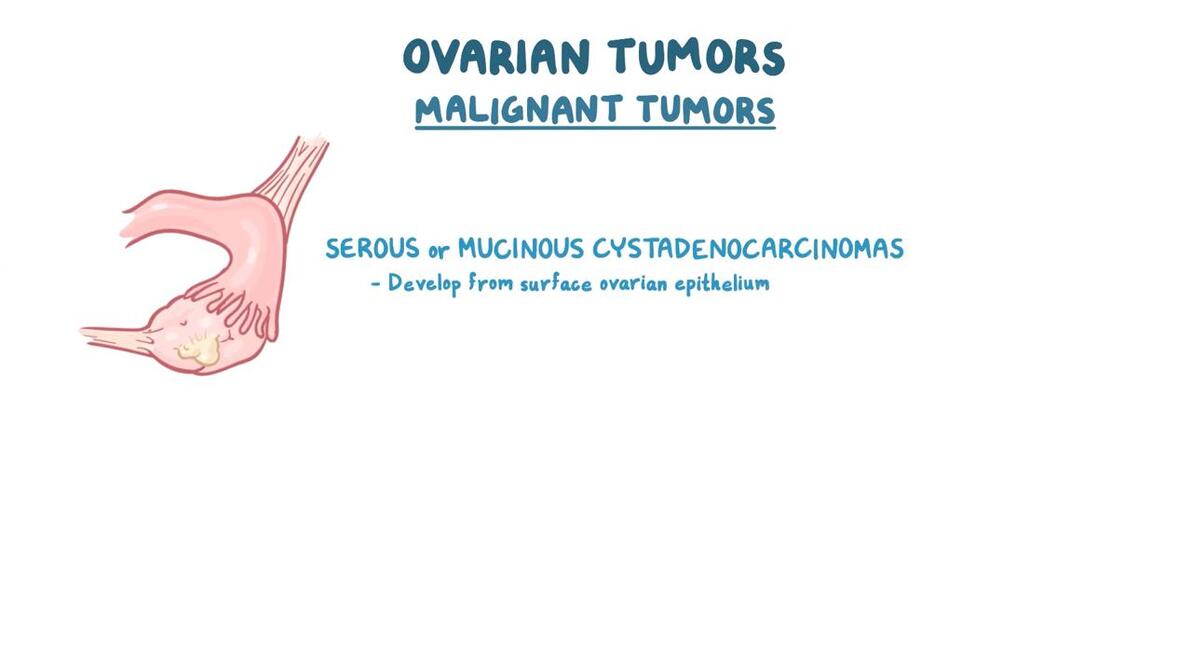
Finally, the last category of neoplastic cysts include malignant ovarian tumours, like serous or mucinous cystadenocarcinomas, which develop from surface ovarian epithelium, just like their benign counterparts.
最后一种赘生性囊肿为卵巢恶性肿瘤,如浆液或黏液囊腺癌,和良性的囊腺瘤相似,它们也由表面的卵巢上皮形成。
【5】并发症
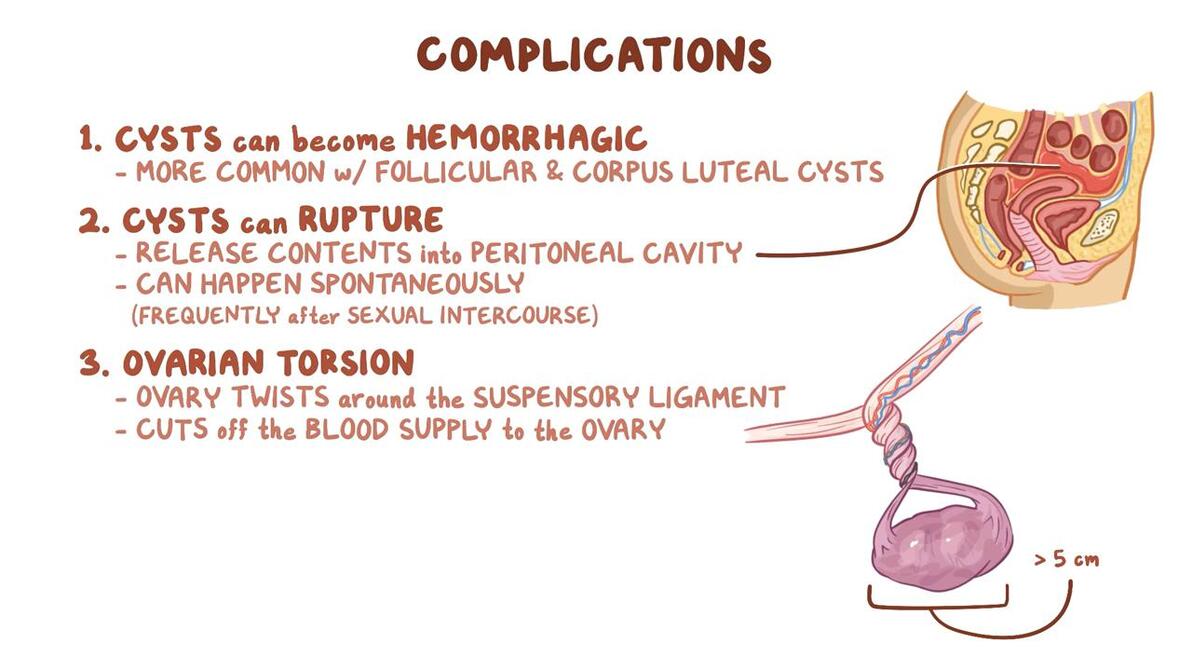
Now, there are three important complications of ovarian cysts.
First, some cysts can become hemorrhagic, meaning there is bleeding inside the cyst. This is more common with follicular and corpus luteal cysts.
Second, some cysts can rupture, which will release their contents into the peritoneal cavity. That can be pretty irritating for the peritoneal cavity. Think for example of a dermoid cyst, with its mixture of tissues like hair and sebaceous fluid: that’s not something the peritoneal cavity is meant to handle! Rupture can happen spontaneously but more frequently it happens after sexual intercourse.
A third complication is ovarian torsion, where the ovary twists around the suspensory ligament. Since this ligament suspends the ovary and contains the ovarian blood vessels within it, torsion can cut off the blood supply to the ovary. A risk factor for this is when the ovary is 5 centimeters or larger, which can happen with all kinds of ovarian cysts.
卵巢囊肿有三个主要的并发症。首先,一些囊肿会变为出血性囊肿,即囊肿内部出血;常见于滤泡和黄体囊肿。第二是某些囊肿可能会破裂,导致内容物进入腹腔;会对腹腔刺激性极大。以皮样囊肿为例,它含有毛发和脂状液体等的混合物;那可不是腹腔能吸收的。囊肿破裂可自然发生,但更常见于性交后。第三种是卵巢扭转,即卵巢随着悬韧带扭转。由于该韧带悬吊着卵巢,并且内含卵巢血管,扭转可能会使卵巢血供中断。高危因素是卵巢大于等于5厘米,可发生于所有种类的卵巢囊肿。
【6】症状
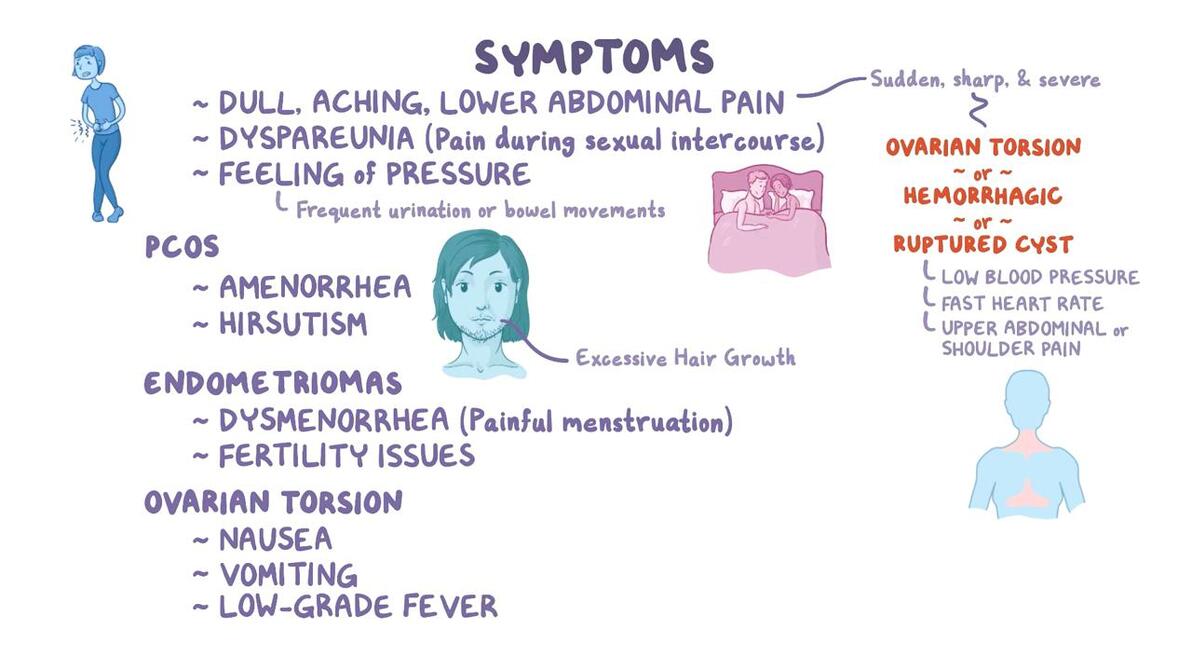
Now, many ovarian cysts are asymptomatic. When there are symptoms, they include a dull aching lower abdominal pain around the location of the cyst, dyspareunia, or pain during sexual intercourse, and a feeling of pressure in the lower abdomen which can also cause frequent urination and bowel movements. If the abdominal pain is sudden, sharp, and severe, that might indicate ovarian torsion, or a hemorrhagic or ruptured cyst. With a ruptured cyst, there may also be low blood pressure or a fast heart rate, and if the blood makes it to the subphrenic space of the peritoneal cavity, which is right below the diaphragm, it may cause upper abdominal or shoulder pain.
许多的卵巢囊肿是无症状的。有的会有囊肿处下腹部钝痛,性交痛,或感到下腹部受压,及由此引起的尿频和肠运动增加等症状。如有突发性剧烈锐痛,可能为卵巢扭转、囊肿出血或破裂。囊肿破裂可能也会导致低血压和心率增快,如果血进入腹腔的膈下隙,(位于膈肌正下方)可能会导致上腹痛或肩痛。
If the cysts are the result of polycystic ovary syndrome, you might also see amenorrhea and hirsutism, or excessive hair growth on the chin and upper lip, chest, and back. Endometriomas can also cause dysmenorrhea, or painful menstruation, and are associated with fertility issues. Finally, with ovarian torsion, there might also be nausea, vomiting, and a low-grade fever.
如果囊肿由多囊卵巢综合征导致,可能会有闭经和多毛等症状,多毛即下巴、上唇、胸、背等处有过多毛发生长。子宫内膜异位症囊肿也可导致痛经,且可能导致生育问题。最后,卵巢扭转时会有恶心、呕吐和低烧。
【7】诊断
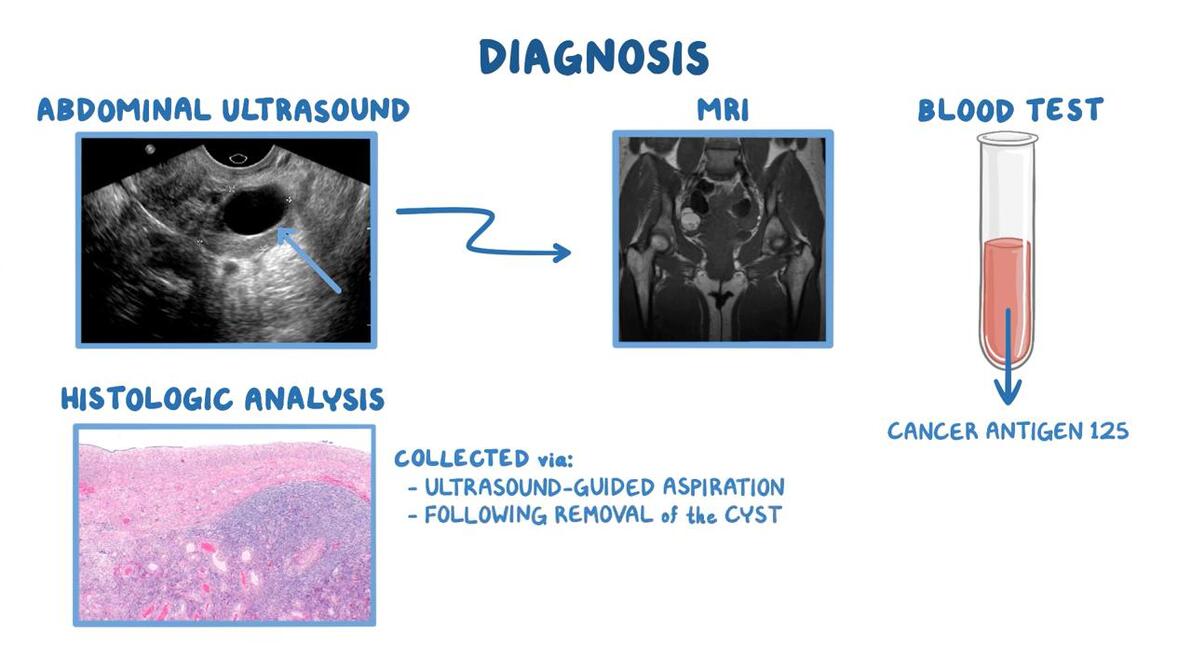
Diagnosing an ovarian cyst starts with an abdominal ultrasound. If diagnosis is uncertain, an MRI can be done for more information. A blood test for cancer antigen 125 might be done to rule out a malignant ovarian tumor. Ultimately, histologic analysis is the only way to get a definitive diagnosis of the type of cyst, and this is usually achieved by collecting some cyst cells via ultrasound-guided aspiration, or following removal of the cyst.
卵巢囊肿的诊断可从腹部超声开始。如果诊断不明确,MRI可以提供更多信息。抽血检查肿瘤抗原125可用来排除恶性肿瘤,最终,组织学检查是明确诊断囊肿类型的唯一方法: 一般通过超声引导下穿刺收集囊肿细胞,或在摘除囊肿后完成。
【8】治疗
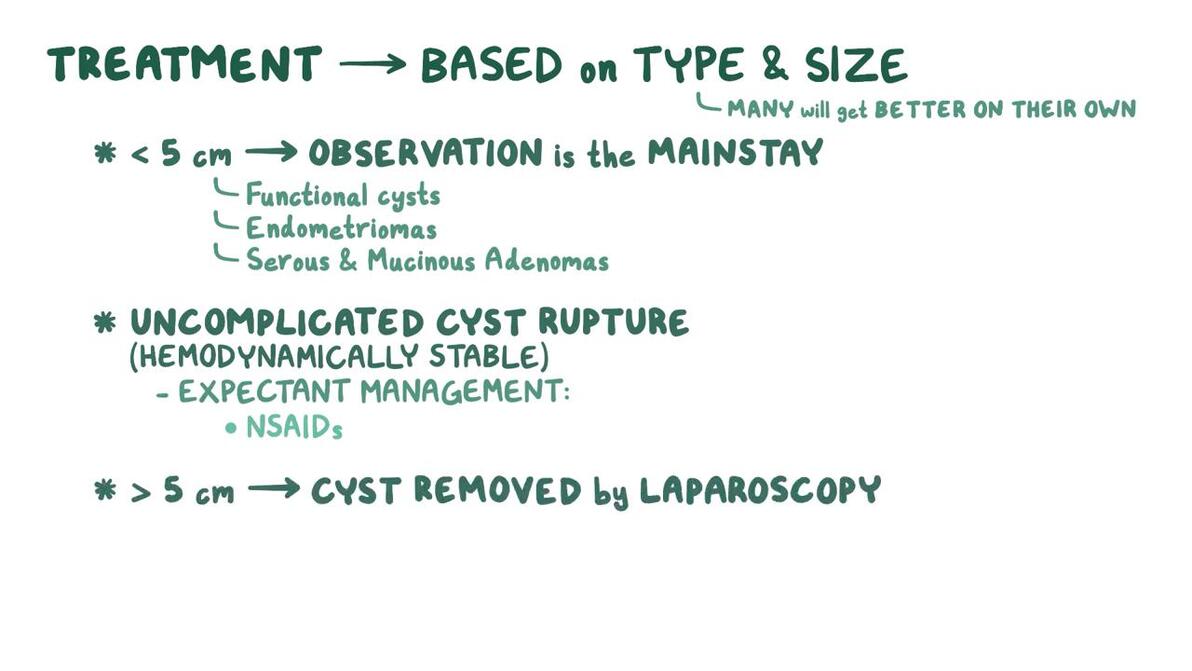
Treatment for ovarian cysts varies based on type and size. Many simple cysts will get better on their own. Broadly speaking, if the cyst is under five centimeters, observation is usually the mainstay of treatment. This applies to both functional cysts and benign neoplasms like endometriomas, as well as serous and mucinous adenomas. With uncomplicated cyst rupture where the person is hemodynamically stable, “expectant management” is also used. They might only be given NSAIDs for pain. If the cyst is over five centimeters, it’s usually removed by laparoscopy.
卵巢囊肿的治疗根据类型或大小有所不同。许多单纯性囊肿可以自愈。一般来说,如果囊肿小于五厘米,可以随访观察这一条适用于功能性囊肿,及诸如子宫内膜异位症囊肿、浆液性或黏液性囊腺瘤等良性肿瘤。对于血流动力学稳定、不伴并发症的囊肿破裂,可采用期待治疗,仅仅使用NSAIDs药物止痛。如果囊肿大于五厘米,常采用腹腔镜手术摘除。
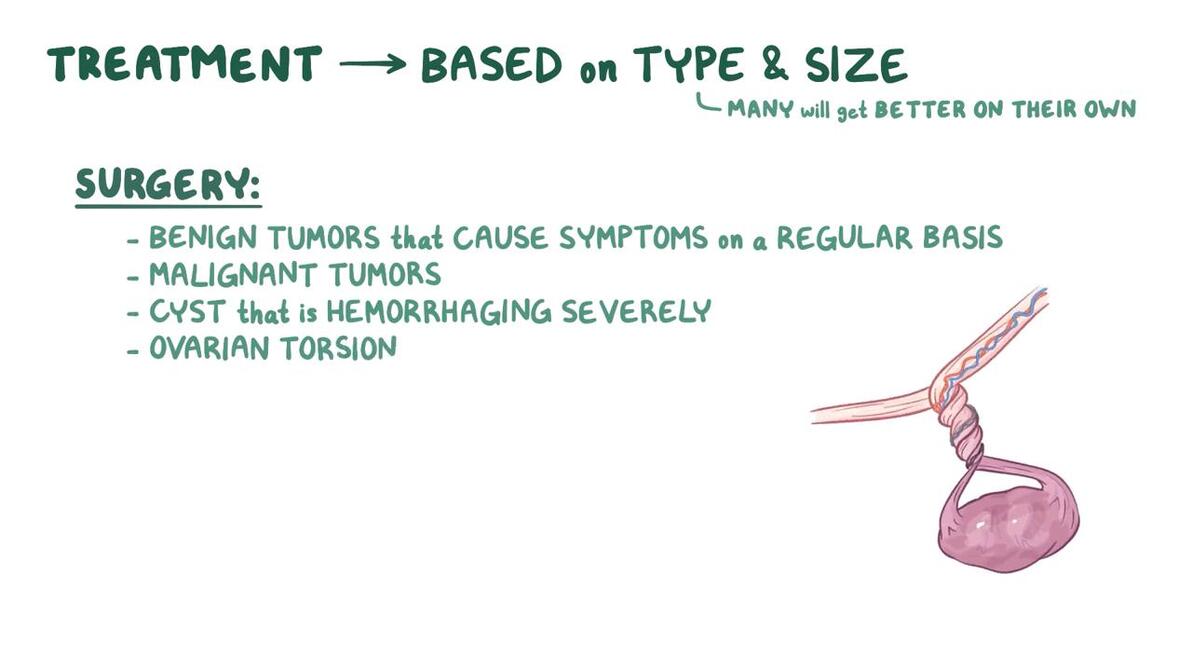
Surgery is also done for benign tumors that cause symptoms on a regular basis, for malignant tumors, if a cyst is hemorrhaging severely and it’s affecting blood pressure and heart rate, or if there is ovarian torsion since lack of blood flow can damage the ovaries.
其他手术指征有:经常引发症状的良性肿瘤;恶性肿瘤的话,如囊肿出血严重影响血压和心率;或由卵巢扭转导致卵巢缺血而损害卵巢。
【9】小结
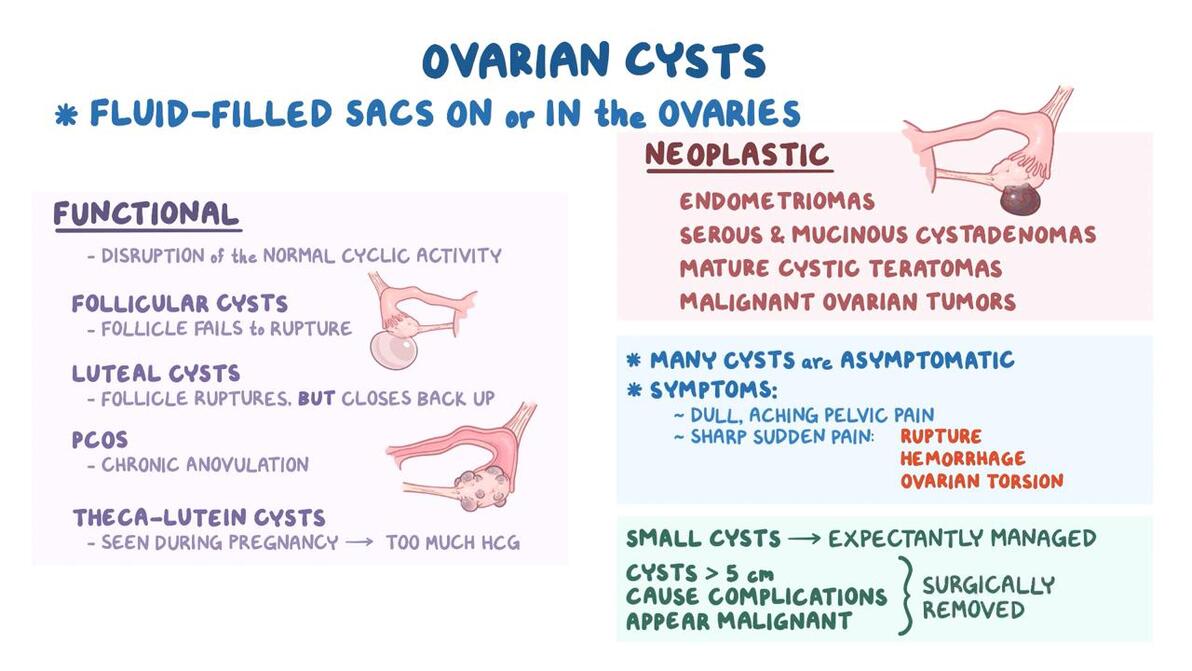
All right, as a quick recap… Ovarian cysts are fluid-filled sacs on or in the ovaries. They can broadly be grouped as functional and neoplastic cysts. Functional cysts result from a disruption of the normal cyclic activity of the ovaries, and they include follicular cysts, which occur when the follicle fails to rupture before ovulation, and luteal cysts, which is when the follicle ruptured but then closed back up. Particular types of functional cysts are those associated with PCOS, which happen because of chronic anovulation, and theca-lutein cysts, which are only seen during pregnancy, when there’s too much HCG.
On the other hand, neoplastic cysts include endometriomas, serous and mucinous cystadenomas, and mature cystic teratomas, as well as malignant ovarian tumors.
OK,快速回顾一下: 卵巢囊肿是在卵巢内或表皮上充满液体的囊性物,可大致分为功能性囊肿和赘生性囊肿。功能性囊肿常由正常的卵巢周期活动被破坏导致,包括滤泡性囊肿,原因为排卵前滤泡未破裂;黄体囊肿,为滤泡破裂但又闭锁形成。PCOS可导致特征性的功能性囊肿,由长期无排卵导致;卵泡膜黄素体肿只见于怀孕期间,由HCG分泌过多导致。
另一种是赘生性囊肿,包括子宫内膜异位症囊肿、浆液性和黏液性囊腺瘤、 成熟囊性畸胎瘤,以及恶性肿瘤。
Many ovarian cysts are asymptomatic, but when it’s symptomatic, a dull, aching pelvic pain is common. A sharp, sudden pain could be a sign of one of three potential complications of ovarian cysts: rupture, hemorrhage, and ovarian torsion. Small cysts can be expectantly managed, whereas cysts over 5 centimeters, who cause complications, or those who appear malignant should be surgically removed.
许多卵巢囊肿是无症状的,但也有些有钝痛、骨盆酸痛等症状。突发剧烈锐痛可能是卵巢囊肿的三个潜在并发症的征象: 即破裂、出血和卵巢扭转。小囊肿可行期待治疗,而大于5厘米导致并发症的囊肿或有恶变表现的囊肿应行手术摘除。
~ 胸腔积液们 ~
~ 下期医番见 ~
