

· 翻译 · 冯琢熙 ·
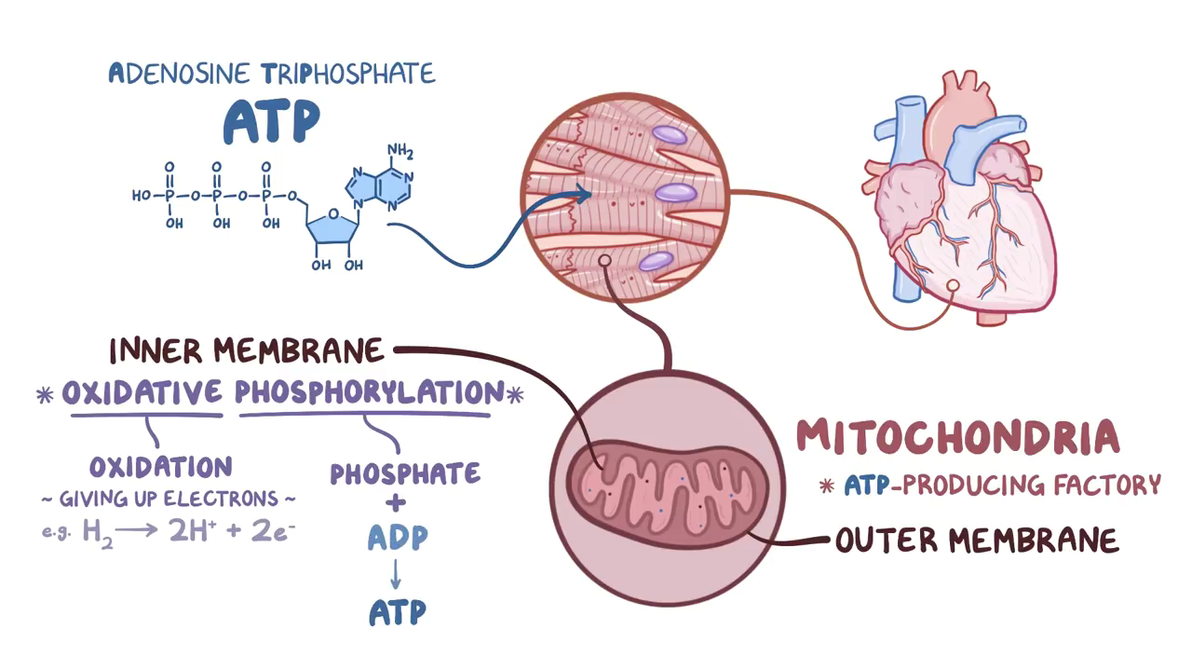
Your heart is constantly working, whether you are swimming or taking a nap. Your heart is always on the go. The main form of energy that keeps our heart cells and really all of our body cells going is adenosine triphosphate, or ATP.
无论你在游泳或小憩,心脏一直在工作。心脏永不停跳。ATP作为能量的主要形式支持心肌细胞乃至所有体细胞工作。
In most cells, the main ATP producing factories are the mitochondria, which have an inner and outer membrane. And it's along the inner membrane where a process called oxidative phosphorylation happens.
大多数细胞中,ATP的主要加工厂是有内外两层膜的线粒体。氧化磷酸化过程沿内膜进行。
Oxidative refers to oxidation, which is when a molecule donates its electron, and phosphorylation refers to the addition of a phosphate group to adenosine diphosphate, or ADP, which forms ATP.
Oxidative指氧化,即一个分子提供电子;Phosphorylation 指向ADP加一分子磷酸基团,产生ATP。
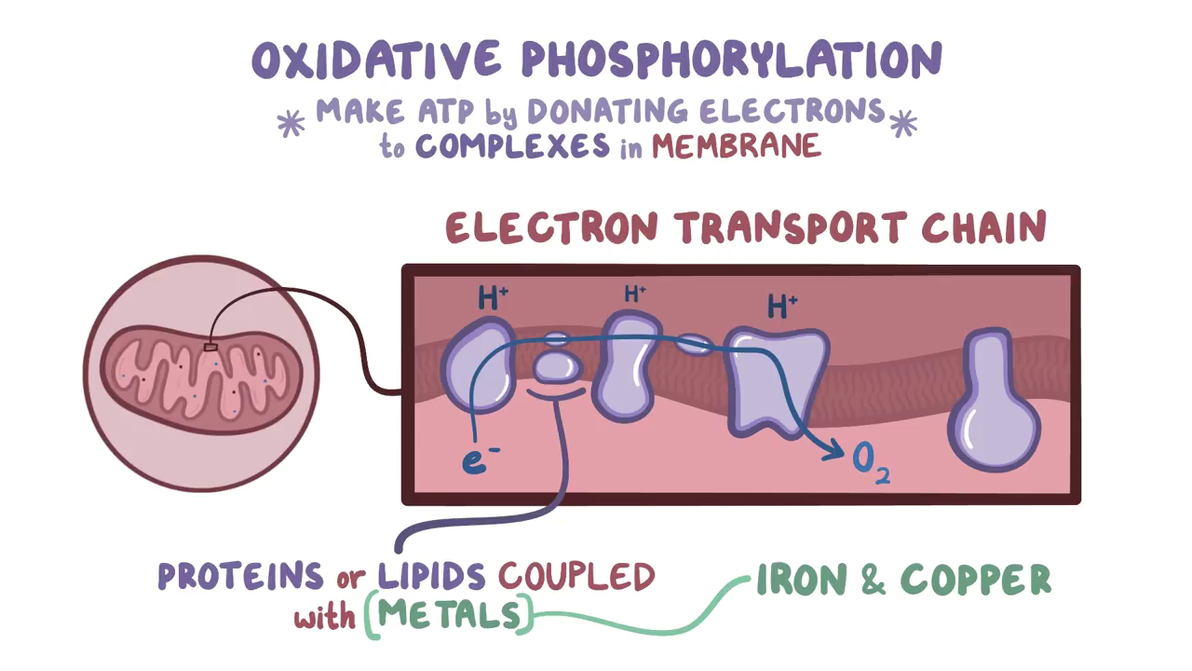
So oxidative phosphorylation is the process of making ATP by donating electrons to complexes imbedded within the inner mitochondrial membrane.
故氧化磷酸化是向锚定在线粒体内膜的复合体供电子从而产生ATP的过程。
These complexes are proteins or lipids coupled with metals like ion and copper, that facilitate the movement of electrons. Together, they form the electron transport chain. During the electron transport chain, electrons are passed down from complex to complex.
这些复合体是与金属离子(如Cu离子、Fe离子)结合的蛋白质/脂质,从而促进电子移动,共同组成电子传递链。电子传递链中,电子在复合体之间传递。
And finally, to oxygen, creating a proton gradient that will be used to make ATP.
最终传递到氧,产生用于制造ATP的质子梯度。
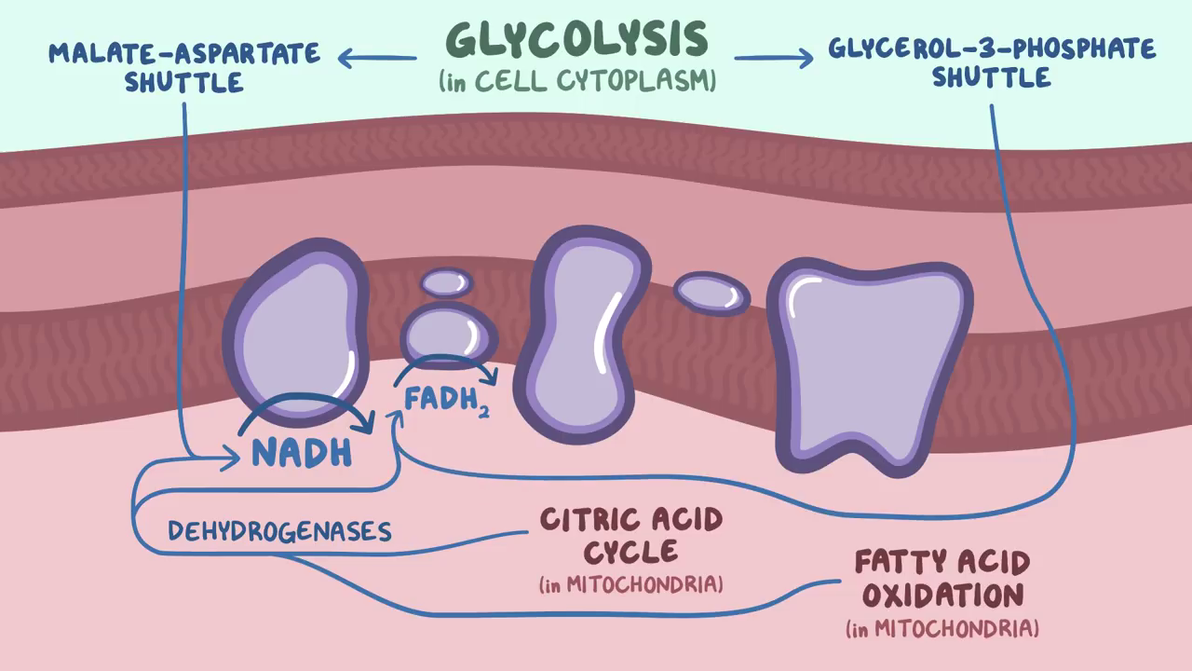
The electron transport chain starts with 2 key molecules that want to donate their electrons: Nicotinamide adenine dinucleotide, or NADH, and flavin adenine dinucleotide, or FADH2, both of which get oxidized near electron transport chain.
电子传递链从2个供电子体起始:NADH和FADH2,两者都在电子传递链附近被氧化。
NADH and FADH2 are primarily generated in the citrate acid cycle, which happens in mitochondria, but it can also come directly from glycolysis, which is the breakdown of glucose in the cytoplasm of the cell, as well as fatty acid oxidation, which is the breakdown of fats and mitochondria. Enzymes called dehydrogenases help generates the electron-rich NADH and FADH2.
NADH和FADH2主要在线粒体柠檬酸循环中产生;但也可以直接来源于糖酵解,即在胞质裂解葡萄糖的过程;也可以来自脂肪酸氧化,即在线粒体分解脂肪酸的过程。脱氢酶帮助产生富电子的NADH和FADH2。
And when those molecules are coming from the cytoplasm, they can only enter the mitochondria using a specific shuttle. When using the malate-aspartate shuttle, electrons enters the electron transport chain as NADH. But when using the glycerol-3-phosphate shuttle, electrons enter the electron transport chain as FADH2.
若这些分子来源于细胞质,则只能通过特定的穿梭途径进入线粒体——使用苹果酸-天冬氨酸穿梭途径,电子由NADH携带进入呼吸链;当使用三磷酸甘油穿梭途径时,电子由FADH2携带进入呼吸链。
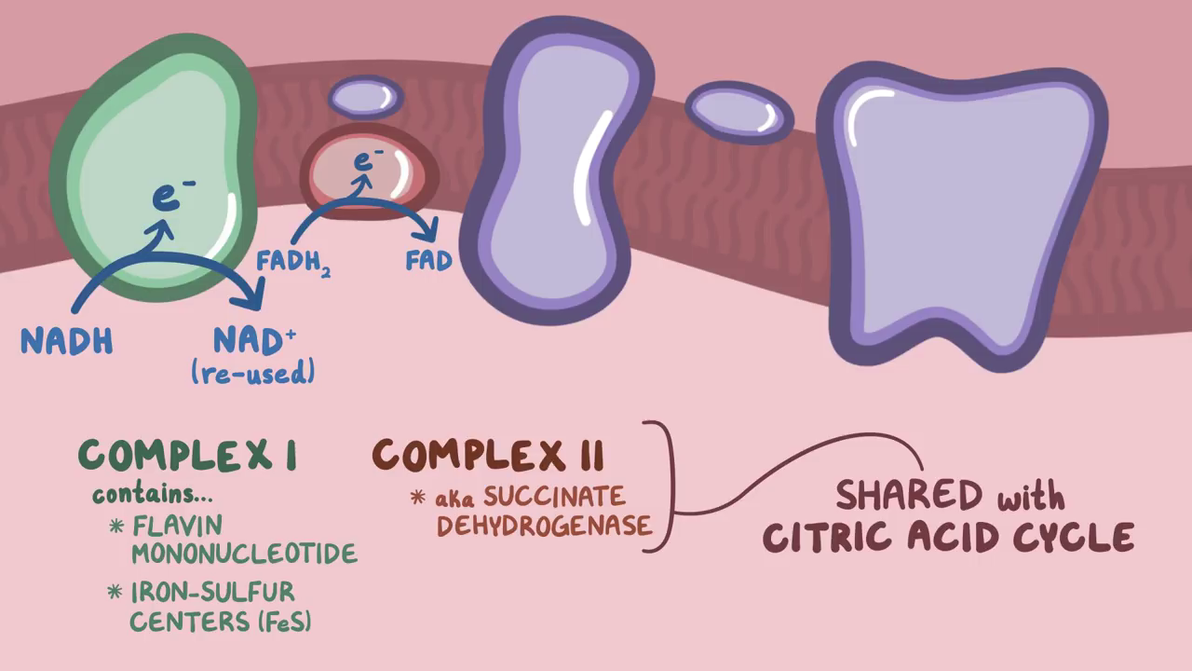
Now there are 2 entry points in the electron transport chain.
电子传递链有两个入口。
The first point of entry is where NADH gives its electron to complex Ⅰ. Complex Ⅰ contains flavin mononucleotide, which is a derivative of riboflavin or Vitamin B2, as well as ion-sulfur centers called Fe-S. NADH gives its electron to flavin mononucleotide, and it turns back to NAD+ and gonna be reused by dehydrogenases to make more NADH.
第一个入口:NADH给电子至复合体Ⅰ。复合体Ⅰ含有FMN(为核黄素/VB2的衍生物)和FeS。NADH给电子至FMN,又变回NAD+,将被脱氢酶重新利用产生更多的NADH。
The second point of entry is where FADH2 gives its electron to complex Ⅱ, which is also called succinate dehydrogenase, which is the exact same enzyme that takes part in the citrate acid cycle. That means that the citrate acid cycle and electron transport chain actually share a step. So, their activity rises and falls together.
第二个入口:FADH2给电子至复合体Ⅱ。复合体Ⅱ也叫琥珀酸脱氢酶,就是参与柠檬酸循环的同一个酶。这意味着柠檬酸循环和电子传递链事实上共有一个相同步骤,因此,两过程活力同时起伏。
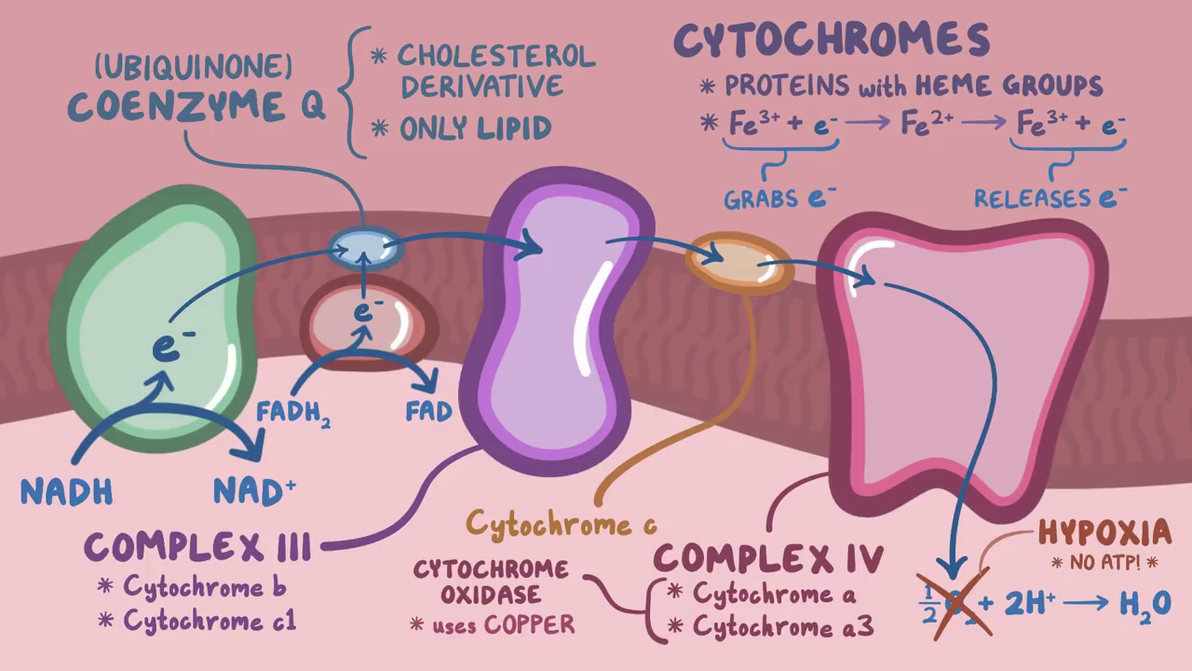
Ultimately, electrons from complexes Ⅰ and Ⅱ flow directly to coenzyme Q, which is also called ubiquinone. Coenzyme Q is actually cholesterol derivative, and therefore the only lipid in the electron transport chain.
最终,电子从复合体Ⅰ和Ⅱ直接进入辅酶Q(也叫泛醌)。辅酶Q其实是胆固醇衍生物,因此是电子传递链中唯一的脂质。
Next, coenzyme Q passes on the electrons to a series of cytochromes, which are proteins that contain heme groups. Heme groups contain iron, which is able to grab an electron from Fe3+ to Fe2+. The heme iron can then release the electron to the next site of chrome in the chain, and go back to being Fe3+. so that's ready to grab another electron. It's kind of like factory chain workers relaying the electron between each other.
接着,辅酶Q将电子传递给一系列细胞色素(含有血红素的蛋白质)。血红素辅基含有铁离子,可以捕获电子使Fe3+变成Fe2+。血红素铁离子可向下一个细胞色素位置释放电子,返回到Fe3+。此时它便能够捕获下一个电子,就像工厂流水线上的工人,互相之间传递电子。
Complex III is made of cytochrome b and cytochrome c1 and then the electrons move over to cytochrome c, and from there, the electrons get passed to complex Ⅳ, which is composed of cytochrome a and a3, which are together refer to as cytochrome oxidase. Interestingly, the heme group of complex Ⅳ contains copper rather than iron.
复合体III 由细胞色素b和细胞色素c1组成;然后电子传递到细胞色素c,由之传递到复合体Ⅳ。复合体Ⅳ由细胞色素a和a3组成,也叫细胞色素氧化酶。有趣的是,复合体Ⅳ的血红素辅基含有Cu离子而不是Fe离子。
Cytochrome oxidase transfers the electrons to the final electronic acceptor, oxygen, making the oxygen electron negative enough to grab 2 protons, which makes them molecule of water, or H2O. Now if the cell doesn't receive enough oxygen, like the in hypoxia, which is the most common cause of cellular injury, then the electron transport chain gets interrupted and the ATP synthesis doesn't happen.
细胞色素氧化酶将电子传递给终电子受体——氧气。使得氧气带足够多负电荷,结合2个质子形成水分子。如果细胞无法获取足够氧气,如组织缺氧(最普遍的细胞损伤原因),那么电子传递链被中断,ATP无法合成。
So, the complexes are responsible for the oxidative part of oxidative phosphorylation.
所以,这些复合体负责氧化磷酸化的氧化部分。
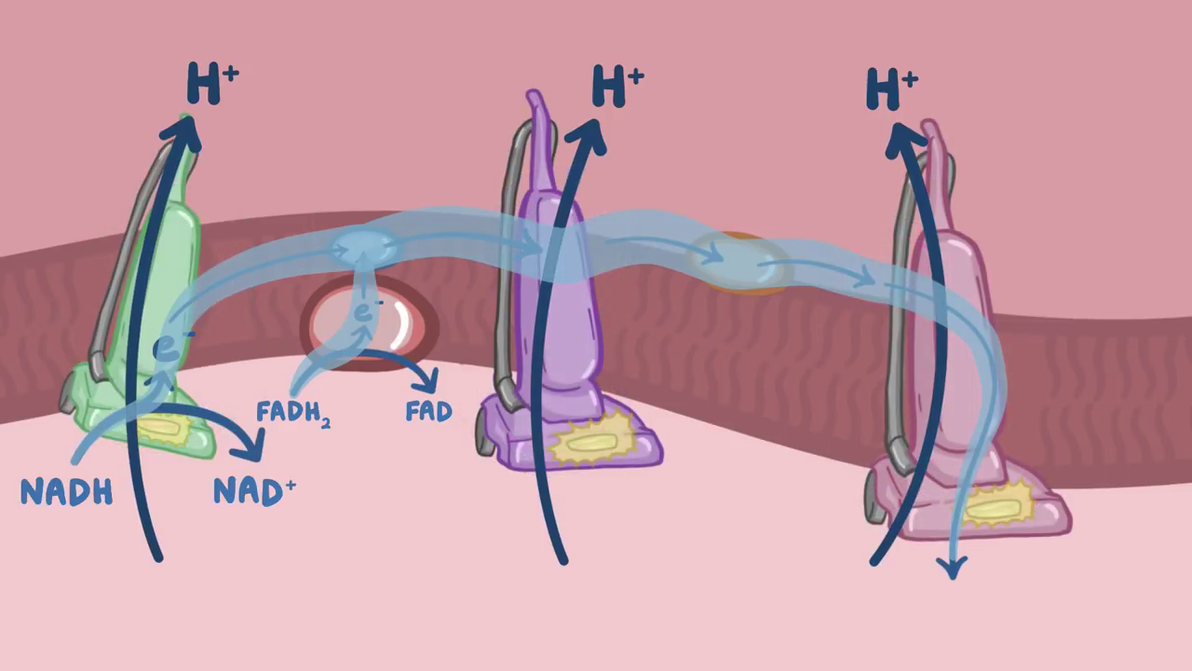
And you can think of the electron transport chain as a game of hot potato, with the complexes rapidly passing electrons off to each other, creating an electrical current. That electrical current actually creates energy, that drives complexes Ⅰ、III、Ⅳ to pump positively charged protons out of the mitochondria and into the space between the inner and the outer mitochondrial membrane, creating a proton gradient across the inner mitochondrial membrane. That's because complexes Ⅰ、III、Ⅳ are the only ones to span the mitochondrial membrane.
你可以认为电子传递链是块烫手的山芋。复合体之间快速传递电子,制造电流。电流可以产生能量。该能量促使复合体Ⅰ、III、Ⅳ将带正电的质子泵出线粒体基质,进入内外膜之间的间隙,产生跨线粒体内膜的质子梯度。那是因为只有复合体Ⅰ、III、Ⅳ完全跨越线粒体内膜。
In fact, as electrons are hopping through, the complexes are changing their conformation to push protons across. It's kind of like how electrons hop wires in a house, and that energy can be used to do work, like porting a vacuum to suck up dirt. In this case, the low complexes would be the vacuums, which suck up protons.
事实上,当电子在复合体之间跳跃传递的时候,复合体构象改变,泵出质子;有点像家里电路中的电子在电线中移动,产生的能量可用来做功,例如用吸尘器吸土。这种情况下,复合体Ⅰ、III、Ⅳ就是吸质子的“吸尘器”。
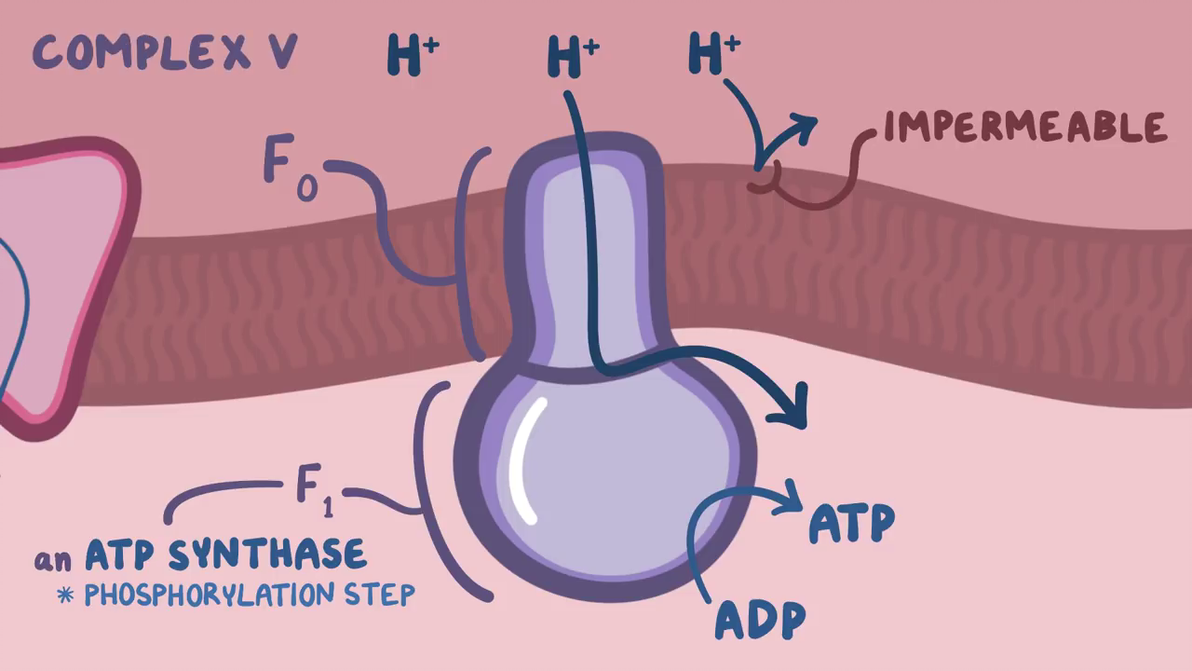
Now, this gradient is considered unstable, because the protons are always trying to equilibrate across the inner mitochondrial membrane, even though it's totally impermeable to them.
这一质子梯度不稳定,因为质子梯度总是趋向跨膜平衡电位,即便线粒体内膜对质子完全不通透。
To get across, protons have to use a special proton channel called F0. That's attached to an enzyme called F1. F1 is an ATP synthase, that uses the proton gradient to phosphorylate an ADP molecule to make ATP.
要想通过内膜,质子必须通过F0质子通道,F0与F1结合。F1是ATP合酶,用质子梯度磷酸化ADP产生ATP。
So, ATP synthase is in charge of the phosphorylation step of oxidative phosphorylation. Sometimes this is referred to as complex 5 of the electron transport chain.
因此,ATP合酶负责氧化磷酸化的磷酸化部分。有时它被称为电子传递链中的复合体Ⅴ。
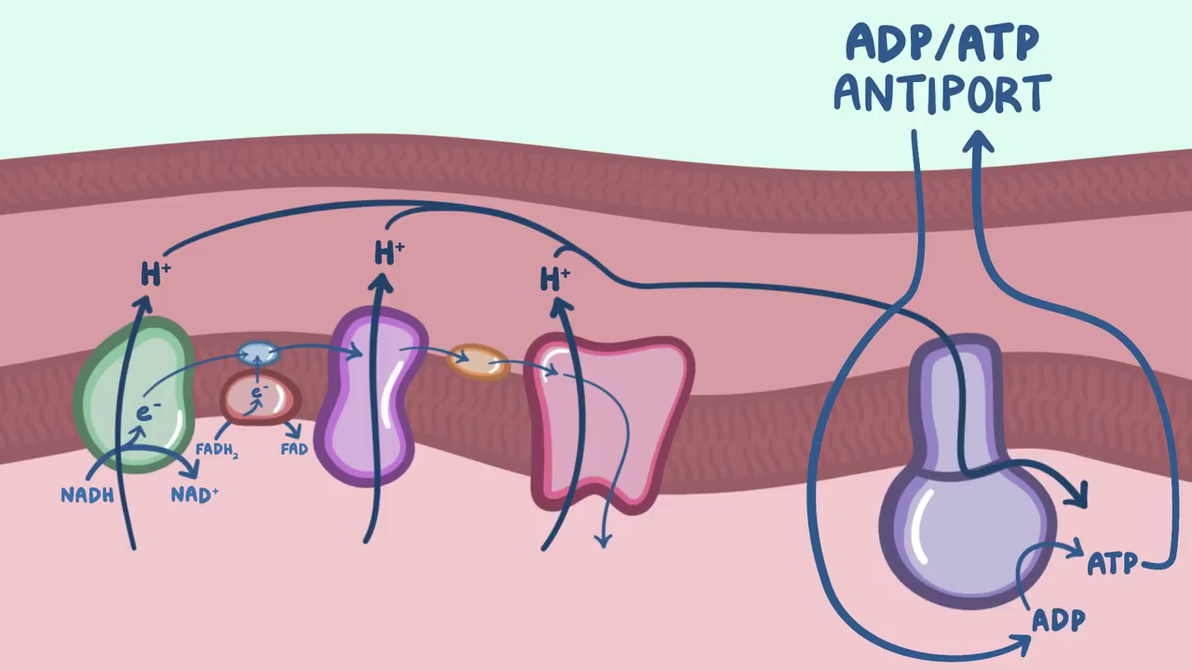
Since ATP is formed in the mitochondria, it uses an ATP/ADP antiport to get pumped out of the mitochondria and into the cytoplasm. In that way the mitochondria get a new ADP molecule which it can use to make the next ATP. You can take it kind of like an ATP shuttle.
既然ATP在线粒体中合成,它使用ATP/ADP 反向转运途径泵出线粒体进入细胞质。这种途径下线粒体得到一分子新的ADP,用于制造下一个ATP,你可以视之为ATP穿梭。
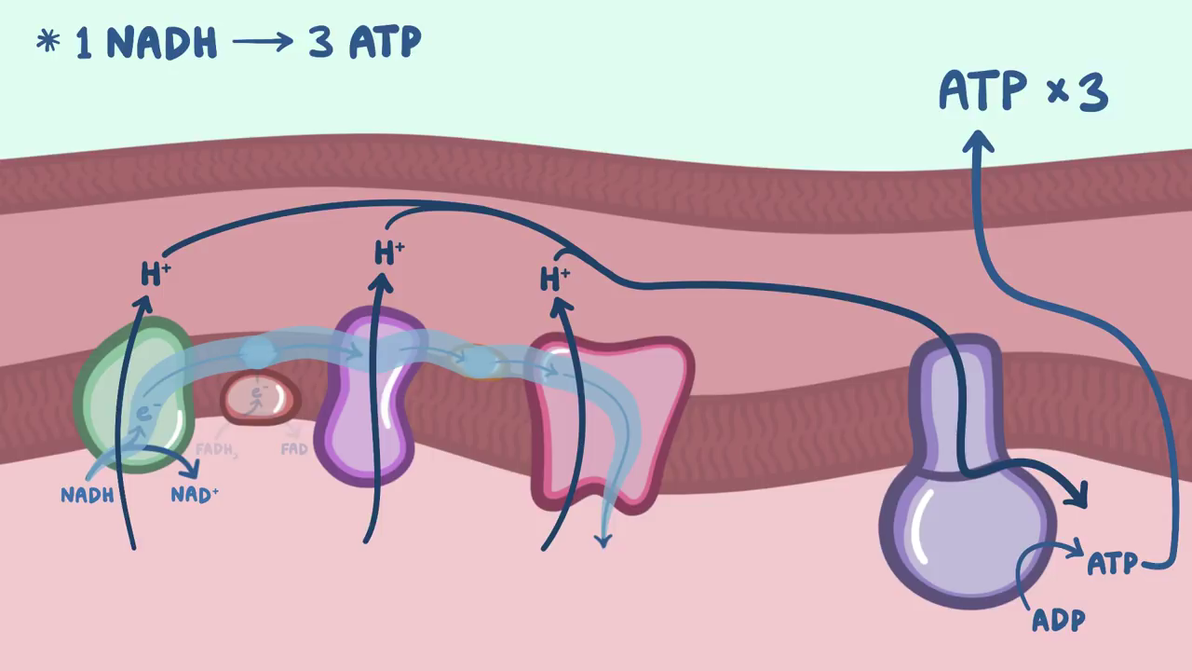
Now, approximately 1 NADH molecule that donates its electron to the electron transport chain generates a proton gradient strong enough to make 3 ATP molecules, since NADH activates 3 proton pumps, complex 1,3,4.
1个NADH供电子给电子传递链,产生的质子梯度大概够产生3个ATP,因为NADH激活3个复合体,复合体Ⅰ、III、Ⅳ。
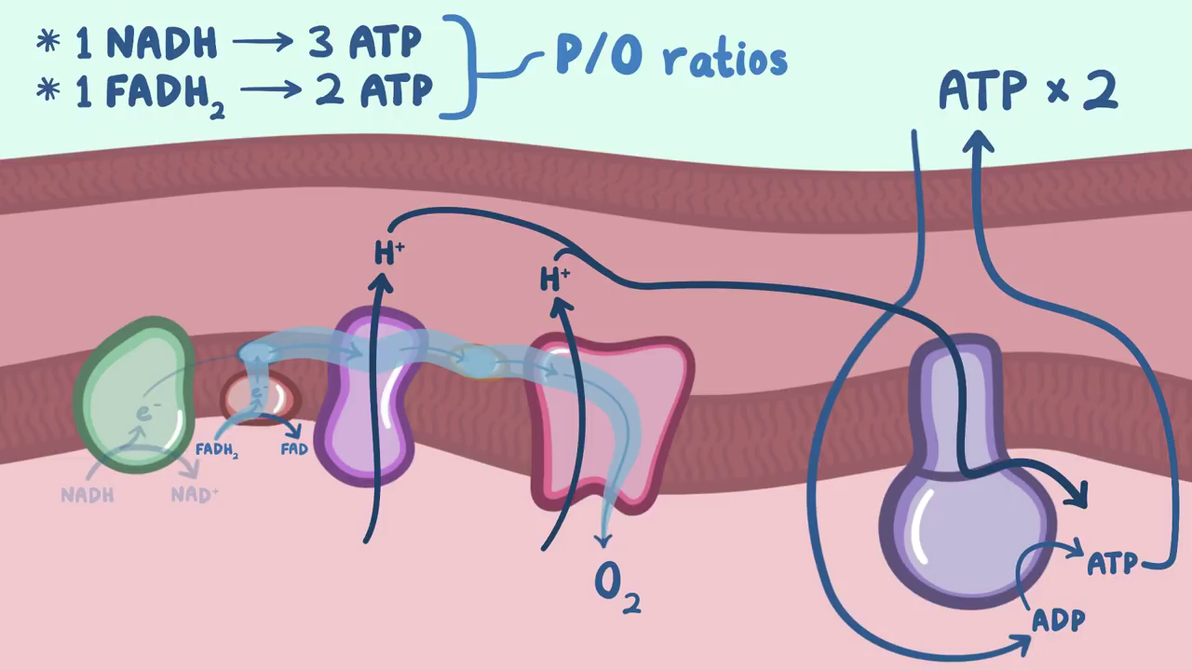
On the other hand, one FADH2 molecule only makes 2 ATP molecules, because FADH2 skips complex Ⅰ, and actually starts at complex 2, activating only 2 proton pumps——complexes III、Ⅳ.
另一方面,一个FADH2分子只产生2个ATP,因为FADH2跳过了复合体Ⅰ,从复合体Ⅱ开始,只激活两个复合体——复合体III、Ⅳ。
Since both NADH and FADH2 require an oxygen molecule to ultimately accept their electrons, these values are called the phosphate to oxygen ratio, or P/O ratio, which is the ratio of ATP produce per oxygen consume for each molecule. But these are just approximate ratios.
因为NADH和FADH2都需要一分子氧气作为终末电子受体,这些(用于衡量的值)称为磷氧比,或P/O比,意思是消耗1个氧原子产生的ATP分子数。这些只是近似比值。
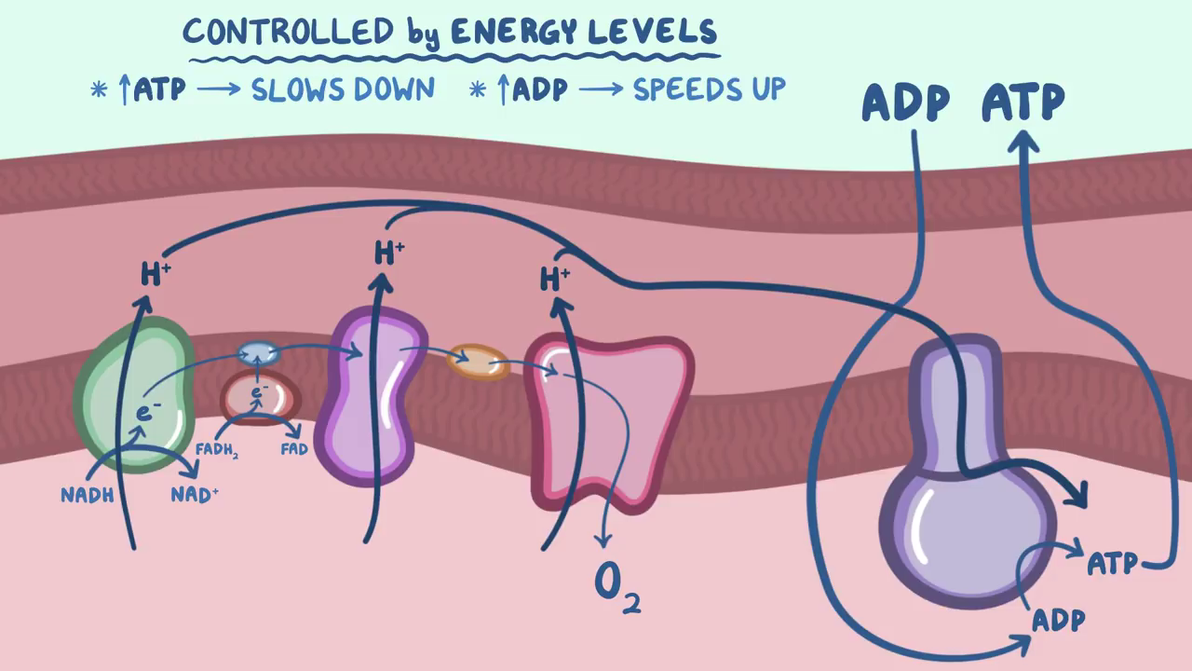
Now, the electron transport chain is not controlled hormonally, rather, its controlled by the energy level within the cell itself.
电子传递链不受激素调控,它由细胞自身的能量水平控制。
When ATP builds up within the cell, which is a sign of high energy, electron transport chain actually slows down. And when ADP builds up, which is a sign of low energy, the electron transport chain speeds up.
当ATP在细胞中积累(这是富能量的标志)电子传递链实际上会减慢;当ADP积累时(低能量标志),电子传递链加速进行。
Now, it turns out that drugs and chemicals can effectively break oxidative phosphorylation in 2 ways, either uncoupling or inhibition.
实际上,药物和化学物质能通过2种方式有效破坏氧化磷酸化,解偶联和抑制。
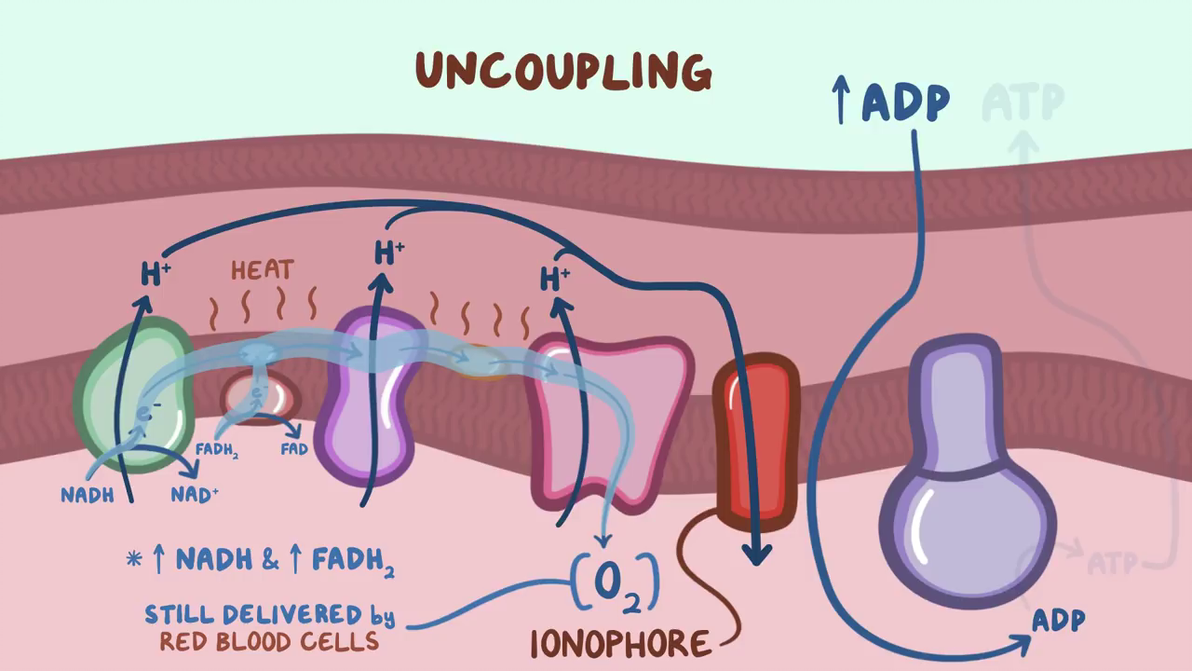
Let's start with uncoupling. Normally, the electron transport chain is coupled with ATP synthesis, meaning that they happen together.
我们从解偶联开始讲。一般,电子传递链与ATP合成偶联,即一同发生。
Uncoupling agents break that link. And they do this by inserting their own proton channels, called ionophores, into the inner mitochondria membrane, or by simply carrying the protons back into the mitochondria matrix. Thereby allowing them to bypass the F0 subunit of ATP synthase enzyme.
解偶联剂破坏该偶联。解偶联剂通过向线粒体内膜插入离子通道,或仅仅携带质子返回线粒体基质,从而使质子绕开ATP合酶的F0亚基。
Uncoupling agents dissipate the proton gradient created by the complexes. And because the protons enter back into the mitochondria matrix with the uncoupling agent and instead of through the F0 component of ATP synthase, F1 isn't able to phosphorite ADP to make ATP.
解偶联剂解散由复合体产生的质子梯度。由于质子通过解偶联剂而不是ATP合酶的F0亚基进入线粒体基质,F1无法磷酸化ADP产生ATP。
Now, it's important to know that the electrons are still flowing from complex to complex, all the way to the final electron recipient, oxygen. So that means red blood cells keep delivering oxygen to the tissues that it can be the electron recipient. Also, as the cell's ADP levels rise, the body tries to increases metabolic rate to make more electron donors like NADH and FADH2.
重要的是,电子仍在复合体间流动,去往终末电子受体——氧。这意味着红细胞继续携带氧气至组织,成为电子受体。并且,随着细胞ADP水平上升,机体会努力提高代谢率,产生更多电子供体如NADH 和FADH2。
But this electron flow is essentially useless. Because no matter how large of a proton gradient there is, the protons just go back with the uncoupling agents instead of through F0.
但这一电子流本质上是无用的。因为无论多大的质子梯度,质子都会通过解偶联剂返回线粒体基质,而不是经过F0。
And because some of that electron's energy is not used up in moving protons across the inner mitochondrial membrane, more of it is available to turn into heat energy.
同时,因为某些电子的能量没有被用于跨线粒体内膜的质子移动,更多电子能被转化为热能。
There are some endogenous uncoupling agents like thermogenin, which is a protein found in brown adipose tissues of babies, and is used to generate heat. Funnily enough, thermogenin is also found in hibernating animals, so yeah, we're kind of like polar bears when we are babies. Uncoupling is kind of like a car with a hot, hard-working engine, but despite that, the car isn't moving.
有一些内源性解偶联剂,例如产热素,就是一种在婴儿棕色脂肪组织发现的蛋白质,用于产热。产热素也在冬眠动物中发现,是的,我们小时候有点像北极熊。解偶联就像一辆发着热、拼命工作的汽车引擎;尽管如此,汽车仍不能前进。
And that example of a medication that can be an uncoupling agent in high doses is aspirin. The uncoupling can lead to a really high metabolic rate, which can lead to a metabolic acidosis. And if ATP levels starts to fall too low to allow the respiratory centers and respiratory muscle sore, then it can lead to a respiratory acidosis as well. A combined metabolic and respiratory acidosis quickly becomes life-threatening.
大剂量的阿司匹林可以成为解偶联剂。解偶联会导致很高的代谢率,后者可能导致代谢性酸中毒。如果ATP水平降的太低,不能支持呼吸中枢和呼吸肌运作,那么会也导致呼吸性酸中毒。代谢性酸中毒和呼吸性酸中毒联合很快会威胁生命。
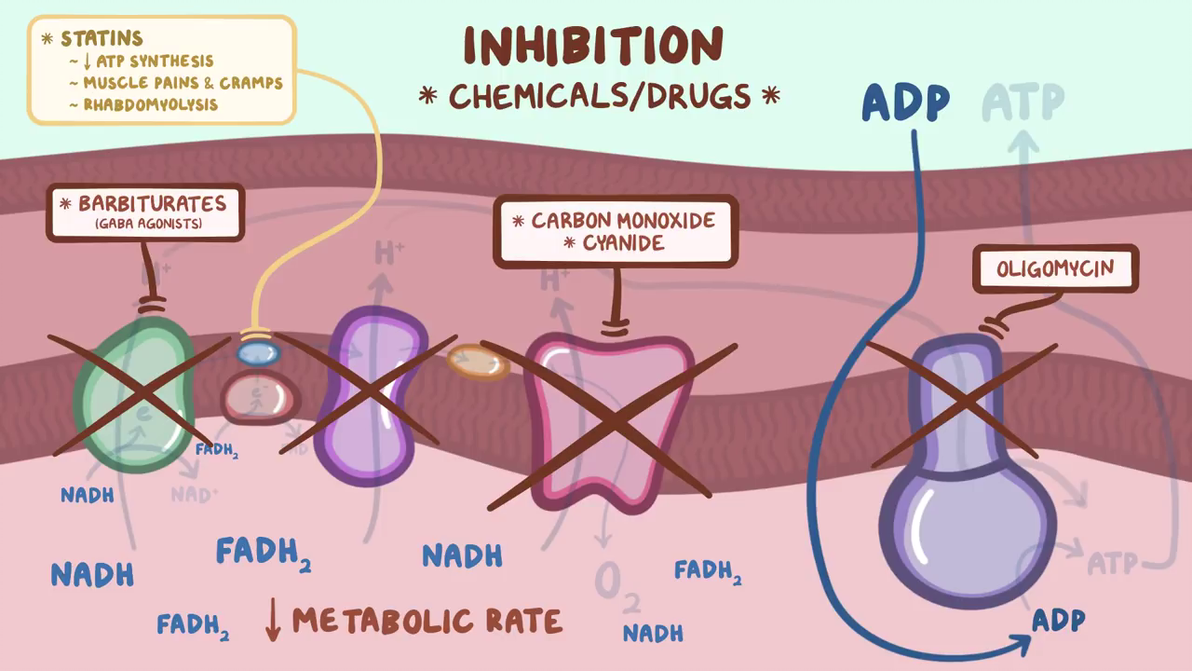
Alright, the other way that oxidative phosphorylation can’t go arise by inhibition, meaning that some chemicals and drugs inhibit components of the electron transport chain.
另一个阻断氧化磷酸化的是抑制作用,即一些化学物质和药物抑制电子传递链中的成分。
Unlike uncoupling, inhibition stops the flow of electrons to the electron transport chain, and that leads to a decrease in ATP synthesis.
和解偶联不同,抑制作用使电子传递链中电流中断,那样会减少ATP合成。
Because electron flow is put to a stop, electron donors like NADH and FADH2 build up. So, the body doesn't feel the need to make more, and the metabolic rate actually falls. Inhibition is like turning off the car engine, which of course means that the car still won't move.
因为电流一旦停止,电子供体如NADH和FADH2积累;因此,机体感到不需要生成更多的电子供体了,代谢率实际上在下降。抑制作用就像关闭汽车引擎,当然意味着汽车不会开动。
And not surprisingly, poisons that work by inhibiting the electron transport chain can lead to death pretty quickly.
抑制电子传递链的毒物能快速致死也不足为奇。
Examples of inhibiting agents include carbon monoxide and cyanide, both of which inhibit complex Ⅳ of the electron transport chain.
抑制剂的例子包括CO、氰化物,两者都抑制电子传递链中的复合体Ⅳ。
Barbiturates, which are Gama agonists, that can be effective for seizure disorders, inhibit complex 1 at high doses.
巴比妥类药物(γ受体激动剂),对治疗癫痫症有效,大剂量则抑制复合体Ⅰ。
Oligomycin, which is an antibiotic too toxic for human use, inhibits the F0 components of ATP synthase.
寡霉素作为抗生素毒性过强不适合人类使用,能抑制ATP合酶的F0亚基。
Statins, which are a class of lipid Loring medications don't inhibit the electron transport chain, but they can decrease the synthesis of coenzyme Q. And that reduction in coenzyme Q can result in decreased ATP production and lead to muscle pains and cramps, and rarely can even cause rhabdomyolysis, which is when there are sever muscle break down which results in kidney failure from the myoglobin released.
他汀类药物是一类不抑制电子传递链的脂类药物,但可减少辅酶Q的合成。辅酶Q减少会导致ATP产生减少,并引起肌肉疼痛和抽筋,罕见导致横纹肌溶解。当有严重的肌肉破坏时,肌红蛋白的释放会导致肾衰竭。
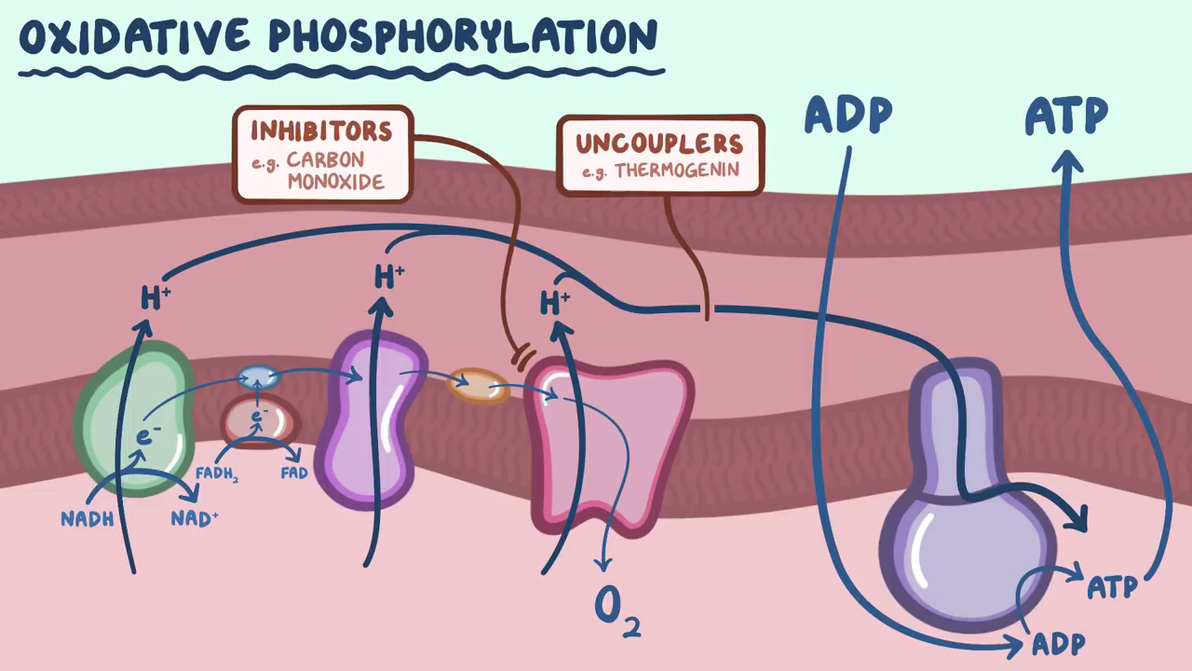
Alright, as a quick recap. Oxidative phosphorylation is a mitochondrial process where electrons are transported across various complexes of the electron transport chain.
好的,做一个快速复习。氧化磷酸化发生在线粒体中,电子在电子传递链中不同复合体间传递。
NADH and FADH2 are the main electron donors, and oxygen is the crucial final electronic acceptor.
NADH和FADH2 是主要电子供体,氧气是重要的终末电子受体。
This movement of electrons helps establish a proton gradient, which is what drives ATP synthase to complete the phosphorylation of ADP into ATP.
电子的传递能帮助建立质子梯度,促使ATP的合成,来完成ADP到ATP的磷酸化过程。
Uncouplers like thermogenin disrupt oxidative phosphorylation by dissipating the proton gradient, while inhibitors like carbon monoxide putting end to the electron transport chain by inhibiting electron flow.
解偶联剂如产热素通过破坏质子梯度扰乱氧化磷酸化过程,而抑制剂如CO通过抑制电子流动终止电子传递链。
英文版权 · Osmosis
