


翻译:凉亭 压制:ivlvn
杰奎琳·杜普雷(Jacqueline Mary du Pré: 1945.1.26-1987.10.19),英籍大提琴家,五岁即展现过人禀赋。十六岁开始职业生涯,才华与年龄的落差倾倒众生;1973年,被确诊罹患多发性硬化症,遂作别舞台;1987年逝世。

Jacqueline Mary du Pré
多发性硬化 Multiple sclerosis
一种中枢神经系统脱髓鞘性疾病,累及大脑和脊髓。髓磷脂 Myelin,是神经轴突周围的保护性鞘膜 sheath,能快速传导神经冲动。髓鞘由支持神经元的少突胶质细胞 oligodendrocytes 形成。
Multiple sclerosis is a demyelinating disease of the central nervous system, which includes the brain and the spinal cord. Myelin is the protective sheath that surrounds the axons of neurons, allowing them to quickly send electrical impulses. This myelin is produced by oligodendrocytes, which are a group of cells that support neurons.
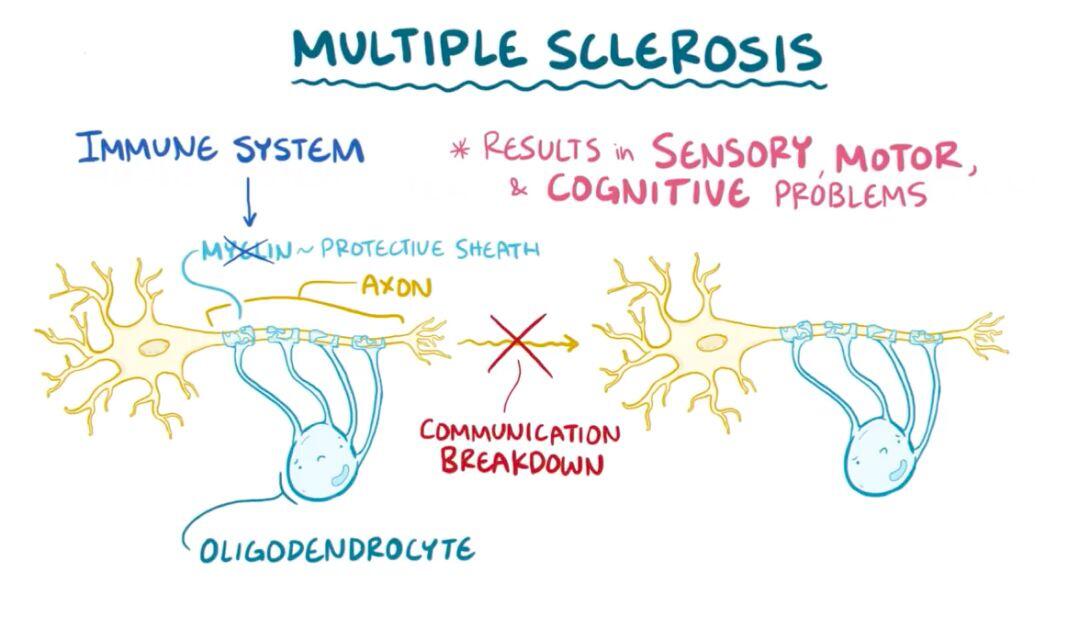
多发性硬化发生脱髓鞘 demyelination 时,免疫系统异常攻击破坏髓鞘,中断神经元之间交流,最终出现一系列的感觉、运动和认知障碍。
In multiple sclerosis, demyelination happens when the immune system inappropriately attacks and destroys the myelin, which makes communication between neurons break down, ultimately leading to all sorts of sensory, motor, and cognitive problems.
血脑屏障
那么,大脑及其中的神经元被血脑屏障(只让血液中某些分子和细胞通过)保护免受血液里物质的损伤。对于免疫细胞来说,如T、B淋巴细胞,有相合的配体 ligand 或表面分子就可以通过血脑屏障,有点像拥有了VIP通行权才能进入私人俱乐部。一旦T淋巴细胞进入中枢神经系统,能够被其中的任一物质激活。
Now, the brain, including the neurons in the brain, is protected by things in the blood by the blood brain barrier, which only lets certain molecules and cells through from the blood. For immune cells like T and B cells that means having the right ligand or surface molecule to get through the blood brain barrier, this is kind of like having the a VIP pass to get into an exclusive club. Once a T cell makes its way in, it can get activated by something it encounters.
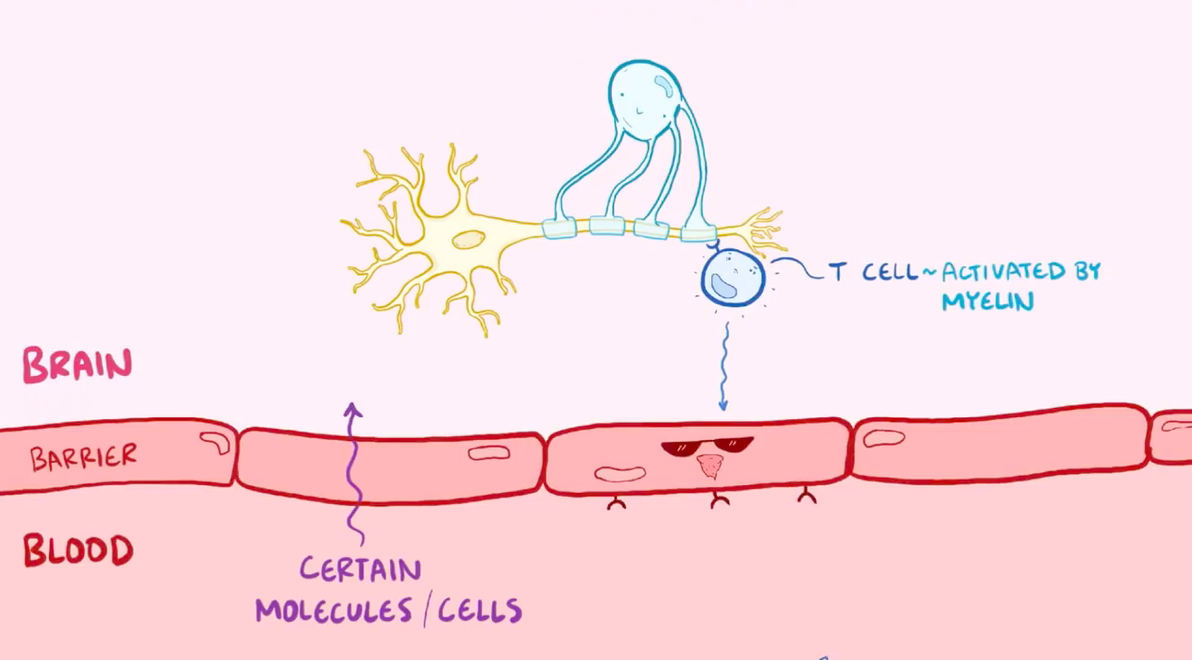
在多发性硬化中,T淋巴细胞是被髓鞘 myelin 激活。一旦T淋巴细胞被激活,会使血脑屏障细胞表达更多受体,让免疫细胞更易结合并通过,这有点像贿赂保镖 bribe the bouncer 让更多人进入。
In the case of multiple sclerosis, it’s activated by myelin. Once the T-cell gets activated, it changes the blood brain barrier cells to express more receptors, and this allows immune cells to more easily bind and get in, it’s kind of like bribing the bouncer to let in a lot of people.
IV型超敏反应
多发性硬化是IV型超敏反应,或细胞介导超敏反应。髓鞘敏感的T淋巴细胞释放细胞因子 cytokines,比如IL-1,IL-6,α-肿瘤坏死因子 TNF-α,γ-干扰素 interferon-γ,并且扩张血管,让更多免疫细胞进入,直接损伤少突胶质细胞。
Now, multiple sclerosis is a type IV hypersensitivity reaction, or cell-mediated hypersensitivity. And this means that those myelin specific T-cells release cytokines like IL-1, IL-6, TNF-alpha, and interferon-gamma, and together dilate the blood vessels which allows more immune cells to get in, as well as directly cause damage to the oligodendrocytes.
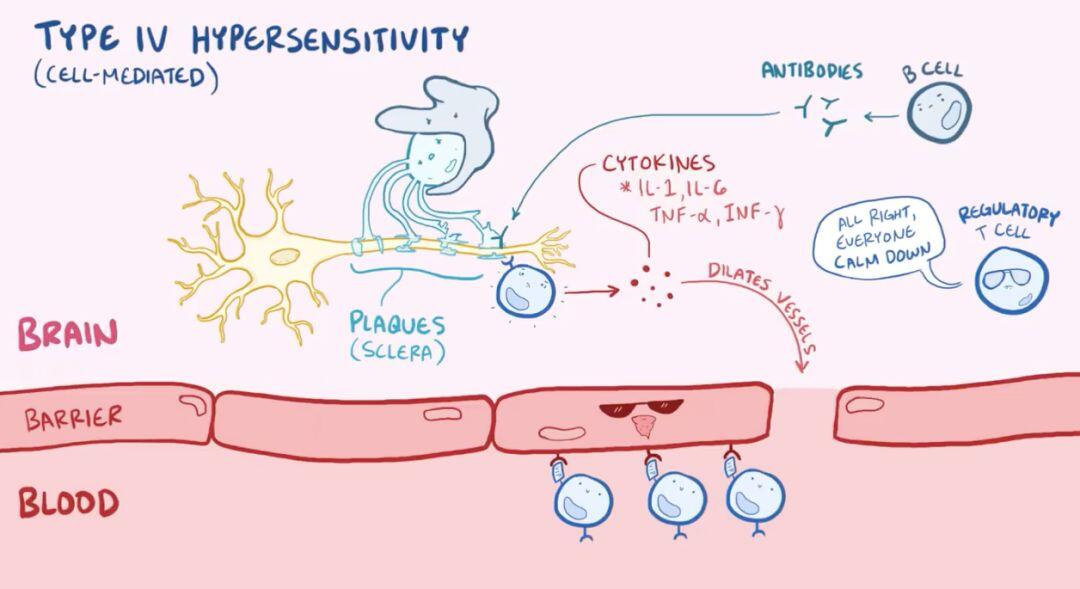
细胞因子也会趋化B淋巴细胞和巨噬细胞,这也是炎症反应的一部分。那些B淋巴细胞分泌抗体,标记于髓鞘蛋白上,巨噬细胞利用抗体标志吞噬摧毁少突胶质细胞。没了少突胶质细胞,也就没有保护神经元的髓鞘,还会留下斑痕组织 plaques(硬化斑 sclera)。
They cytokines also attract B-cells and macrophages as part of the inflammatory reaction. Those B-cells begin to make antibodies that mark the myelin sheath proteins, and then the macrophages use those antibody markers to engulf and destroy the oligodendrocytes. Without oligodendrocytes, there’s no myelin to cover the neurons, and this leaves behind areas of scar tissue, also called plaques or sclera.
多发性硬化的免疫攻击通常是发作式的。换言之,自身免疫攻击少突胶质细胞后,T调节淋巴细胞会赶到并安抚其它免疫细胞,从而减轻炎症。
多发性硬化早期,少突胶质细胞可以自我修复,形成新髓鞘,包裹住神经元,叫作髓鞘再生 remyelination。病情长期下去因为少突胶质细胞的死亡,髓鞘将停止再生,并随神经元轴索减少,这些损伤不可逆。
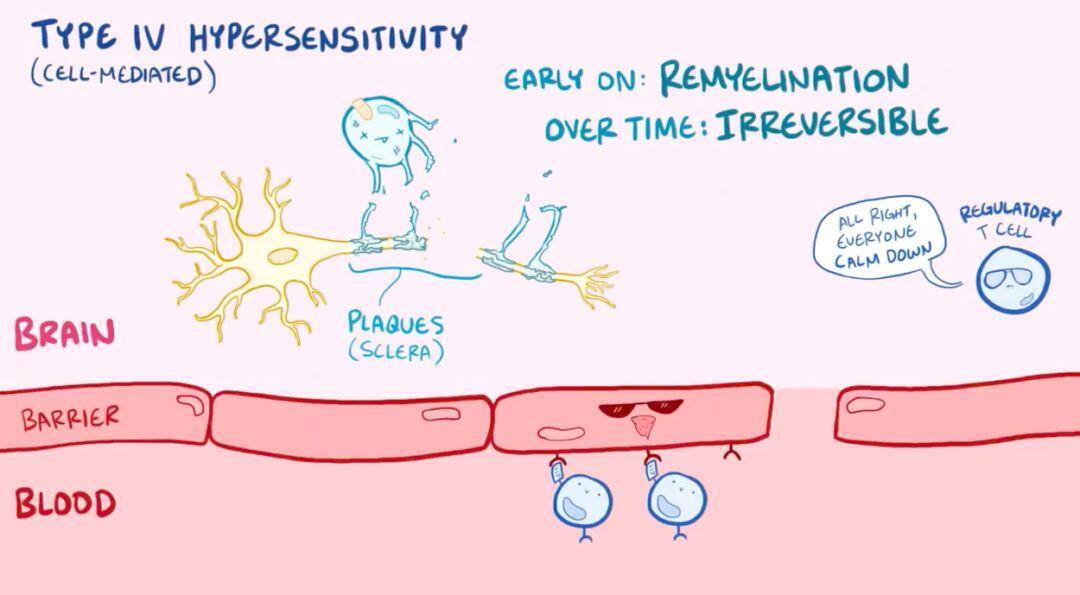
In multiple sclerosis, these immune attacks typically happen in bouts. In other words, an autoimmune attack on the oligodendrocytes might happen, and then regulatory T cells will come in to inhibit or calm down the other immune cells, leading to a reduction in the inflammation. Early on in multiple sclerosis, the oligodendrocytes will heal and extend out new myelin to cover the neurons, which is a process called remyelination. Unfortunately, though, over time as the oligodendrocytes die off the remyelination stops and the damage becomes irreversible with the loss of axons.
病 因
与其它自身免疫疾病一样,多发性硬化的明确病因尚未得知,但是与基因和环境因素有关。
1. 基因危险因素:女性,以及一种编码特殊类型的免疫分子HLA-DR2的基因序列,HLA-DR2常常识别和结合外源分子。
2. 环境危险因素:感染、维生素D缺乏(能解释为什么多发性硬化发生率在南北极地区要高于日光更充足的赤道区)。
基因和环境因素共同影响下,可能导致机体不能清除那些攻击髓鞘的免疫细胞。
Just like other autoimmune diseases, the exact cause of multiple sclerosis is unknown, but is linked to both genetic and environmental factors. Genetic risk factors include being a woman and having genes that encode a specific type of immune molecule called HLA-DR2 which is used to identify and bind to foreign molecules. Environmental risk factors might include infections as well as vitamin D deficiency, which is an interesting one because it might help explain why the rates of multiple sclerosis are higher at the northern and southern poles compared to the equator where there’s a lot more sunlight. Together these genetic and environmental influences might lead to the body not killing off immune cells that target myelin.
4种类型
多发性硬化主要有四种类型:根据随时间发生的症状模式。为表达清楚,我们借助图来说明,以x轴表示时间,代表人的一生;y轴代表功能障碍。
So it turns out that there are four main types of multiple sclerosis based on the pattern of symptoms over time. To break this down, we can use this graph with time on the x-axis, where time refers to the lifespan of the individual, and disability on the y-axis.
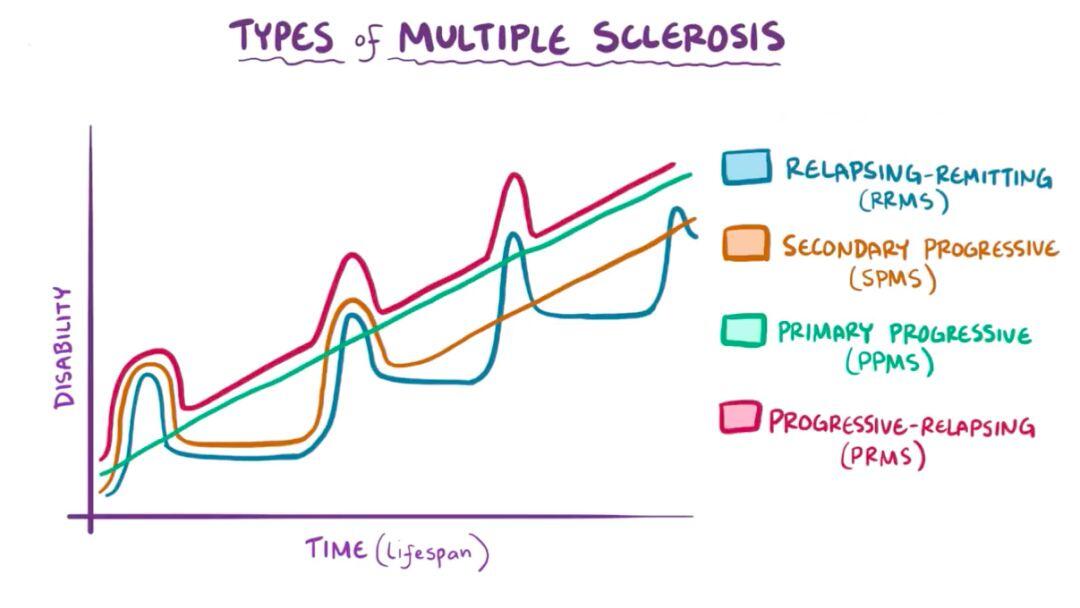
1. 复发-缓解型多发性硬化(RRMS, relapsing-remitting multiple sclerosis):目前为止最常见类型,即上文描述的,自体免疫的发作相隔数月甚至数年,残疾阶段性进展。例如,在一次发作期间,患者可能视力下降,但如果伴随髓鞘再生,病情会有改善。
不幸的是,髓鞘再生往往是不完全的,所以常常遗留功能障碍,这意味着每次攻击下,越来越多的中枢神经系统区域最终将形成不可逆损伤。复发缓解型MS通常在疾病发作间期无残疾进展,所以在此期间线是平的。
The first, and by far the most common pattern of multiple sclerosis, is called relapsing-remitting multiple sclerosis or RRMS. This condition is what we just described, bouts of autoimmune attacks happening months, or even years, apart, and causing an increase in the level of disability. For example, during a bout a person may lose some vision, but then it may be followed by improvement if there’s remyelination. Unfortunately, though, more often than not, the remyelination process is not complete so there is often some residual disability that remains, and that means that with each attach, more and more of the central nervous system gets irreversibly damaged. In the relapsing-remitting multiple sclerosis type there’s typically no increase in disability between bouts, so the line stays flat during that time.
2. 继发进展型MS(SPMS),发病一开始和复发缓解型MS很相似,但是一段时间后免疫攻击持续,导致残疾持续进展。
3. 原发进展型MS(PPMS),基本上一直持续攻击髓鞘,造成患者全程残疾持续进展。
4. 进展复发性MS(PRMS),也是持续攻击髓鞘,但是这次是每次发作叠加,意味着残疾发展更加迅速。
Now, the second type is called secondary progressive multiple sclerosis or SPMS which initially is pretty similar to the relapse-remitting type, but over time the immune attack becomes constant which causes a steady progression of disability. The third type is primary-progressive multiple sclerosis or PPMS, which is basically one constant attack on myelin which causes a steady progression of disability over a person’s lifetime. The final type is progressive relapsing multiple sclerosis or PRMS, which is also one constant attack but this time there are bouts superimposed during which the disability increases even faster.
症 状
特发性症状人与人之间是不同的,很大程度上取决于硬化斑的位置。多发性硬化的发病年龄一般在20到40岁。与疾病相关的症状一般几周后会恶化,也可在未治疗下迁延 linger 数月。
常见的MS三联征,Charcot神经三主征(不是肝外胆管结石继发胆管炎那个!)包括构音障碍 dysarthria(说话困难或不清),眼球震颤 nystagmus(不自主的快速眼球运动),以及意向性震颤 intention tremor。
Specific symptoms varying a lot from person to person, and largely depend on the location of the plaques. And multiple sclerosis typically affects individuals between the ages of 20 and 40. Symptoms related to bouts can typically worsen over weeks and can linger for months without treatment. One common trio of multiple sclerosis symptoms is called Charcot’s neurologic triad and it includes dysarthria, which is difficulty or unclear speech, nystagmus, which is involuntary rapid eye movements, and an intention tremor.
1. 构音障碍 dysarthria 是由于脑干上的斑块使支配口肌和咽喉肌的神经纤维受累,影响随意运动(如吃和说话,可导致口吃 stutter)和不随意运动(如吞咽)。
Dysarthria is due to plaques in the brainstem that affect nerve fibers that control muscles of the mouth and throat, and this can interfere with conscious movements, like eating and talking and can lead to things like a new stutter, as well as unconscious movements, like swallowing.
2. 眼球震动是由于支配眼活动的神经周围有斑块。视神经周围斑块导致单眼或双眼视觉缺失,因为视神经损伤(视神经炎)。有时视觉模糊或变暗,或者视觉中心有黑点。另外,如果支配眼球运动的神经被损伤,眼球运动时会疼痛,并且若眼球不能协同运动,可出现复视。
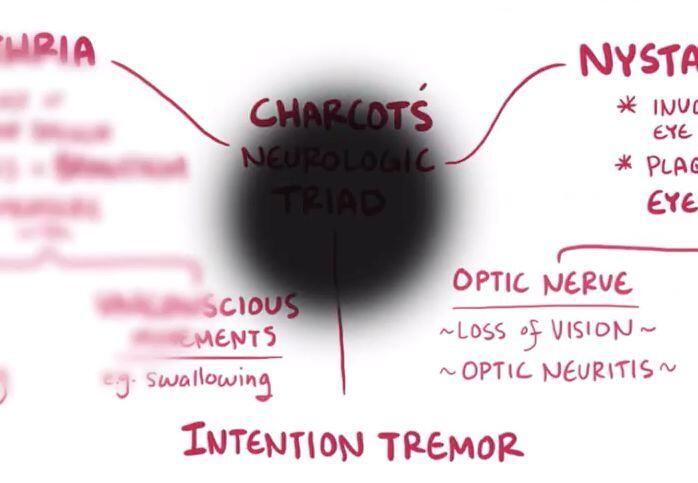
Nystagmus is due to plaques around the nerves controlling eye movements. Plaques around the optic nerve causes loss of vision in one or both of the eyes because of damage to the optic nerve, which is called optic neuritis. Sometimes there’s blurring or graying of the vision, or alternatively there might be a dark point in the center of vision. Additionally, if there’s damage to the nerves controlling eye movement, then eye movements can be painful and there can even be double vision, if the eyes can no longer move in a coordinated way.
3. 意向性震颤是由于脊髓内运动通路有斑块,干扰了控制骨骼肌的传出信号。运动症状包括肌无力,肌痉挛,震颤和共济失调 ataxia(失去平衡和协调运动);严重情况下,可导致瘫痪。
Finally, intention tremors can be caused by plaques along the motor pathways in the spinal cord which can affect outbound signals like skeletal muscle control. Motor symptoms can include muscle weakness, muscle spasms, tremors, and ataxia, which is a loss of balance and coordination. In serious cases, this can lead to paralysis.
此外,感觉通路(如皮肤感觉通路)有斑块能影响传入信号,可出现症状如麻木、针刺感和感觉异常 paresthesia,如刺痛感,也可能是瘙痒样或烧灼样疼痛。
有时,会出现特殊的感觉症状,比如莱尔米特征 Lhermitte’s sign,当人前屈颈部时,出现沿背部放射到四肢的电击感。硬化斑也会影响自主神经系统,导致肠道与膀胱症状(便秘和尿失禁 constipation and urinary incontinence),和性功能障碍。
In addition, plaques in the sensory pathways can affect inbound signals like sensations from the skin which causes symptoms like numbness, pins-and-needles, and paresthesias which are often a tingling feeling but may also be a painful itching or burning sensation. Occasionally there can be very specific sensory symptoms like Lhermitte’s sign, which is when an electric shock runs down the back and radiates to the limbs when a person bends their neck forward. Plaques can also involve the autonomic nervous system which can lead to bowel and bladder symptoms like constipation and urinary incontinence, as well as sexual symptoms like sexual dysfunction.
最后,多发性硬化也能影响大脑的高阶活动,出现注意力不集中、批判性思维下降以及抑郁、焦虑。当出现不同部位神经系统损伤的多种神经症状,以及不同时间发生病变(复发 flare-ups 与缓解 remission 交替)时,通常才能怀疑是多发性硬化。
Finally, multiple sclerosis can also affect higher order activities of the brain, causing poor concentration and critical thinking, as well as depression and anxiety. Multiple sclerosis is typically suspected when there are multiple neurologic symptoms separated in space, which is attributable to damage in different locations in the nervous system, as well as time, meaning separate bouts or flare-ups as well as remission.
诊 疗
诊断:需要MRI的支持,显示多发的中枢神经系统损伤 multiple central nervous system lesions(白质斑 white matter plaques),因为该处有大量髓鞘;还有脑脊液中可有抗体水平增高,暗示有自身免疫活动;视觉诱发电位(visual evoked potential - VEP)也对诊断有帮助,衡量神经系统对视觉刺激的反应。
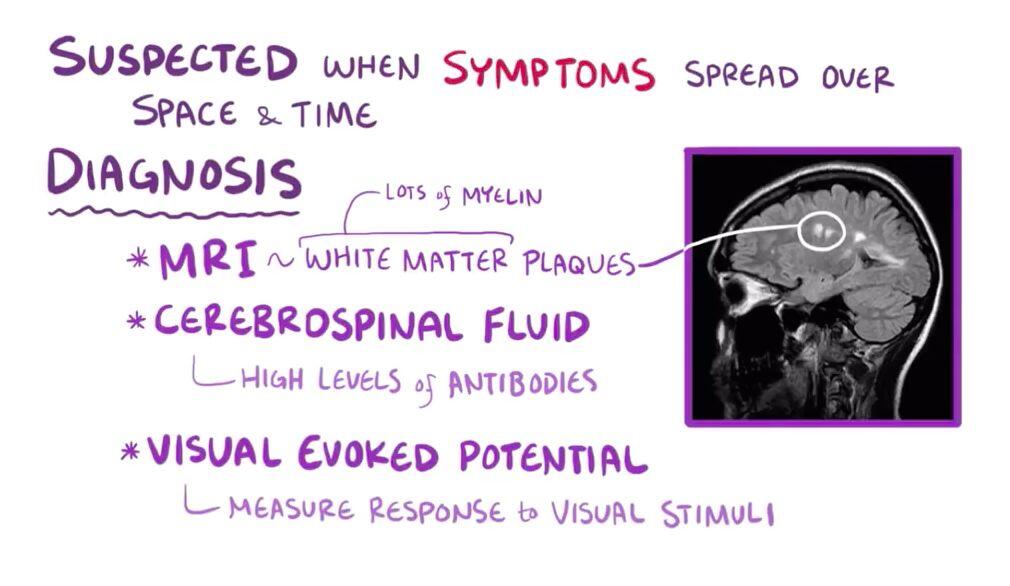
The diagnosis of multiple sclerosis is supported by an MRI which shows multiple central nervous system lesions, called white matter plaques, since these regions tend to have lots of myelin. Also, in the cerebrospinal fluid there might be high levels of antibodies, which indicates an autoimmune process. Finally a visual evoked potential can be helpful as well, which measures the nervous system’s response to visual stimuli.
治疗:目前还不能治愈多发性硬化,但是药物治疗对复发缓解型MS有效,因为它们可以减轻复发 relapse 的剧烈程度和减少复发频率。药物像是糖皮质激素,环磷酰胺 cyclophosphamide(细胞周期阻断剂)和静注免疫球蛋白 intravenous immunoglobulin 能有效钝化 blunt 自身免疫活动。另外,血浆置换 plasmapheresis 也有效果,通过过滤血浆移除导致疾病的自身抗体。
For treatment, there is no cure for multiple sclerosis, but there are medications which are particularly effective for the relapsing-remitting type because they lessen the severity of relapses and make them happen less frequently. Medications like corticosteroids, cyclophosphamide which is a cell cycle inhibitor, and intravenous immunoglobulin can all be used to help blunt the autoimmune process. In addition, plasmapheresis can be effective as well, which is when the plasma is filtered to remove disease-causing autoantibodies.
疾病调节治疗 Chronic treatment:可用免疫抑制剂(重组β-干扰素 recombinant beta-IFN),可降低大脑内炎性因子水平和增加T调节淋巴细胞的功能。其它的免疫抑制剂 immunosuppressants 通常阻断T淋巴细胞进入大脑,通过干扰它们用来通过血脑屏障的细胞表面蛋白。
Chronic treatment for multiple sclerosis includes immunosuppressants like recombinant beta-IFN which decreases the level of inflammatory cytokines in the brain and increases the function of T regulatory cells. Other immunosuppressants actually block T cells from getting into the brain by interfering with their cell surface molecules they use to gain passage through the blood brain barrier.
很可惜,暂时没有针对进展型MS(后三种)的治疗手段。只有对症治疗,管理一切明确的症状(从抑郁到膀胱功能障碍)。物理疗法和认知康复治疗 cognitive rehabilitation 能有效改善感觉,运动和认知症状。人们对于维生素D的治疗效果也在持续观望中。
Unfortunately, though, there are fewer treatment options available for the progressive MS. Instead, treatments are often targeted at managing specific symptoms—everything ranging from depression to bladder dysfunction. Physical therapy and cognitive rehabilitation therapy can be particularly helpful with sensory, motor, and cognitive symptoms. Finally, there’s also an increasing interest in the role of vitamin D as an effective treatment.
小 结
多发性硬化:一种慢性进展性自身免疫紊乱疾病,最常见的类型是复发缓解型,疾病突然发作又缓解,每次发作后全身症状会有轻微恶化。在发作期间,T淋巴细胞导致炎症并损伤中枢神经系统的少突胶质细胞,在脱髓鞘神经元处形成瘢痕(硬化斑),从而根据部位的不同产生不同的症状。
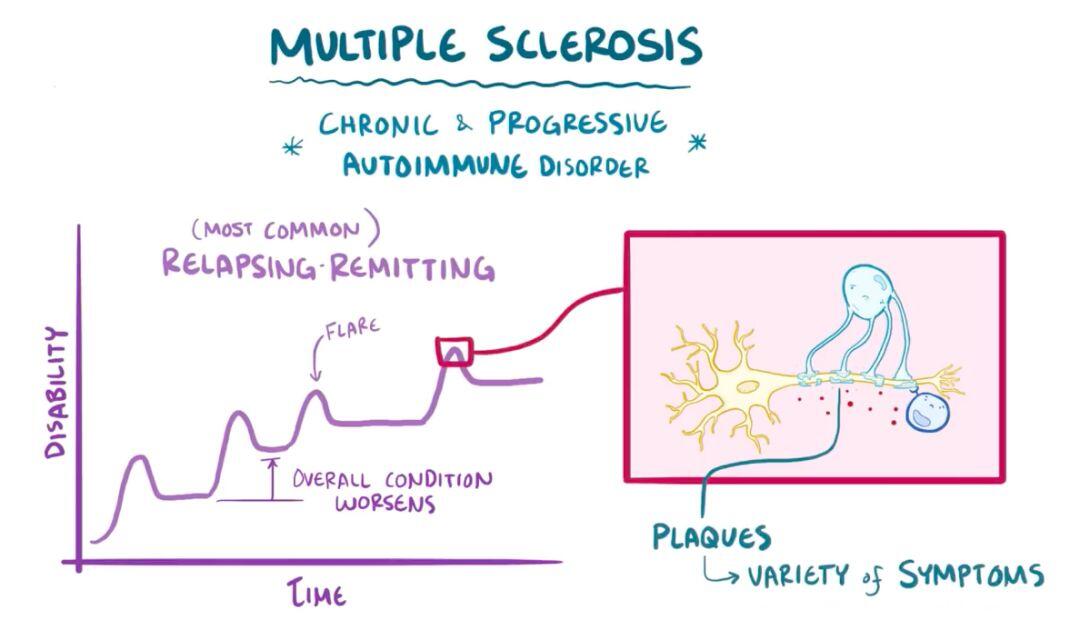
All right, as a quick recap, multiple sclerosis is a chronic and progressive autoimmune disorder, and the most common pattern is the relapsing-remitting type, where individuals have flares that come and go, with each one slightly worsening their overall condition. During a flare, T-cells cause inflammation and damage to oligodendrocytes in the central nervous system,which leaves behind scarred areas of demyelinated neurons called plaques, which causes a variety of symptoms depending on the location.
小伙伴们,下期再见啦
喜欢的话,咱做朋友吧
别忘了阅读原文
还有好多词群小怪兽可以打
Biu!Biu!Biu!
MEDUCAL:为医学打Call

下期预告
「医学英语常用后缀」
@DRWILBER
