
开篇自述:写代码写得越久,越是有种恐惧,生怕自己真变成了一个码农,只会机械地调参。所以总要想点办法提高自已,把这个过程公开化,也算是对自己的激励和鞭策。
选择翻译的这篇文章是2019年一篇综述,讲述了神经网络,目标检测20年来的发展历程,有着恐怖的411篇参考文献,感觉通读一下对自己有所提升。综述类文章也可以看作是科普文来读,尤其是这样一篇贯通古今的文章,可温故而知新。工作量很大,会是一个长期的工程,话不多说,进入正题。
论文题目:Object Detection in 20 Years: A Survey 20年间的目标检测:综述
Abstract—Object detection, as of one the most fundamental and challenging problems in computer vision, has received great attention in recent years. Its development in the past two decades can be regarded as an epitome of computer vision history. If we think of today’s object detection as a technical aesthetics under the power of deep learning, then turning back the clock 20 years we would witness the wisdom of cold weapon era. This paper extensively reviews 400+ papers of object detection in the light of its technical evolution, spanning over a quarter-century’s time (from the 1990s to 2019). A number of topics have been covered in this paper, including the milestone detectors in history, detection datasets, metrics, fundamental building blocks of the detection system, speed up techniques, and the recent state of the art detection methods. This paper also reviews some important detection applications, such as pedestrian detection, face detection, text detection, etc, and makes an in-deep analysis of their challenges as well as technical improvements in recent years.
摘要----目标检测,作为计算机视觉中最为基础也是最具挑战性的问题之一,近年来得到了广泛关注。它在过去20年的发展可以看作计算机视觉历史的缩影。如果我们把目标检测看作深度学习威力下的科技美学,那么将时钟拨回20年可以让我们见证“冷兵器”时代的智慧。本文从目标检测技术发展的角度,对400余篇有关目标检测的论文进行了综述,跨越了四分一个世纪(上世纪90年代到2019)。这篇文章囊括了很多主题,包括历史上里程碑式的检测器,检测数据集,小技巧,检测系统的基本组建,加速技术和最近业界最好的检测模型。本文也回顾了一些重要的检测技术的应用,比如行人检测,人脸检测,文本检测等等,同时深度分析了近年来各种应用种遇到的挑战和技术的进步。
1 INTRODUCTION 简介
OBJECT detection is an important computer vision task that deals with detecting instances of visual objects of a certain class (such as humans, animals, or cars) in digital images. The objective of object detection is to develop computational models and techniques that provide one of the most basic pieces of information needed by computer vision applications: What objects are where?
目标检测计算机视觉领域中很重要的一项课题,任务是在一幅数字图像中检测出特定类别(如人,动物,汽车)的实例。其目的是开发出一些计算机模型和技术,来给出计算机视觉应用需要的最基础的信息之一:目标在哪里?
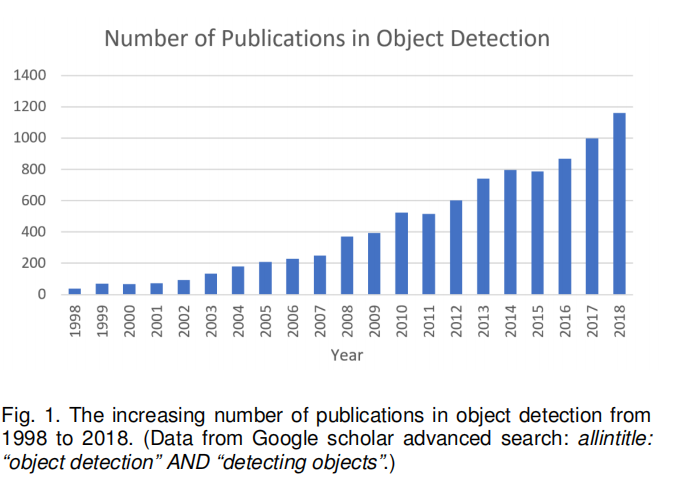
As one of the fundamental problems of computer vision, object detection forms the basis of many other computer vision tasks, such as instance segmentation [1–4], image captioning [5–7], object tracking [8], etc. From the application point of view, object detection can be grouped into two research topics “general object detection” and “detection applications”, where the former one aims to explore the methods of detecting different types of objects under a unified framework to simulate the human vision and cognition, and the later one refers to the detection under specific application scenarios, such as pedestrian detection, face detection, text detection, etc. In recent years, the rapid development of deep learning techniques [9] has brought new blood into object detection, leading to remarkable breakthroughs and pushing it forward to a research hot-spot with unprecedented attention. Object detection has now been widely used in many real-world applications, such as autonomous driving, robot vision, video surveillance, etc. Fig. 1 shows the growing number of publications that are associated with “object detection” over the past two decades.
作为计算机视觉的基本问题之一,目标检测组成了很多其他计算机视觉任务的基础,如实例分割[1-4],图像捕捉[5-7],目标跟踪[8]等。从应用的角度说,目标检测可以可分为两个研究课题:一般目标检测和检测技术应用,其中,前者旨在探索在统一框架下检测不同类型对象的方法,以模拟人类的视觉和认知,后者指的是特定应用场景下的检测,如行人检测、人脸检测、文本检测等。近年来,随着深度学习技术的快速发展[9],目标检测技术也被注入了新的血液,并取得了显著的突破,使其被推上了前所未有的研究热点。目标检测目前已广泛应用于许多实际场景中,如自主驾驶、机器人视觉、视频监控等。图1展示了过去20年中与目标检测相关的出版物的增长速度。
• Difference from other related reviews 与其他综述类文章的区别
A number of reviews of general object detection have been published in recent years [24–28]. The main difference between this paper and the above reviews are summarized as follows:
近年来发表了许多关于一般目标检测的综述[24-28]。本文与上述综述的主要区别如下:
1. A comprehensive review in the light of technical evolutions: This paper extensively reviews 400+ papers in the development history of object detection, spanning over a quarter-century’s time (from the 1990s to 2019). Most of the previous reviews merely focus on a short historical period or on some specific detection tasks without considering the technical evolutions over their entire lifetime. Standing on the highway of the history not only helps readers build a complete knowledge hierarchy but also helps to find future directions of this fast developing field.
1. 基于技术演进的全面回顾:本文广泛回顾了目标检测发展历史上的400多篇论文,跨越四分之一个世纪的时间(从20世纪90年代到2019年)。以前的大多数综述仅仅关注一个短的历史时期或者一些特定的检测任务,而没有考虑它们整个生命周期内的技术演进。站在历史的高速公路上,不仅有助于读者建立一个完整的知识体系,而且有助于找到这个快速发展领域的未来方向。
2. An in-depth exploration of the key technologies and the recent state of the arts: After years of development, the state of the art object detection systems have been integrated with a large number of techniques such as “multiscale detection”,“hard negative mining”, “bounding box regression”, etc. However, previous reviews lack fundamental analysis to help readers understand the nature of these sophisticated techniques, e.g., “Where did they come from and how did they evolve?” “What are the pros and cons of each group of methods?” This paper makes an in-depth analysis for readers of the above concerns.
2. 深入探索关键技术及最新发展状况:经过多年的发展,目前最先进的目标检测系统已经与“多尺度检测”、“难例挖掘”、“边界框回归”等大量技术相结合。然而,以前的回顾缺乏基本的分析来帮助读者理解这些复杂技术的本质,例如,“它们从哪里来,它们是如何发展的?”“每一组方法的优缺点是什么?”本文针对上述问题为读者进行了深入的分析。
3. A comprehensive analysis of detection speed up techniques: The acceleration of object detection has long been a crucial but challenging task. This paper makes an extensive review of the speed up techniques in 20 years of object detection history at multiple levels, including“detection pipeline” (e.g., cascaded detection, feature map shared computation), “detection backbone” (e.g., network compression, lightweight network design), and “numerical computation” (e.g., integral image, vector quantization). This topic is rarely covered by previous reviews.
3.综合分析目标检测算法的加速技术:加速目标检测一直是一项关键而又具有挑战性的任务。本文综合回顾了20多年来,在多个层次上的加速技术,包括“检测管道”(如级联检测、特征图共享计算)、“检测主干”(如网络压缩、轻量化网络设计)、和“数值计算”(如积分图像、矢量量化)等。以前的综述很少关注这个话题。
• Diffificulties and Challenges in Object Detection 目标检测中的困难与挑战
Despite people always asking “what are the difficulties and challenges in object detection?”, actually, this question is not easy to answer and may even be over-generalized. As different detection tasks have totally different objectives and constraints, their difficulties may vary from each other. In addition to some common challenges in other computer vision tasks such as objects under different viewpoints, illuminations, and intraclass variations, the challenges in object detection include but not limited to the following aspects: object rotation and scale changes (e.g., small objects), accurate object localization, dense and occluded object detection, speed up of detection, etc. In Sections 4 and 5, we will give a more detailed analysis of these topics.
尽管人们总是问“什么是目标检测的困难和挑战?”,事实上,这个问题不容易回答,甚至可能被过度概括。由于不同的检测任务具有完全不同的目标和约束条件,因此它们的困难程度可能各不相同。除了其他计算机视觉任务中一些常见的挑战,如目标的视角不同,照明条件,和内部变化等,目标检测的挑战包括但不限于以下方面:目标旋转和尺度变化(例如,小目标),精确目标定位,密集有遮挡的目标检测、快速目标检测等。在第4节和第5节中,我们将对这些主题进行更详细的分析。
The rest of this paper is organized as follows. In Section2, we review the 20 years’ evolutionary history of object detection. Some speed up techniques in object detection will be introduced in Section 3. Some state of the art detection methods in the recent three years are summarized in Section 4. Some important detection applications will be reviewed in Section 5. In Section 6, we conclude this paper and make an analysis of the further research directions.
本文的其余部分组织如下。在第二章,我们回顾20年来目标检测的发展历史。第3章将介绍一些目标检测的加速技术。第四部分总结近三年来的一些最先进的检测方法。一些重要的检测应用将在第5节中进行综述。第六部分对本文进行了总结,并对进一步的研究方向进行了分析。
第一章简介翻译完毕,算是开胃菜。本人英语水平一般,大学6级,翻译上力求“信”和“达”,“雅”么,随缘吧~
