
在看到这篇文章前,请确保你已经学习过Dijkstra和Bellman-Ford算法(用SPFA也行)。
johnson用于解决存在负权的全源最短路问题,时间复杂度为,比对所有点跑一遍Bellman-Ford(可以判断负权图,但是如果对每个点求一次单源最短路时间复杂度为)要快。
本篇文章会分三部分讲解Johnson算法,其中第一、二部分是算法实现流程,第三部分是原理解释。
题目背景是求解类似以下稀疏图的全源最短路,点的个数,边数,典型的稀疏图。
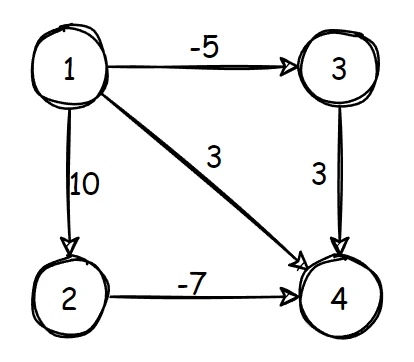
可以做一下这个例题:www.luogu.com.cn/problem/P5905
1.re-weight operation
re-weight,顾名思义就是重新调整每条边的权重。
对于一个图,我们先建立一个"Super Source Node"(超级源点),我们用0号节点表示,并且将其与所有点连接起来,边权为0。
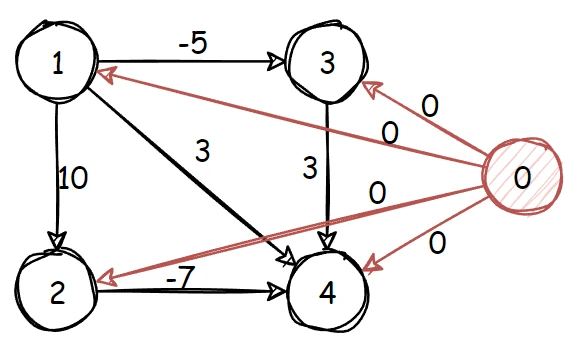
接下来用Bellman-Ford算法计算出超级源点的单源最短路,这个是很简单的。
ll h[N];//h[x]表示源点0到到x的最短距离,通过Bellman-Ford计算

bool Bellman_Ford()
{
	//初始化h[]为无穷
	for(int i = 1;i <= n; ++ i)h[i] = inf;

	//松弛n-1次,i仅用于计数
	for(int i = 1;i < n; ++ i)
	{
		//枚举所有边,尝试用这条边去松弛点x
		for(const auto &[x, y, w] : es)
		{
			if(h[x] == inf)continue;
			//如果可以通过这条边可以松弛
			if(h[x] + w < h[y])
			{
				h[y] = h[x] + w;
			}
		}
	}

	//判断是否存在负权环
	for(const auto &[x, y, w] : es)
	{
		if(h[x] == inf)continue;
		//如果还有边可以松弛,那么说明存在负环返回false
		if(h[x] + w < h[y])return false;
	}
	//不存在负环,返回true
	return true;
}好,假如不存在负环,现在我们就得到了一个数组对吧,接下来我们令每条边的权重。
这样一定可以使得所有边权都为正权,假如,那么必然有,于是有。
2.run Dijkstra Alogorithm
在此基础上去对每一个点跑一遍Dijkstra算法,即可求得对于每一个点的单源最短路,而求出来的这个距离d(u, v)实际上是进行了偏移之后的,要还原为真实的距离还要令:f(u, v) = d(u, v) - h[u] + h[v]。
直接看代码(这里就不写注释了):
void dijkstra(int st)
{
	static ll d[N];

	for(int i = 1;i <= n; ++ i)d[i] = inf;
	bitset<N> vis;

	priority_queue<Node> pq;
	pq.push({st, d[st] = 0});

	while(pq.size())
	{
		int x = pq.top().x;pq.pop();
		if(vis[x])continue;
		vis[x] = true;

		for(const auto  &[y, w] : g[x])
		{
			if(d[x] + w < d[y])
			{
				d[y] = d[x] + w;
				pq.push({y, d[y]});
			}
		}
	}

	for(int i = 1;i <= n; ++ i)dis[st][i] = d[i];
}3.原理解释
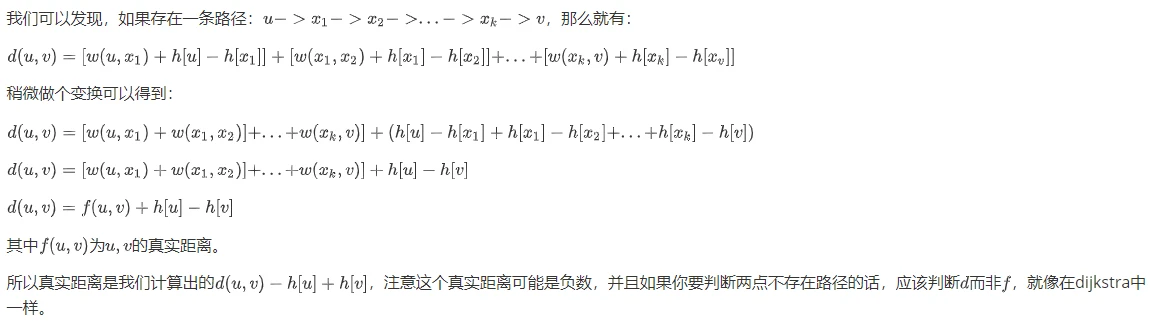
注意我们第一次求的数组,为什么不直接d用来表示呢?因为在物理中h的含义是“势能”,我们将一个物理含义挪用到信息学中,可以形象的解释h数组的含义。
b站贴latex太吃史了,直接看图。
例题的代码:
#include <bits/stdc++.h>
using namespace std;
using ll = long long;
const int N = 3e3 + 9;
const ll inf = 1e9;

ll n, m;
struct Edge
{
	ll x, y, w;
};
vector<Edge> es;

struct Node
{
	ll x, w;
	bool operator < (const Node &u)const
	{
		return w == u.w ? x < u.x : w > u.w;
	}
};

vector<Node> g[N];


ll h[N];//h[x]表示源点0到到x的最短距离,通过Bellman-Ford计算
ll dis[N][N];

bool Bellman_Ford()
{
	//初始化h[]为无穷
	for(int i = 1;i <= n; ++ i)h[i] = inf;

	//h[0] = 0这个可以忽略

	//一共(n+1)个点,所以松弛n次,i仅用于计数
	for(int i = 1;i <= n; ++ i)
	{
		//枚举所有边,尝试用这条边去松弛点x
		for(const auto &[x, y, w] : es)
		{
			if(h[x] == inf)continue;
			//如果可以通过这条边可以松弛
			if(h[x] + w < h[y])
			{
				h[y] = h[x] + w;
			}
		}
	}

	//判断是否存在负权环
	for(const auto &[x, y, w] : es)
	{
		if(h[x] == inf)continue;
		//如果还有边可以松弛,那么说明存在负环返回false
		if(h[x] + w < h[y])return false;
	}
	//不存在负环,返回true
	return true;
}

void dijkstra(int st)
{
	static ll d[N];

	for(int i = 1;i <= n; ++ i)d[i] = inf;
	bitset<N> vis;

	priority_queue<Node> pq;
	pq.push({st, d[st] = 0});

	while(pq.size())
	{
		int x = pq.top().x;pq.pop();
		if(vis[x])continue;
		vis[x] = true;

		for(const auto  &[y, w] : g[x])
		{
			if(d[x] + w < d[y])
			{
				d[y] = d[x] + w;
				pq.push({y, d[y]});
			}
		}
	}

	for(int i = 1;i <= n; ++ i)dis[st][i] = d[i];
}

void solve()
{
	cin >> n >> m;
	for(int i = 1;i <= m; ++ i)
	{
		ll u, v, w;cin >> u >> v >> w;
		g[u].push_back({v, w});
		es.push_back({u, v, w});
	}
	for(int i = 1;i <= n; ++ i)es.push_back({0, i, 0});

	if(!Bellman_Ford())
	{
		cout << -1 << '\n';
		return;
	}

	//求出h[]数组后,0号点已经没用了

	//1.re-weight
	for(int x = 1;x <= n; ++ x)
	{
		for(auto &[y, w] : g[x])
		{
			w = w + h[x] - h[y];
		}
	}

	//2.run Dijkstra
	for(int x = 1;x <= n; ++ x)dijkstra(x);

	//3.calculate the Sum
	for(int i = 1;i <= n; ++ i)
	{
		ll sum = 0;
		for(int j = 1;j <= n; ++ j)
		{
			if(dis[i][j] == inf)sum += 1ll * j * inf;
			else sum += 1ll * j * (dis[i][j] - h[i] + h[j]);
		}
		cout << sum << '\n';
	}

}


int main()
{
    ios::sync_with_stdio(0), cin.tie(0), cout.tie(0);
    int _ = 1;
    while(_ --)solve();
    return 0;
}留到最后
非常感谢你看到这里,我是ErikTse,一名致力于做优质计算机教程的UP主~
欢迎关注我的账号,学习更多ACM算法、计算机编程相关知识~
如果你是正在准备算法竞赛的新手,或者是想要通过算法相关考试的同学,欢迎进入我的b站个人主页,了解我的《算法基础课》(39元超值),或在【爱发电】网页/APP中搜索【Erik_Tse】了解详情(这里价格更低)。
