
Phylum Echinodermata
Subphylum Homalozoa †
Obsoletely known as Subphylum Carpoidea and Subphylum Heterostelea.[1] Paraphyletic group.[2] All homalozoan groups below might be potentially paraphyletic or even polyphyletic, for example recent proposals of regarding homalozoans as derived blastozoans/crinozoans and classifying them thus into those subphyla.
1. Class Ctenocystoidea † [3]
2. Class Cincta † [3]
Obsoletely known as Class Homostelea.[1]
3. Class Soluta † [3]
Obsoletely known as Class Homoiostelea.[1]
4. Class Stylophora † [3]
There are some arguments about whether Stylophora should be classified under Phylum Chordata within Subphylum Calcichordata. However, recent studies have proven the echinoderm essence of stylophorans.[4] In addition to the genetic proof that echinoderms are sister groups with hemichordates, instead with chordates, a key theory in the Calcichordate Hypothesis, the author decides to put Class Stylophora within Subphylum Homalozoa.[5]
Subphylum Blastozoa †
Also called Subphylum Cystoidea.[6][7] According to [8], this group might be potentially paraphyletic if the hypothesis crinoids evolve from blastozoans is proved valid.
1. Class Rhombifera † [9][10]
Polyphyletic group.[8]
2. Class Diploporita † [8]
Polyphyletic group.[8]
3. Class Paracrinoidea †
Disputed taxonomic placement.[11][12] [13] classifies it in Crinozoa. However, since most professional articles consider it blastozoan, the author hereby classifies it within Blastozoa.[14][15] [16], however, states the possibility of Paracrinoidea belonging to a subphylum called Paracrinozoa, but since the author of that article himself is more inclined toward paracrinoids being blastozoan, additional to the fact that the paracrinozoan classification has not received wide approval, it is hence classified here.
4. Class Eocrinoidea † [9]
Polyphyletic group.[8] Contains Order Imbricata, which contains Family Lepidocystoidae.[17] One hypothesis is that it gave birth to other pelmatozoic classes.[18]
5. Class Blastoidea † [9]
6. Class Parablastoidea † [9]
7. Class Coronoidea † [11][12][19]
Note that coronates belong to coronoids.[19]
8. Class Cryptocrinoidea †
[14] claims it to be a class under Blastozoa while [11] and [12] say the classification of this taxon is uncertain. Many of the sources cited are inaccessible, and the data on cryptocrinoids is extremely scarce on the internet. (The author wonders whether this class is established upon the Genus Cryptocrinites) Even though the author puts it under Blastozoa here, keep in mind of the uncertainties.
Subphylum Crinozoa
1. Class Crinoidea [9][20]
Subphylum Asterozoa
Obsoletely known as Subphylum Stelleroidea.[21] The author has also seen some sources where Stelleroidea is treated as a class and the taxa below as subclasses.[13] Also, apparently there are two main classification hypotheses for the phylogeny of Asteroidea, Ophiuroidea, Echinoidea, and Holothuroidea, the Asterozoan Hypothesis and the Cryptosyringid Hypothesis. Here, the author adopts the Asterozoan Hypothesis, which identifies Asterozoa and Echinozoa as sister groups, because more scholars adopt it and one article supports the Asterozoan Hypothesis with mitochondrial genetic evidence.[22] Still, at the current state, both hypotheses are equally valid, for Paleontological evidence tends to favor the Asterozoan Hypothesis while embryological evidence tends to favor the other.[23][7]
1. Class Somasteroidea † [24]
Also known as Class Stomasteroidea.[24]
2. Class Asteroidea [24]
Includes Infraclass Concentricycloidea.[25]
3. Class Ophiuroidea [24]
4. Class Stenuroidea † [26]
Subphylum Echinozoa
Note that many classes are apparently classified under Echinozoa for convenience. Especially for some taxa below where there isn’t really robust morphological evidence supporting their belonging under this subphylum.
1. Class Camptostromatoidea †
Also called Class Camptostromoidea. There are hypotheses for camptostromatoids being its own class, a member of the edrioasteroids, basal for all echinoderms, or not belonging to Echinodermata at all.[27][28][6] The author follows [29] and [30] for Camptostromatoidea being its own echinozoan class.
2. Class Cyclocystoidea † [31][32]
One hypothesis that it should be under Edrioasteroidea.[7]
3. Class Ophiocistioidea † [30][33]
Paraphyletic group.[7]
4. Class Echinoidea [30]
5. Class Holothuroidea [30]
6. Class Edrioblastoidea † [31]
Some consider it to be echinozoan; some consider it to be blastozoan; some consider it to be under Edrioasteroidea.[9] Here, the author adopts the first hypothesis where edrioblastoids are designated a single class.
7. Class Helicoplacoidea †
Different from Class Helicocystoidea.[34] [30] states that Helicoplacoidea can be classified under Echinozoa out of convenience. However, many hypotheses also state Helicoplacoidea to be an early offshoot or stem group of echinoderms,[28][18][6] which is probable due to its primitive triradiate structure, so putting Helicoplacoidea within Echinozoa here is only for the sake of a classification. Be aware of that.
8. Class Edrioasteroidea †
According to [8], this class might be polyphyletic, though has not received wide approval. The current Wikipedia states that edrioasteroids are classified under Crinozoa; however, no reliable source is found to support this idea. More confusingly, [35] and [31] show Edrioasteroidea to be under Echinozoa, [36] states that Edrioasteroidea is closer to Crinozoa or Blastozoa than to Echinozoa, and [37] puts it as a basal stem group for asterozoans and echinozoans. The author shall put Edrioasteroidea in Echinozoa, where the professional and recent sources supporting are also more,[38][30] and since [30] literally opines, “There are four classes that can definitely be placed here [Echinozoa]: (1) Edrioasteroidea” (Fell and Sepkoski)… However, it needs to be noted that some hypotheses classify edrioasteroids as basal before the diversion of the aforementioned subphyla, so it might well as belong to neither, [28] and Edrioasteroidea being classified in Echinozoa here is frankly more for the sake to fit into a subphylum.
Postscript:
Note that lower classifications such as Clade Cambroernida, Family Vetulocystidae, Genus Ctenoimbricata, and Genus Arkarua that belong to unclear classes or have disputes of whether belonging in Echinodermata or not are excluded from this work.
Subphylum Pelmatozoa and Eleutherozoa
There has been some debate for whether the three-subphyla taxonomy (Homalozoa-Pelmatozoa-Eleutherozoa) or the five-subphyla taxonomy (Homalozoa-Blastozoa-Crinozoa-Asterozoa-Echinozoa) should be adopted.[9] Even though the presence of a stalk or not has been said to depend on ecologic adaptations rather than cladistic relationships,[36] many recent studies and hypotheses still adopt Pelmatozoa and Eleutherozoa as valid monophyletic subphyla.[28] Here, the author adopts the newer and more probable five-subphyla taxonomy.[39] And also because the ambiguity instigated when certain pelmatozoans are actually free-living (ex: feather stars) and when certain eleutherozoans are actually “stalked” (ex: certain edrioasteroids, if they can be classified under Echinozoa).
Subphylum Haplozoa (contains Class Cyamoidea and Cycloidea) †
Cyamoidea and Cycloidea are supposed to be under a subphylum called Haplozoa. However, later researches have brought those taxa under uncertain classification due to lack of evidence, and nowadays, those taxa are pretty much redundant and rejected.[40][41]
Class Cystoidea †
According to [9], it has been split into two classes, Rhombifera and Diploporita, both now in Blastozoa, and this idea has been recognized by [16] by referring to Cystoidea as now informal after the split. However, there is still a lot of data and research for Cystoidea even after the proposal of the aforementioned idea. Cystoidea is classified in Crinozoa according to [42] along with a source-less Wikipedia’s support even though [43] and [44] classify it within Blastozoa and [20] and [16] state that no other class except Crinoidea exists in Crinozoa. Due to the extreme ambiguity of the sources and the question of whether this taxon even exists, the author shall leave it in the postscript for awareness and further potential research. Cystoidea is also an alternative nomenclature for Blastozoa, which just adds to the confusion.[6][7]
Class Lepidocystoidea †
Supposed class containing Genus Lepidocystis. However, more recent studies have placed this clade within Eocrinoidea, becoming synonymous with Order Imbricata.[9][17] Therefore, the author excludes it as an independent class.
Class Helicocystoidea †
The author currently has not found which subphylum this belongs to, but since helicocystoids have more derived pentaradial symmetry than helicoplacoids, and helicoplacoids can be classified in Echinozoa out of convenience, is it reasonable to classify Helicocystoidea in Echinozoa as well?[45] Or maybe helicoplacoids being in Echinozoa is based on a different hypothesis which can’t be applied to the classification of Helicocystoidea? The author is not sure, thus putting it in the postscript.
Disclaimer: Do not believe everything the author states here, for many have equally-viable hypotheses, and the author is not professional in Paleontology either. However, the author does consider this to be a helpful reference because this is the first resource the author knows of to adopt newer theories and introduce uncommon classes into echinoderm taxonomy. Still, try to research and form individually persuasive opinions.
Works Cited
[1] Lefebvre, Bertrand, et al. "A Reinterpretation of the Solutan Plasiacystis mobilis (Echinodermata) from the Middle Ordovician od Bohemia." Zoosymposia, vol. 7, 12 Dec 2012, pp. 287-306. Accessed 27 Jun 2022.
[2] 攀缘的井蛙. “【地球演义】寒武纪的余烬:棘皮动物篇(上).” 知乎, 30 Nov 2018, zhuanlan.zhihu.com/p/51287717. Accessed 27 Jun 2022.
[3] Parsley, Ronald. “Homalozoa.” Tulane University, pp. 106-117. Accessed 27 Jun 2022.
[4] Lefebvre, B., Guensburg, T.E., Martin, E.L.O., Mooi, R., Nardin, E., Nohejlova, M., Saleh, F., Kouraiss, K., Hariri, K.E., David, B., “Exceptionally Preserved Soft Parts in Fossils from the Lower Ordovician of Morocco Clarify Stylophoran Affinities within Basal Deuterostomes,” Geobios (2018), https://doi.org/10.1016/j.geobios.2018.11.001.
[5] Cannon, Johanna, et al. “Xenacoelomorpha is the Sister Group to Nephrozoa.” Nature, vol. 530, no. 7588, 4 Feb 2016, pp. 89-93. Accessed 27 Jun 2022.
[6] Paul, C.R.C. and Smith, A.B. “The Early Radiation and Phylogeny of Echinoderms.” Biological Reviews, vol. 59, Apr 1984, pp. 443-481. Accessed 16 Jul 2022.
[7] Smith, Andrew. “Classification of the Echinodermata.” Paleontology, vol. 27, 1984, pp. 431-459. Accessed 16 Jul 2022.
[8] Sheffield, Sarah and Sumrall, Colin. “The Phylogeny of the Diploporita: a Polyphyletic Assemblage of Blastozoan Echinoderms.” Journal of Paleontology, vol. 93, 28 Feb 2019, pp. 1-13. Accessed 8 Jul 2022.
[9] Sprinkle, James. Morphology and Evolution of Blastozoan Echinoderms. Cambridge, Mass.: Museum of Comparative Zoology, Harvard University, 1973. Accessed 27 Jun 2022.
[10] Taxonomicon editors. “Class Rhombifera.” The Taxonomicon, taxonomicon.taxonomy.nl/TaxonTree.aspx?id=83895&src=0. Accessed 8 Jul 2022.
[11] Foote, Mike. “Paleozoic Record of Morphological Diversity in Blastozoan Echinoderms.” Proceedings of the National Academy of Sciences of the United States of America, vol. 89, Aug 1992, pp. 7325-7329. Accessed 8 Jul 2022.
[12] Paul, Christopher. “New Insights into the Origin and Relationships of Blastoid Echinoderms.” Acta Paleontologica Polonica, vol. 66, no. 1, 2 Mar 2021, pp. 41-62. Accessed 8 Jul 2022.
[13] Sprinkle, James. “Echinoderm Faunas from the Bromide Formation (Middle Ordovician) of Oklahoma.” The University of Kansas Paleontological Institute, 1982. Accessed 9 Jul 2022.
[14] Ciampaglio, Charles. “Determining the Role that Ecological and Developmental Constraints Play in Controlling Disparity: Examples from the Crinoid and Blastozoan Fossil Record.” Evolution & Development, vol. 4, no. 3, 2002, pp. 170-188. Accessed 8 Jul 2022.
[15] Taylor, Christopher. “Paracrinoidea.” Variety of Life, 24 Oct 2012, taxondiversity.fieldofscience.com/2012/10/paracrinoidea.html. Accessed 8 Jul 2022.
[16] Broadhead, Thomas. “Blastozoa.” University of Tennessee, Knoxville, 1980, pp. 118-132. Accessed 8 Jul 2022.
[17] Nardin, Elise, et al. “Evolutionary Implications of a New Transitional Blastozoan Echinoderm from the Middle Cambrian of the Czech Republic.” Journal of Paleontology, vol. 91, Jul 2017, pp. 1-13. Accessed 8 Jul 2022.
[18] Ubaghs, Georges. “Early Paleozoic Echinoderms.” Annual Review of Earth and Planetary Sciences, vol. 3, 1975, pp. 79-98. Accessed 9 Jul 2022.
[19] Brett, Carlton, et al. “Coronoidea: A New Class of Blastozoan Echinoderms Based on Taxonomic Reevaluation of Stephanocrinus.” Journal of Paleontology, vol. 57, no. 4, Jul 1983, pp. 627-651. Accessed 8 Jul 2022.
[20] 攀缘的井蛙. “【地球演义】寒武纪的余烬:棘皮动物篇(下).” 知乎, 5 Dec 2018, zhuanlan.zhihu.com/p/51585435. Accessed 8 Jul 2022.
[21] Kroh, Andreas, et al. “Asterozoa.” World Register of Marine Species, 18 Oct 2021, www.marinespecies.org/aphia.php?p=taxdetails&id=148743. Accessed 8 Jul 2022.
[22] Smith, Michael, et al. “The Phylogeny of Echinoderm Classes Based on Mitochondrial Gene Arrangements.” Journal of Molecular Evolution, vol. 36, Jun 1993, pp. 545-554. Accessed 13 Jul 2022.
[23] Wray, Gregory. “Echinodermata.” Tree of Life web project, 14 Dec 1999, tolweb.org/Echinodermata/2497/1999.12.1. Accessed 13 Jul 2022.
[24] ITIS editors. “Asterozoa.” Integrated Taxonomic Information System, www.itis.gov/servlet/SingleRpt/SingleRpt?search_topic=TSN&search_value=914171#null. Accessed 8 Jul 2022.
[25] Janies, Daniel, et al. “Echinoderm Phylogeny Including Xyloplax, a Progenetic Asteroid.” Systematic Biology, vol. 60, no. 4, Jul 2011, pp. 420-438. Accessed 8 Jul 2022.
[26] Blake, Daniel. “Early Asterozoan (Echinodermata) Diversification: A Paleontologic Quandary.” Journal of Paleontology, vol. 87, no. 3, 2013, pp. 353-372. Accessed 17 July 2022.
[27] Sprinkle, James. “Camptostromatoidea.” AccessScience, Oct 2019. Accessed 8 Jul 2022.
[28] Mooi, Rich. “Not All Written in Stone: Interdisciplinary Syntheses in Echinoderm Paleontology.” Canadian Journal of Zoology, vol. 79, no. 7, Jul 2001, pp. 1209-1231. Accessed 8 Jul 2022.
[29] D. G. McKnight (1969) Review: Fossil Homalozoa and Crinozoa, New Zealand Journal of Geology and Geophysics, 12:2-3, 575-577, DOI: 10.1080/00288306.1969.10420300.
[30] Fell, Howard and Sepkoski, John. “Echinozoa.” AccessScience, Dec 2019. Accessed 8 Jul 2022.
[31] University of Kentucky editors. “Echinoderms.” University of Kentucky, www.uky.edu/OtherOrgs/KPS/paleoclass/pages/wimbergechinodermata.htm. Accessed 8 Jul 2022.
[32] Reich, Mike and Kutscher, Manfred. “Cyclocystoids (Echinodermata: Echinozoa) from the Silurian of Gotland, Sweden.” Echinoderms: Durham, Jan 2010, pp. 68-70. Accessed 8 Jul 2022.
[33] Reich, Mike. “Linguaserra spandeli sp. nov. (Echinodermata: Ophiocistioidea) from the Late Permian (Zechstein) of Thuringia, Germany.” Annales de Paleontologie, vol. 93, 8 Nov 2007, pp. 317-330. Accessed 8 Jul 2022.
[34] Smith, Jansen. “Exclusively Fossil Taxa.” Digital Atlas of Ancient Life, 22 Jun 2020, www.digitalatlasofancientlife.org/learn/echinodermata/fossil-echinoderms/. Accessed 8 Jul 2022.
[35] Taxonomicon editors. “Class Edrioasteroidea.” The Taxonomicon, taxonomicon.taxonomy.nl/TaxonTree.aspx?id=40788&src=0. Accessed 8 Jul 2022.
[36] Bell, Bruce. “Phylogenetic Implications of Ontogenetic Development in the Class Edrioasteroidea (Echinodermata).” Journal of Paleontology, vol. 50, no. 6, Nov 1976, pp. 1001-1019. Accessed 8 Jul 2022.
[37] Smith, Andrew and Jell, Peter. “Cambrian Edrioasteroids from Australia and the Origin of Starfishes.” Memoirs of the Queensland Museum, vol. 28, no. 2, 1990, pp. 715-778. Accessed 16 Jul 2022.
[38] Guensberg, Thomas and Sprinkle, James. “Revised Phylogeny and Functional Interpretation of the Edrioasteroidea Based on New Taxa from the Early and Middle Ordovician of Western Utah.” Chicago, Ill. : Field Museum of Natural, 1994. Accessed 8 Jul 2022.
[39] Fell, Howard. “Pelmatozoa.” AccessScience, Aug 2019. Accessed 8 Jul 2022.
[40] Taylor, Christopher. “‘Haplozoa’ – A Couple of Loose Ends.” Palaeos, palaeos.com/metazoa/deuterostomia/homalozoa/homalozoa.html. Accessed 10 Jul 2022.
[41] Haugh, Bruce and Bell, Bruce. “Fossilized Viscera in Primitive Echinoderms.” Science, vol. 209, no. 4457, 1980, pp. 653-657. Accessed 10 Jul 2022.
[42] Jurassic James editors. “Fossils Specimen: Crinoids, Cystoids, and Blastoids.” Jurassic James, jurassicjames.com/fossil-specimen-crinoids-cystoids-and-blastoids/. Accessed 8 Jul 2022.
[43] Encyclopedia.com editors. “Cystoidea.” Encyclopedia.com, 22 Jun 2022, www.encyclopedia.com/science/dictionaries-thesauruses-pictures-and-press-releases/cystoidea. Accessed 8 Jul 2022.
[44] Oxford editors. “Cystoidea.” Oxford Reference, www.oxfordreference.com/view/10.1093/oi/authority.20110803095656681. Accessed 8 Jul 2022.
[45] Smith, Andrew and Zamora, Samuel. “Cambrian Spiral-plated Echinoderms from Gondwana Reveal the Earliest Pentaradial Body Plan.” Royal Society, vol. 280, no. 1765, 22 Aug 2013, pp. 1-6. Accessed 20 July 2022.
A source which mentions many echinoderm classes not mentioned in this article, most of them the author deems obsolete or no longer organized as class levels from the author’s research. However, the author is not so confident whether to leave them out or to include them in the postscript, which would be too lengthy, so this source is left here in case one is interested:
Blackwelder, Richard. Classification of the Animal Kingdom. Carbondale, Ill., Southern Illinois University Press, 1963. Accessed 14 July 2022.
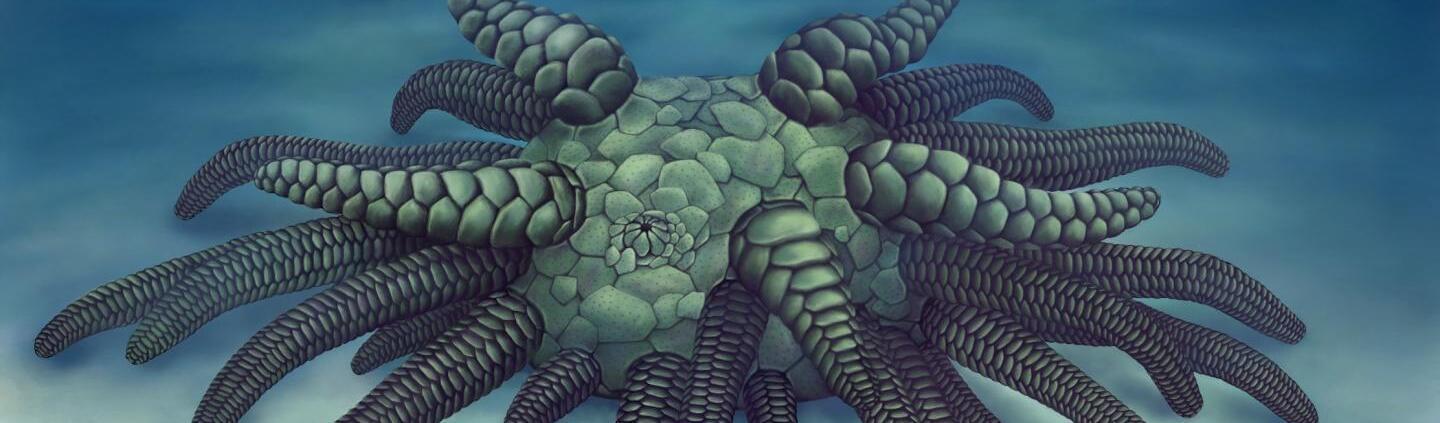
Cover image, a reconstruction of an ophiocistioid:
Rahman IA, Thompson JR, Briggs DEG, Siveter DJ Sutton MD. 2019 A new ophiocistioid with soft-tissue from the Silurian Herefordshire Lagerstätte, and of the holothurian body plan. Proc. R. Soc. B 286:20182792. http://dx.doi.org/10.1098/rspb.2018.2792.
Respect to those who have devoted their entire lives to echinoderm paleontology and has contributed so much on the internet for curious users like us to explore.
