
没看过的先看第一篇吧 cv1205467
读前必看:
这些资料多数来自于历史学者,冷兵器及兵击研究者D. A. Kinsley的著作,他从各种近代文献搜集了数千条英国剑士(顺带一点其他欧洲国家)在欧亚非各地的近身战斗记录。
科普大光头Matt Easton高度认可他的著作,并为其作序,认为这些历史资料可以让我们更深入地理解兵击武术。
注意,时代不同,一个国家的武术氛围兴衰,士兵或者武者的战斗经验可能截然不同,不同的团体和个人也是一样。这些记录的来源也出自五花八门的文献资料,其参考性自行斟酌。
由于D. A. Kinsley搜集的记录多达数千条,所以我每次只能选小部分翻译,作为一个长期系列来做。这些记录收录在他的著作《大英帝国的剑士Swordsmen of the British Empire》《不列颠尼亚剑客Sword Fighter of Britinnia》中,至今他仍然在持续不断地搜集新的记录。
我会在有些条目下发表一些感想,这些感想建立在假设这些叙述属实的情况下。
太平军英国军官 vs 大清满人军官
来自英国商船队军官的一条记录,1853年,他在太平天国起义军的炮艇上服役期间,参与了一次对满人帝国大帆船的攻击。此人以前在中国东北方海岸遭遇船难,他和其他两个幸存者得到了太平起义者的友善帮助。
前太平军军官奥古斯都·F·林德利(中文名伶俐)记录了这件事:“火枪射击,箭矢呼啸,刀砍矛刺激烈来往,在从撞见我们的震惊中恢复过来后,帝国乡勇们不顾一切地想要登上我方船只。尽管我们的船首炮对他们造成了惨重损失,敌人还是远远多于我们。我们必须艰难地战斗才能抵挡他们。这是一场典型的白刃格斗战,几乎每个人都要面对一个或更多袭击者。“不知怎么地,我对上了一名发号施令的满人。他是个高大,强壮的家伙,而且毫无疑问,以中国的训练来说,是个优秀的剑士。两艘船的舷边紧锁在一起,所以我们在较低的一侧战斗,仅仅一英尺半高(0.45米左右),我的对手拿着一把沉重的直刃鞑靼骑兵刀,而我拿着一把更加笨拙的中国造刀剑,若非如此,我可以很快结束这场搏斗,因为我以前有着印度海军最强剑士之一的名声。我的敌人非常强壮,他降下的打击即快又重,但仍然碰不到我。我的刀剑实在是太过粗制滥造且设计笨拙,我甚至没办法迅捷地操控它,以充分利用对手暴露给我的众多空档。”
“这场无结果的战斗持续了一会——在我的沉默中。而满人一直在吼叫着激励自己和他手下的乡勇“Tah!Tah!(打!打!)”而且还对着我大声辱骂“Shar yang quetzo!(杀洋鬼子!)”终于,一名长相野蛮的乡勇来到他的军官旁边,拿着他的竹矛准备钉住我。满人受此鼓励,把我逼得更紧了,让我无法腾出注意力去对付新的攻击者,再过片刻,我肯定会被短矛刺穿。但这时候,我忠实的阿里(他的印度仆从)跳出来支援我。他的血流进眼睛里,我说不清他是不是半瞎了。总之很不幸,他没有攻击那名乡勇,而是把全部注意力放在了满人身上,他的短戟在头顶上挥舞,一下凿进了接近我的满人军官的脑子里,同时,短矛刺穿了他的心脏,那一下本来是刺向我。在乡勇来得及收回武器撤开之前,我的剑尖从他的背后穿出,为阿里报了仇。”
“我估计战斗仅仅再持续了一到两分钟,我们获胜了,完全的胜利。满人帝国的大帆船,船上的每一条灵魂,都被摧毁殆尽。”
(The Log of the Fortuna, 1870.)
【Up感想:不知道到底是那把刀剑真的粗制滥造,还是英国人不习惯中国刀剑的手感和重心。另外这起码是我第三次在记录中看见印度仆从救主了。太平天国战争正是勇营大放异彩的时期,本记录中对乡勇的战斗意志也有较高评价。】
原文:
From the account of a British merchant-marine officer, who served aboard a gunboat of the Taiping insurgents during an attack on an imperial Manchu galley in ca. 1853, after he and two others survived a shipwreck off the northeast coast of China and were befriended by the insurgents, as recorded by Captain Augustus F. Lindley, who was formerly in the Taiping service: “Matchlocks were fired, arrows whistled, spear thrusts and sword cuts were fiercely exchanged; and after recovering from the shock with which we ran into them, the Imperial braves made desperate efforts to board us. In spite of their loss from the discharge of our bow gun, the enemy were still more numerous than ourselves; and we had to fight hard in order to keep them off. It was a regular hand-to-hand combat, nearly every man having one or more assailants. “Somehow, I became engaged with the petty mandarin commanding the enemy. He was a tall, powerful fellow, and no doubt, according to Chinese practice, a good swordsman. The boats were lying locked with their gunnels close together, so that we fought over the low sides, only a foot and a half high. My antagonist was armed with one of the straight and heavy Tartar cavalry swords, whilst I had a still more awkward Chinesemade blade. But for this, I could soon have ended the contest; for I had the reputation of being one of the best swordsmen in the Indian Navy. My enemy was a strong fellow, and rained his blows both quick and heavy; still, he could not touch me; but then my sword was so wretchedly made and clumsy a contrivance that I could not possibly handle it quick enough to take advantage of the many openings he gave me. “This resultless combat had been going on for some time—in silence on my part, though the mandarin kept encouraging himself and his braves by yelling, ‘Tah! tah!’ (Fight! fight!), and abusing me by shouting at me, ‘Shar yang quitzo!’ (Kill the foreign devil!). At length, however, a savage-looking brave stepped to the side of his officer, and bringing down his bamboo spear to the charge, prepared to impale me. The mandarin, encouraged at this, pressed me harder; and I could not give any attention to my new assailant. Another instant, and his spear would have been through me, when the faithful Ali [his Indian servant] came springing to my assistance. He had already received a severe wound on the forehead, and I cannot tell whether or not he was half blinded with the blood flowing into his eyes; but, unfortunately, instead of attacking the brave, he paid all his attention to the mandarin. Whirling aloft the short halberd he carried, he buried the axe-like blade in the brain of my immediate antagonist, but at the same instant was himself run through the heart by the spear thrust intended for me. Before the brave could withdraw his weapon or move from the spot, the point of my sword had passed out at his back; and Ali was avenged.
“I imagine the fight only lasted another moment or two. We were victorious, completely so. The Imperialist galley, with every soul onboard, had been destroyed.” (The Log of the Fortuna, 1870.)
英国骑兵 vs 迈索尔骑兵(印度地区)
L.E.诺兰上尉(第15轻骑兵连【还是团?】)谈到:“马德拉斯(印度城市)军队中有最好的骑手和最富经验的剑客。”在1782-99年的迈索尔(印度地区)战争中。“马背上的战斗就像一场击剑比赛,技艺精湛的剑客总是右侧朝着对手(右侧在剑的保护之下),试图抓到对手薄弱的左侧。这就完全取决于骑术了。迈索尔骑兵中充满了聪明的骑手和一流的剑士,这些拿着锋利武器的骑兵甚至比拿着图瓦刀的锡克人更厉害。他们频繁朝我们的龙骑兵发起单挑,而且通常都会在决斗中占据上风。不过我们的骑兵中有一名军官,他和他的战马都饱经训练,常被认为是他们之中最优秀的。这就是达拉斯少校——后来的托马斯·达拉斯中将,他以骑术,剑术,勇气和对白刃格斗的热爱闻名遐迩,有人目睹他在同一天之内砍倒了三四个迈索尔冠军,一个接一个(“据说他罕有不带着人头回营,这些人头是他胜利的象征,挂在他的马鞍上。”)他用这些大胆的举动彰显自己,必然会在印度留下一个难以磨灭的名字。”
【up感谢:锡克人,迈索尔人等印度地区的骑兵给英国人留下了深刻印象,之后英国人吸收了印度骑兵的训练方法(骑马砍木钉等等)也将英国步兵剑术体系带入印度,两国武术的交叉影响在环尹翻译的序中有提到】
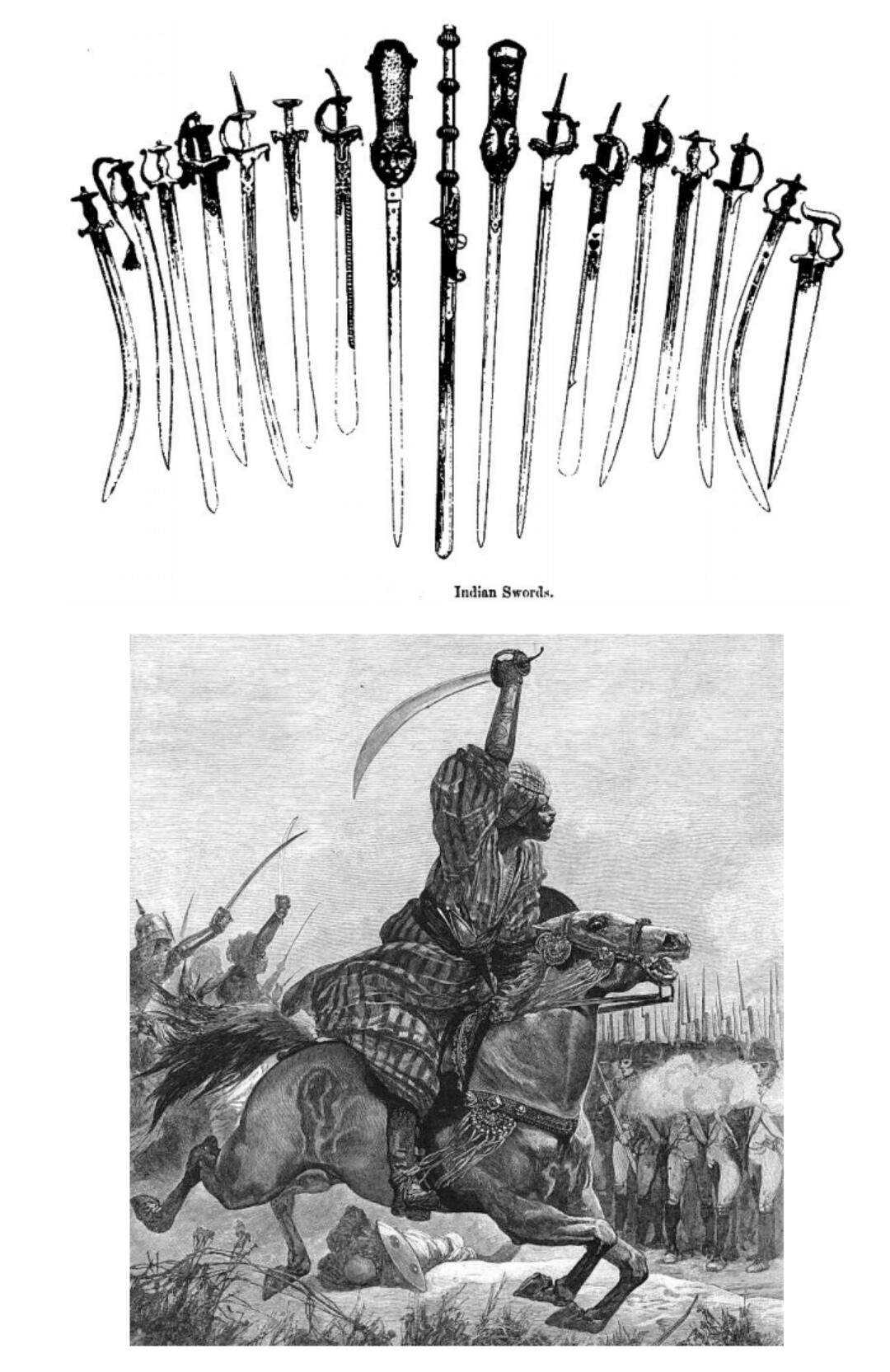
印度刀剑,印度骑兵
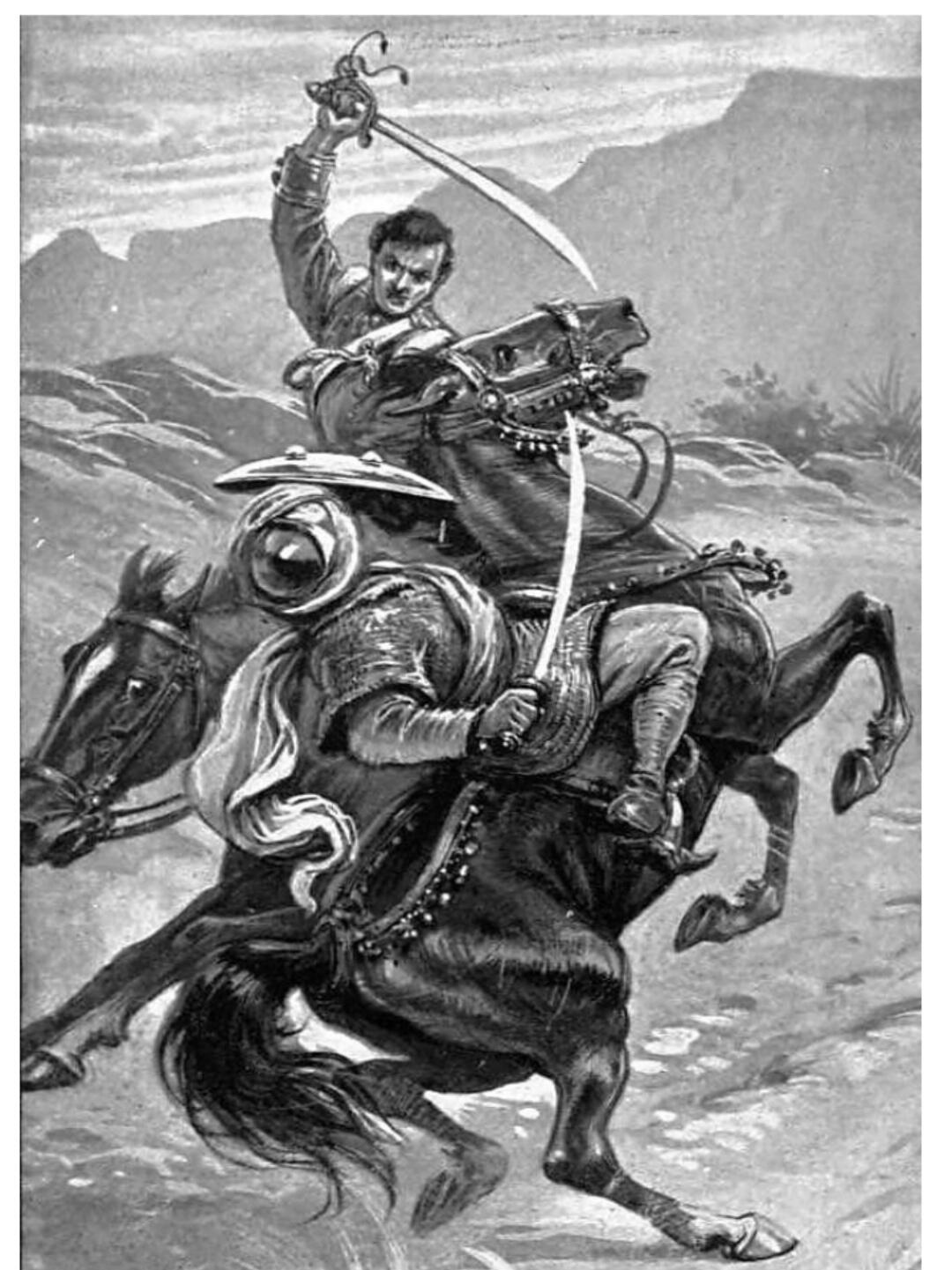
英国骑兵大战印度骑兵
原文:
Capt. L. E. Nolan (15th Hussars) regarding “the best horseman and most experienced swordsman in the Madras Army” during the Mysore Wars, 1782-99: “A fight on horseback is like a fencing match, in which the skilful horseman always presents his right side (which is under cover of his sword) to his adversary, and seeks to gain his weak side, the left one. Here all depends on horsemanship. The Mysorean cavalry abounded in clever horsemen and first-rate swordsmen, who used their sharp weapons even with more effect than that with which the Sikhs have since been found to wield their tulwars. They frequently challenged our dragoons to single combat, and they generally had the advantage over them in the duels. But there was an officer riding with our troopers who had trained himself and his steed, and who could always give a good account of the best of them. This was Major Dallass—afterwards Lieutenant General Sir Thomas Dallas—remarkable for his horsemanship and swordsmanship, for his daring courage, and for his love of hand-to-hand combats. He was sometimes seen to cut down three or four of the Mysorean champions, the one after the other, on the same day. [“It is said that he seldom returned to camp without a human head, the token of his victory, hanging at the saddle bow.” (Asiatic Journal, 1836.)] He signalised himself by many daring feats, and left a name that will be long remembered in India.” (Cavalry, 1853.)
葡萄牙人 vs 日本人(圣母号事件)
1610年1月6日上午,有利的微风使佩索亚能够将他的船移到福田附近的一个小湾,但没有靠得更近。眼看自己的猎物即将逃脱,有马晴信带领一支小船队追击,为首的是一艘巨塔戎克船,由两艘大船绑在一起建造,上面竖立了一座木质攻城塔,和卡拉克船(葡萄牙人的船)的甲板一样高。塔上覆盖着潮湿物质,以对抗葡萄牙人的火攻,并开有能让隐藏其中的500个弓箭手和火枪手射击的开口。在过去的三天里,由于援军的增援,共有全部大约3000名武士,加入了这支船队,并在巨塔船的掩护下尝试接近葡萄牙人。
晚上8,9点左右,船队迫近葡萄牙卡拉克船的船尾,因为船尾只有一门舰炮可以用来抵御敌人的进攻,另一门被带到船首去保护Cable(船缆?),一名日本基督徒领袖带着他的手下冲锋,因为如果没有捕获或摧毁卡拉克船,德川家康会把怒火转向基督徒社区,教会将被摧毁。少数日本人成功登船,但立即被砍倒。(似乎佩索亚自己就杀了两个)或者被迫跳进水里。
葡萄牙人用手榴弹击退了小股进攻,但对已经抓住了尾楼甲板的攻城塔影响不大。目前为止葡萄牙人伤亡很少。只有四五个葡萄牙人和少量非洲人以及东印度水手。而日本人估计死亡数百。然而,在战斗进行了六个小时后,来自巨塔的一发射击打碎了一个葡萄牙人手中的火罐,掉在他脚边的火药上,引发了一场在甲板上迅速蔓延的大火并引燃了后桅上的船帆。佩索亚和他的手下撤退到艏楼甲板,在那里,他们意识到已经没有足够的人手同时扑灭火焰和对抗日本登船者。此时此刻,佩索亚命令点燃船只的弹药库,因为他宁死也不愿投降。正当他的事务长犹豫踌躇的时候,他丢下剑和盾牌,拿起十字架,大声呼唤道:“蒙汝庇佑,我主,因您将让这一切结束!”然后他嘱咐船员们在他去点火的时候各自逃生。之后,圣母号在一连串的爆炸中一分为二,带着货物,船员,登船者一起沉没。日本人杀死了他们看见的所有落水者,但仍有少数幸存者安全地上了岸。
【up感想:翻译自wiki中的圣母号事件Nossa Senhora da Graça incident,资料出自多位历史学家的研究。事件中葡萄牙天主教武士的悍勇决绝给日本人造成了深刻印象,导致此事件到19世纪仍被当地人提及。
事件的起因是日本水手在澳门闹事,并打伤了前去处理的葡萄牙管事。葡萄牙人可能是出于对日本人跋扈的不满或者是对日本势力在澳门滋长的忌惮,派人围杀了全部50名日本水手。佩索亚就是参与这次围杀的重要指挥官。
之后佩索亚航行到日本贸易,恰好事情被捅露,德川家康本就对葡萄牙人的跋扈和天主教势力在日本滋长不满,准备让西班牙人等其他国家取代葡萄牙贸易,因此严令查处。由于葡萄牙人的拒不合作,冲突逐渐升级,最后变成讨伐。(似乎一开始只是让他们交出祸首佩索亚,但回复是“葡萄牙人没有交出他们船长的习惯”)
海上的追击进行了三天,翻译选自最后一天。
那时候日本刚刚经历了战国时期,留下了一堆久经沙场的精兵强将。而经历九死一生远洋探险的葡萄牙人,则一直是狂热的天主教武士,对抗穆斯林的先锋。葡萄牙方仅有80名葡萄牙人和一些非洲人,东印度水手,但占有军事技术优势和更丰富的海战经验。】
Boxer, C. R. (1948). Fidalgos in the Far East, 1550–1770. The Hague: Martinus Nijhoff.
Boxer, C. R. (1951). The Christian Century in Japan: 1549–1650. University of California Press. GGKEY:BPN6N93KBJ7.
Boxer, C. R. (1979) [1st. pub. 1929]. "The affair of the Madre de Deus". In Moscato, Michael. Papers on Portuguese, Dutch, and Jesuit Influences in 16th- and 17th-Century Japan: Writings of Charles Ralph Boxer. Washington, D.C.: University Publications of America. pp. 4–94. ISBN 0890932557.
Boyajian, James (2008). Portuguese trade in Asia under the Habsburgs, 1580–1640. Baltimore, Md. London: Johns Hopkins University Press. ISBN 0801887542.
Curvelo, Alexandra (2003). "Nagasaki/Deshima after the Portuguese in Dutch accounts of the 17th century" (PDF). Bulletin of Portuguese - Japanese Studies. Universidade Nova de Lisboa. 6 (June 2003): 147–157. Retrieved 6 May 2015.
原文:
On the morning of January 6, 1610, a favourable breeze made it possible for Pessoa to move his ship to an inlet near Fukuda, but no further. Seeing that his prey was about to get away, Arima gave chase in a flotilla led by a huge tower-junk. This junk was built by lashing two large boats together, upon which a wooden siege tower as tall as the carrack's deck was erected. The tower was covered with wet hides to protect it against Portuguese fire, and had openings for the 500 archers and musketeers inside to shoot out of. With a total of around 3000 samurai due to reinforcements in the last three days, the flotilla tried to approach the carrack under the cover of the tower-junk.[34]
Between 8 and 9 o'clock at night the flotilla closed in at the carrack's stern, where only one of the two chase guns could be used to fend off the attack since the other had been moved to the prow to protect the ship's cables. A Japanese Christian captain led the charge, rallying his fellow coreligionists with the reasoning that if the carrack was not destroyed or captured, Ieyasu would turn his wrath onto the Christian community and the churches would be destroyed.[4] A few Japanese succeeded in boarding the ship but were promptly cut down (Pessoa himself apparently killed two) or were forced to jump into the water.[1]
The Portuguese were able to fend off the smaller crafts with hand grenades, but they made little effect on the floating tower, which grappled the poop deck.[35] Up to this point the Portuguese casualties had been few, with only four or five Portuguese along with a few Africans and lascars killed,[36] while the Japanese dead were estimated at several hundred.[3] However, six hours into the fighting,[35] a shot from the tower-junk hit a fire pot that a Portuguese soldier was about to throw, smashing it onto the gunpowder at his feet. This started a conflagration that spread through the deck and set the mizzen sail ablaze. Pessoa and his men retreated to the forecastle, where they realized that they did not have enough men to simultaneously fight the fire and the Japanese boarders. At this point Pessoa ordered the ship's magazine to be set on fire since he would rather die than surrender. When the ship's purser hesitated, Pessoa cast away his sword and shield and picked up a crucifix, then he exclaimed: "Blessed be thou, oh Lord, since thou willest that all this should end!" He then told his crew to save themselves as he went down to start the fire himself.[4] The Nossa Senhora da Graça then blew up in two successive explosions, split into two, and sank with cargo, crew, and boarders alike.[3] The Japanese killed all they could see swimming in the water, but a few survivors made it onto the shore to safety. André Pessoa's body, however, was never found
英国私掠船 vs 西班牙私掠船
1824年,一艘美洲私掠纵帆船船在哥伦比亚卡贝洛港服役期间遭到了一艘西班牙私掠双桅船的攻击。诺曼.斯科特,英国第五跨国海军叙述了这件事。在三个半小时的枪炮轰鸣之后,纵帆船瘫痪了西班牙人的双桅船,西班牙人投降了。斯科特和其他七个人上船准备接手财宝,但他们没干多久就收到西班牙上尉的热烈欢迎,至少30个船员从船艏楼跳出来并从各处袭击我们,引发了一场血腥的搏斗,几把手枪同时开火,2名我方船员倒在了甲板边上。船长和奥弗林二副像被超自然力量附体,之后,一通砍劈之后杀死了三个敌人,而船长则更为冷静,更富技巧,以大师级的技理操控着他的剑。同时有四个人奋力想要杀死他,但他还是强行越过他们,对上了西班牙上尉——他呼喊着“Muerte á los piratas!”(杀死海盗!),在这次刺客式袭击中激励他的船员。几次格挡之后,船长将他的剑没入了这个无信的西班牙人心脏里。
我自己战斗得极其决绝,不止一个人在我的奋力反抗下遭受致命伤,这惊到我了,我们居然没在五分钟内被砍成碎片,10分钟过去了,我们死了四个,还剩四个。那一刻 海豚号的大副发现了对手背信弃义的行为,操作纵帆船靠到双桅船边上,以能够抓住她(对方的船)。她的船员装装备着水手刀和船矛,在登船进攻中有三个受到致命伤落入水中,其他人得到了他们指挥官的支持,这是一场能够载入海战史的战斗,持续了一个半小时以上,我们只有16个人,敌人超过我们两倍。短时间内,甲板上因血变得滑腻,堆满死尸和伤员。几乎没有哪张脸不带着可怕的创口,只有少数人敢夸口自己肢体无伤。
我们的队伍迫于数量上的劣势,终于开始考虑怎么撤回纵帆船,我们拼尽全力夺取被西班牙人包围的gangway(舷梯?跳板?),他们守在那里砍杀所有撤退者。我们朝着占有优势的敌人发起了一次大胆的冲击,尽管伤及他们许多人,但第一次尝试仍然失败了。我们有几个人的水手刀因为金属质量太差折断了,于是从垂死敌人紧握的手中拖出他们的刀剑和船矛。一个英国人的小腿严重受伤,已经站不起来了,于是他跪在地上战斗,直到头部吃了军刀的致命一击。英勇的法国大副被船矛刺穿后背(Was run through the back by a pike),他垂死挣扎着想要复仇,这并非徒劳,因为他在倒下时伸直了剑,借着身体的重量将其送入了对手的心脏中,他们失去生命的躯体抱在一起滚倒在甲板上。随着最后一次可怕的努力,我们夺得了舷梯,越过死者的躯体,跳到了纵帆船的甲板上。我们解开将两艘船系一起的船缆,缓慢地顺着下风漂离,我们所有人身上都带着若干皮肉伤,which we bound up in the best manner we could(不知道怎么翻这句。)
(“A Sea-Fight, From the Liverpool Observer,” The Casket, 1829; “The Privateer,” The Portfolio, 1829.)
In 1824, an American privateer schooner (the Dolphin) in the Colombian service and bound for Puerto Cabello (Colombia) was attacked by a Spanish privateer brig; and Norman Scott, the British captain of 15 multinational marines, related what happened when the schooner disabled the brig after 3½ hours of mutual cannonade and musketry, the Spaniards surrendered, and Scott and 7 others boarded “to take possession of the prize”. They no sooner did so, and were cordially received by the Spanish lieutenant, when “a crew of at least thirty men sprang from th0e forecastle and assailed us on every side. A bloody contest ensued. Several pistols were simultaneously fired, and two of our men fell lifeless into the boat alongside. Cutlasses then gleamed on high, and the captain [of the Dolphin] and O’Flinn [the 2nd mate] seemed to be armed with a supernatural strength. The latter laid about him in every direction, and cut down three men in as many blows. The captain, with more of skill and less of fury, wielded his sword with the science of a master; and though four, at one time, strove to destroy him, he forced his way through them; and encountering the [Spanish] lieutenant, who was animating his men in the assassin-like attack by exclaiming “Muerte á los piratas!” [Death to the pirates!], after a few parries he sheathed his sword in the heart of the faithless Spaniard.
“My own exertions were certainly desperate, and more than one received his death wound in endeavouring to deal me mine. It surprises me, to this day, that we were not all cut to pieces in five minutes; and double that time elapsed before our party, of whom four were killed and four only remained, was reinforced. The [1st] mate of the Dolphin, the moment he discovered that treachery was on foot, steered the schooner close alongside the brig, to which she was instantly grappled. Her crew were armed with cutlasses and boarding pikes; and three of them, in boarding, fell overboard with mortal wounds. The rest gained the side of their commander on the quarter deck of the brig; and a conflict, unequalled in the annals of nautical warfare, continued for upwards of half an hour. We were but sixteen in number; the enemy were more than double our number; and in a short time, the decks became slippery with blood and were strewed with the dead and the dying. There was scarcely a countenance without a frightful gash, and few could boast of uninjured limbs.
“Our party, overpowered by numbers, at length thought of effecting a retreat to the schooner. We made a desperate effort to gain the gangway, which was hemmed round by the Spaniards, who strove to cut off all retreat. We made a bold rush against our unequal foes; but though many of them were wounded, we were foiled in our first attempt. The cutlasses of several of our men had snapped, from the badness of the metal, but they armed themselves with the swords and pikes dragged from the stiffened clench of their dying foemen. One of the Englishmen [of the schooner’s multi-national crew] was severely wounded on the shins, and was unable to keep his legs. He fought upon his knees, until he received a death blow on the head from a sabre. The brave French mate was run through the back by a pike. He made a dying effort to be avenged, and not in vain; for, stretching out his sword as he fell, his weight sent it into the heart of his antagonist; and they rolled together lifeless upon the deck. A last fearful effort; and we gained the gangway, over the bodies of the dead, and leaped on board of the schooner. We let go the hawsers that bound us to the brig, and slowly drifted from her to the leeward. We had all received a number of flesh wounds, which we bound up in the best manner we could.” (“A Sea-Fight, From the Liverpool Observer,” The Casket, 1829; “The Privateer,” The Portfolio, 1829.)
