


A04 研究建议 (50%) 4000-5000字小组完成,最终结果需要提交word文档基于同学和老师评价
重要变化:请注意,本学期,我们希望您提交草稿和最终版本作为 Word 文档。根据同行的反馈(通过同行评审)和/或教学团队的反馈,您必须在适当的时候(如果不是立即显示)用这些人的评论来标记您的最终提交,并在最终提交中展示您对反馈采取了什么回应。这一进程与grant funding processes一致,因此具有很强的专业价值。 如果做不到这一点,可能会导致最高 10% 的最终建议标记的罚款。
截止日期
研究问题 第 4 周, 3 月 12日, 2355/1155pm
提案草案 第8周, 4月9日 , 2355/1155pm
草稿的同行审查 第 9 周, 4 月1 日 6, 2355/1155pm
最终提案 第 14 周,5 月 17 日,2355/1155pm
团队评估 第 14 周 ,5 月 21 日,2355/1155pm
概述和莫蒂夫
在学期初,您将被分配到一个由4-6名学生组成的团队,该团队将根据工程研究挑战之一研究一个主题,开发一个研究问题,然后提出进行该研究的建议,以适应下面提出的一个场景。
请注意,课程协调员根据通过 Moodle 访问的调查,有一个团队选择过程。你应该尽快完成这个调查。
另请注意,只有在特殊情况下才会考虑不同初始规模的团队,并且不允许非团队自行工作。如果团队成员在任期内提前退出,则团队可能会合并。团队成员在早期任务完成后丢失可能意味着较小的团队继续他们的工作,而不是扰乱其他团队。这既不能提供帮助,也不能改变,也不能反映现实世界的情况,在这种情况下,有时任务需要由一个比原计划或设想的要小的团队完成。我们已让团队缩减为两名成员,任务仍按时完成。
回到任务本身。。。
研究建议书是本课程的主要评估任务,它结合了特定背景和单个文件中所涵盖的许多想法,以及团队成员的集体经验、兴趣、知识、观点、技能和态度。
继续在其硕士课程中开展研究项目的学生可以将其用作向潜在主管展示建议书的一种方式。 被免除研究项目的学生可以将其用作在行业环境中制定研究建议的实践。无论您关注哪个焦点,文档都必须满足以下要求。
学习成果
完成此任务后,您将拥有:
· 在一些深度和细节上,详细回顾了关于一个工程研究挑战(ERC)的一个方面的文献,并:
· 提出一个研究计划,以回答一个研究问题下的一个ERC主题。
格式
在此期间,您r团队将识别您觉得有趣的学科中的工程研究问题,并计划一个研究项目来研究解决方案。请注意,您可能无法在您特定、个人感兴趣的领域或专业活动中工作,而是在一个至少具有广泛共同利益的团队中工作。
您必须首先为您的研究建议选择两种方案之一:
· 一项在大学进行为期12个月的研究项目的建议,如 硕士 论文项目。"目标受众"是你想要的学术主管(但是,您必须以非专家也能理解您的建议的方式写作)。假设他们有很多学生申请与他们一起做项目,你需要说服他们选择你。
· 一项在工业环境中开展为期12个月的研究项目的建议。目标受众是您的老板(但是,您必须以非专家也能理解您的建议的方式写作)。假设您在一家研发团队中工作的公司,该团队对本年度的项目有一定的预算。你想说服你的老板,你的项目理念应该得到资助,并继续前进。
无论哪种情况,您都希望表明您有一个好主意和一个可靠的计划,即您知道需要做什么,以及您将如何对待研究。在这两种情况下,请记住,这是一个人(也许你!)或一小群人(你的团队)在12个月内进行的一项研究。要回答的问题和建议需要适当限制,以满足这一期望。
你的最后报告将是4000-5000字。请务必酌情包括图片、图表和表格(了解您自己未开发或生成的任何想法、文本、图像或数据的来源)。下面的任何单词限制都仅用作指南,而不是规范性,用于引导您达到总体单词限制的结构。
最终报告结构
研究人员经常需要写申请资金来开展研究项目。一个典型的研究经费申请将包括:一个高级别的介绍,一些工作背景,项目描述和预算。这也是进口蚂蚁解释该项目的预期影响。 您的报告的结构将 与这些申请类似,但无需提供预算或预算理由 (尽管您可能希望提供所需资金水平的一些说明)。 它应该 有以下结构:
标题页
标题页上的信息应包括机构名称、教职员工和课程、评估名称、协作研究组、评估标题、您的姓名和 学生 证号码,以及提交的日期 (确保这是最新的,与您在线提交的日期一致)。
抽象
摘要本质上是一个执行摘要,它简要概述了整个文档。它 不同 于"介绍"。摘要不应包括任何不在体内出现的材料, 不应包括任何数字或表格,也不应包括引用(包括身体中的引用)。您应该用非技术术语简要地解释项目是什么,为什么它很重要,如何处理它,以及可能的结果是什么。它应该只有一两个段落的长度(约300字)。
介绍
简介简要解释了该项目的背景或背景。它阐述了项目如何适应大背景,涉及什么,为什么它很重要,以及成功成果的好处是什么。它应该只有一两段的长度(200-300字)。
文学评论
《文学评论》需要为项目设置较窄的上下文,并详细描述您计划解决的问题的背景。您应该描述问题的各个方面、局限性、限制因素等,并应描述和分析此特定问题(或密切相关的问题,如果您的问题尚未被加法),则应描述和分析之前的任何工作。需要确定以前工作的长处和弱项,你需要"找出"精确的问题,作为解决现有弱点的方法(找出知识或技术的"差距")。in这一节,y ou也应该提供与这个问题相关的实验技术的分析,特别是那些在以前的工作中已经使用的技术。 以差距分析结束您的文献评论。
这部分显然需要仔细 引用 文献。
一个全面的背景应该是大约1,300-1,500字。
意义与创新
本节应约100-150字。
意义——描述研究的重要性以及它如何解决一个重要的问题。描述预期的结果将如何推进学科的知识库。您的项目有哪些深刻而深刻的变革性?你的项目会在你的领域和领域有所作为吗?其他哪些领域会对你正在做的事情感兴趣?
创新——详细说明提案中的目标和概念如何具有新颖性和创新性。详细说明在研究过程中将开发哪些新方法或技术,以及它们将如何推进知识,以及您认为项目具有创新性的方式(如何/为什么),而不是描述创新本身。
建议
研究建议书需要描述一个潜在的研究项目来调查您的问题。你应该首先建议一个潜在的解决方案,你描述的问题在 文学评论。 (注意: 由于 这是推测性的,您实际上不必提供完整的解决方案)。
如果你做了一些分析,以检查解决方案的可行性, 提出这里。
最后,描述您计划如何证明您的解决方案有效有效。这包括描述您将使用哪些实验技术,以及如何分析结果。该提案应在1,200-1,400字左右。
酌情将案文与相关数字和图表、要点、选择性地使用粗体/italic 来突出关键语句。本节中的一些子标题(及相关内容)可能包括方法、方法、概念框架、时间轴、结果传播、National/I国家益处。
结论
包括一个简短的结论,以汇总你的建议的关键点(100字)。
引用
在此处收集您建议的所有部分的来源。将您的来源 与适合您选定的研究领域的研究期刊的风格进行格式化,并在此部分顶部引用该期刊选择。
附录
在提案的最终版本(包括研究问题)中,您至少应该记录您根据收到的草稿版本反馈而做出的更改。
重要变化:请注意,本学期,我们希望您提交草稿和最终版本作为 Word 文档。根据同行的反馈(通过同行评审)和/或教学团队的反馈,您必须在适当的时候(如果不是立即显示)用这些人的评论来标记您的最终提交,并在最终提交中展示您对反馈采取了什么回应。这一进程与grant funding processes一致,因此具有很强的专业价值。 如果做不到这一点,可能会导致最高 10% 的最终建议标记的罚款。
可酌情包括其他附录。使用任何大数字或数据集的附录来中断文本的流。附录不计入单词或页面限制,但不使用附录来垫出您的建议的主体。
建议
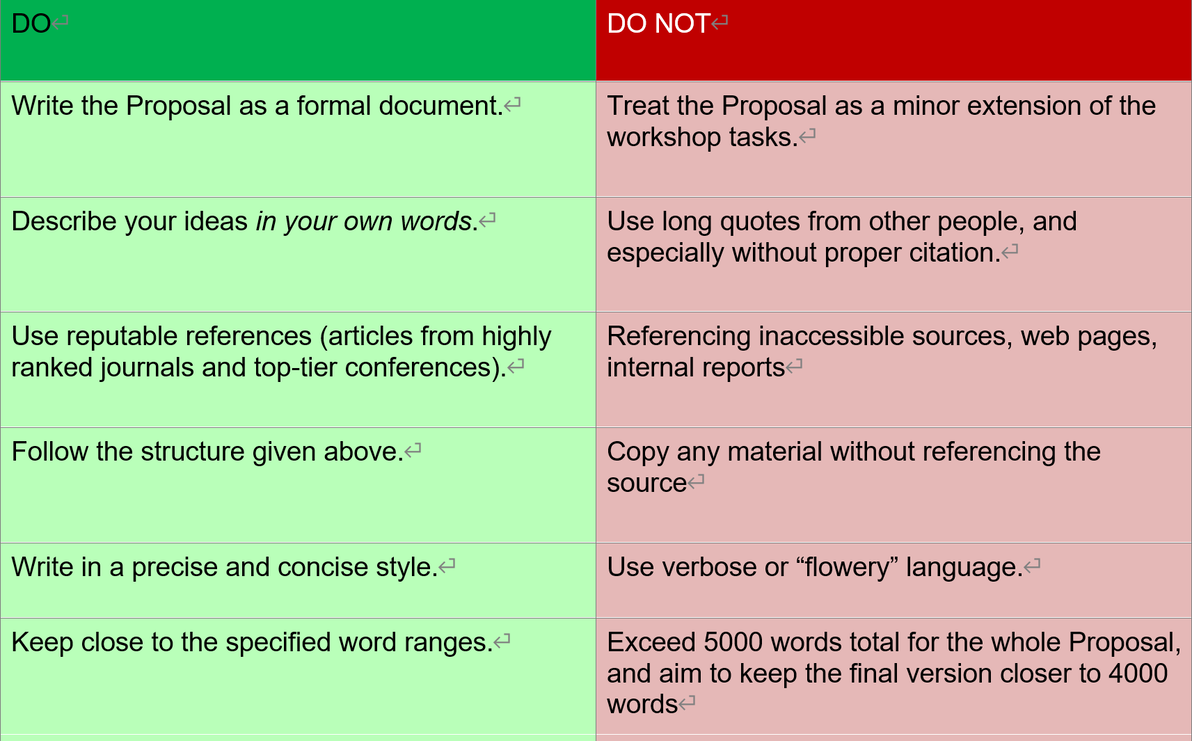
撰写报告时考虑以下准则:
将 提案 写成正式文件。
将该建议视为车间任务的一个小延伸。
用你自己的话来描述你的想法。
使用其他人的长引号,特别是没有适当的引文。
使用 信誉良好的 参考文献(来自 排名靠前的 期刊和顶级会议的文章)。
引用无法访问的来源、网页、内部报告
按照上面给出的结构。
在不引用来源的情况下复制任何材料
以精确简洁的风格书写。
使用冗长或"花"的语言。
靠近指定的单词范围。
整个提案总字数超过 5000 字,旨在使最终版本接近 4000 字
提交
研究问题和研究委员会选择
通过moodle的专用门户网站提交您的团队打算为其开发旨在提供答案的研究建议的问题。您将被要求考虑已经广泛的挑战类别,和具体的,编号的ERC,作为团队组建过程的一部分,你的团队应该已经同意类别和ERC,如果有任何异议。
请记住,您的研究问题不应仅仅通过检索现有数据来回答,而应指出您的项目将(帮助)填补的知识空白。回答研究问题不仅需要你收集一组事实/数据,而且需要开发和测试能够预测或解释现象的理论—— 重新进行研究。
正如上面已经强调的,你的研究问题应该是简洁的,最终产生某种"是/否"的答案,研究的结果可以指向,并足够集中,它是可回答的12个月的研究项目。
提案草案
对于草稿,您至少应该提交您的 P轮值的第一阶段,包括标题、简介、文学评论以及意义和创新,不过如果您的团队取得了良好的进展,您可以提交其他部分。
您需要向三个门户网站提交提案草案副本,
向"重新搜索提案草案,以进行相似性检查(Turnitin)"提交PDF 版本,
向 Moodle上的"研究建议草案提交供同行审查(研讨会)"提交Word版本,
向Moodle 上的"研究建议草案提交 TA 反馈(分配)"活动提交Word版本。
所有提交的截止日期和时间是相同的。
最终提案
对于最终提交,您必须提供上述最终提案中指定的所有部分的最终版本。
在准备最终版本时,您应该考虑您收到的来自教师和同行的意见/建议。如上所述,由 TA 标记的最终版本必须是一个标记版本,显示您如何改进您的工作从草稿到最终。你还可以包括附录(如果您处理了一般性的评论),要求在多个位置进行更改或修改。
您需要向 Moodle 上的"最终研究建议书提交以进行相似性检查(Turnitin)"和"最终研究建议书提交TA 反馈(分配)"提交最终版本的PDF copy。两次提交的截止日期和时间是经过谈判的,但它们将是相同的。
评估标准
重新搜索建议值您最终课程分数的 5 0%。 所有标记都将按照下面包含的标尺执行。标记分布在三个提交如下。
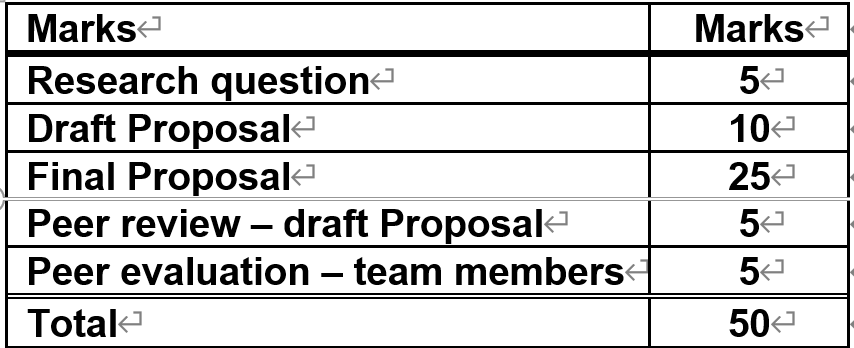
研究问题5
提案草案10
最终 提案25
同行评议–提案草案5
同行评价–团队成员5
总50
在团队中工作
学生将被分配到,(情况允许),必须在一个由4-6名成员组成的团队中工作,与课程学习成果之一保持一致,围绕团队合作。已选择成员的数量来创建一个团队动态,虽然没有太大,物流问题可能会出现,而且,没有创建太多的组(作为一个后勤问题在课程中)。独自工作是完全不能接受的,要求在2人一组或3人一组(2-3)工作,通常是不可接受的,除非在特殊情况下,因为,特别是独奏工作,不符合课程的学习成果要求。团队将由我组成,课程协调员,根据团队成员的特点,从网上调查中提出的问题(细节要单独通知,通过moodle)。调查问题已在教职员工和学生之间协商,目的是建立具有关键相似性和差异的群体。将提供在线设施,以促进您的互动,但您的团队可能需要找到更多富有创意的解决方案,以支持您的团队工作(协作)。作为团队的一员,您将完成对团队成员的n 评估,以及提交最终版本的研究建议书,该评估可能并且确实已用于调整分数以反映学生对团队结果的贡献。所有这些流程都反映了职业世界,组员在团队中有时远程工作,并且对团队项目的努力和结果负责。
计算每次提交的最终标记
1. 初步总分出 100%
· 提案草案的标记将由一名教职员工提供。同行评审期间给出的评论会些许改变老师的分数,但不会用于计算初始分数。我们发现,虽然来自同龄人的评论通常非常有用,但所分配的分数,尤其是新学生,可能过于慷慨,或者异常苛刻,但往往不公平。所以学生评分不计入初始成绩中。
· 教师标记,根据同侪反馈或工作人员之间的适度,将给你一个初步标记出100%。
· 未能完成同行评审作业 会导致丧失分数。
2. 查重
· TurnItIn 将为您的作业生成百分比相似性分数。实现 0% 的相似性不是现实的目标,但是,低于 15% 是合理的预期(不包括 bibliography)。
· 因此,在适当考虑证据后,超过2%(从15%开始计算)会扣相应分数。 请注意,这不是自动的 - 工作人员评估员将对其进行检查,以确定其相似性,以及是否构成剽窃。此外,在严重剽窃的情况下,可立即处以0(0)分,由于这是研究生课程,可能会处以更严重的处罚。继续阅读...
· 例如,如果您的初步分数为 70%,但相似性分数为 20%,则您可能只获得 60%。计算如下:70-2*(20-15)=60%。
· 然而,公然剽窃是不能接受的。如果您提交的提案被发现违反了大学学术行为政策,则可能会受到一系列处罚。你可能被允许并被要求重新编写和重新提交提案,并处以实质性的标记处罚(根据不当行为的程度作出决定)。你可能会被授予0分,而且,我n非常严重的情况下,t他可能有严重影响你的能力,通过课程。事实上,鉴于这是一门研究生课程,剽窃案件可能导致课程本身的失败!大学也会施加进一步和更严厉的处罚。
· 这是非常重要的,因为这是一个团队的任务,你们共同努力,以确保剽窃是避免的,你们每个人,单独考虑你的责任,你的队友。
3. 延迟处罚
· 根据UNSW3+,在压缩的教学期间,及时提交基本上是及时提供反馈,包括来自同行的反馈,特别是学期末,成绩和成绩的最终确定。 因此,提交日期和时间都非常严格地遵守。尽管有迟到的合法理由,但将予以处罚。
· 如果提案提交晚点不到24小时,则为每小时0.5%将被扣除。
· 如果提案迟交超过24小时,除上述处罚外,20%/天将被扣除。
4. 团队成员评价
· 团队的每个成员将完成每个提交的队友的同行评估 - 是否匿名需要讨论。
· 如果有证据表明团队成员未能对团队任务作出充分贡献,则将考虑评论证据以及建议的减分,然后课程协调员将强制适当减少分数。请注意,这个过程被非常严肃地对待;过去有学生收到90%减分(通常为20-50%)。不承担团队任务被认为是一个严重的问题,不仅在本课程中,而且在大学中也是如此,因为UNSW收到有关团队合作的投诉,主要是团队成员获得他们未获得的分数。我宁愿与低分同学打交道, 也不愿与白嫖成员打交道。我亦想指出,虽然团队成员很难作出绝对平等的贡献:在分配工作完成团队任务时,请考虑努力是否公平,而非平等。我也希望,如果团队成员遇到困难,作为研究生的你会尽快纠正这种情况。如果不可能,则必须尽早向课程协调员报告情况,以便纠正这种情况。如果问题继续存在,则将通过最终的团队评估来解决。
· 如果不能完成团队成员 的评估 ,将导致 该任务的分数丢失。
5. 纳入审查反馈
· 虽然不是标准的正式部分(必须制定标准),但助教的反馈强烈地表明,通过更好和明确地整合反馈,可以改进以前群体的最终建议。要推动这一进程,每个团队必须在对提案草案进行同行审查后提供一个 rejoinder反驳。rejoinder回复feedback,您如何处理(或不处理)同行和/或TA 提供的反馈。这通常是一个文档,如dot points或表,说明您是否使用了一条反馈,为什么或为什么不,以及您如何使用它。如上所述,这一次,我们要求对最终提案进行标记提交,显示想法、意见问题以及反馈已纳入最终提案的位置。更多的一般反馈可以包含在文档或表格中,作为附录。
· 通过更好地关注反馈,教学团队感到研究建议书最终版本的质量将得到提升。如果无法清楚地看到反馈是如何接收和处理的,则将扣除分数(最高为 10%)。
研究建议的标记标尺
此评估的各个部分的标记标识标识在以下页面上给出。 请注意,这些是作为标准和标准的指南提供的,可以帮助您制作适当的作品。标记会考虑这些因素并应用它们,但通常以整体和定性反馈的方式标记丰富的评估任务,同时考虑所有标准。 通常 它不是原子性的, 也不是零件的简单标记总和。
研究问题的评分标准
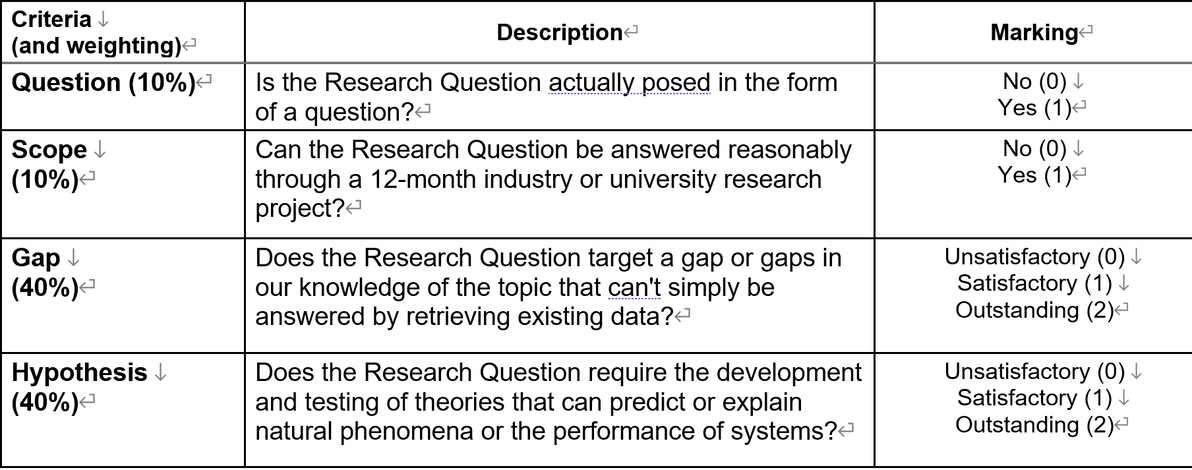
提问
研究问题 是否真的 以问题的形式提出?
否 (0) 是 (1)
范围
Research Question能否通过1200 万的行业或大学研究项目得到合理的回答?
否 (0) 是 (1)
差距 (40%)
研究问题是否针对我们对该主题的了解存在无法简单地通过检索现有数据来回答的空白或差距?
不满意 (0) 满意 (1) 优秀 (2)
假设 (40%)
研究问题是否需要开发和测试能够预测或解释自然现象或系统性能的理论?
不满意 (0)满意(1) 优秀 (2)
草稿评分规则(rubric)
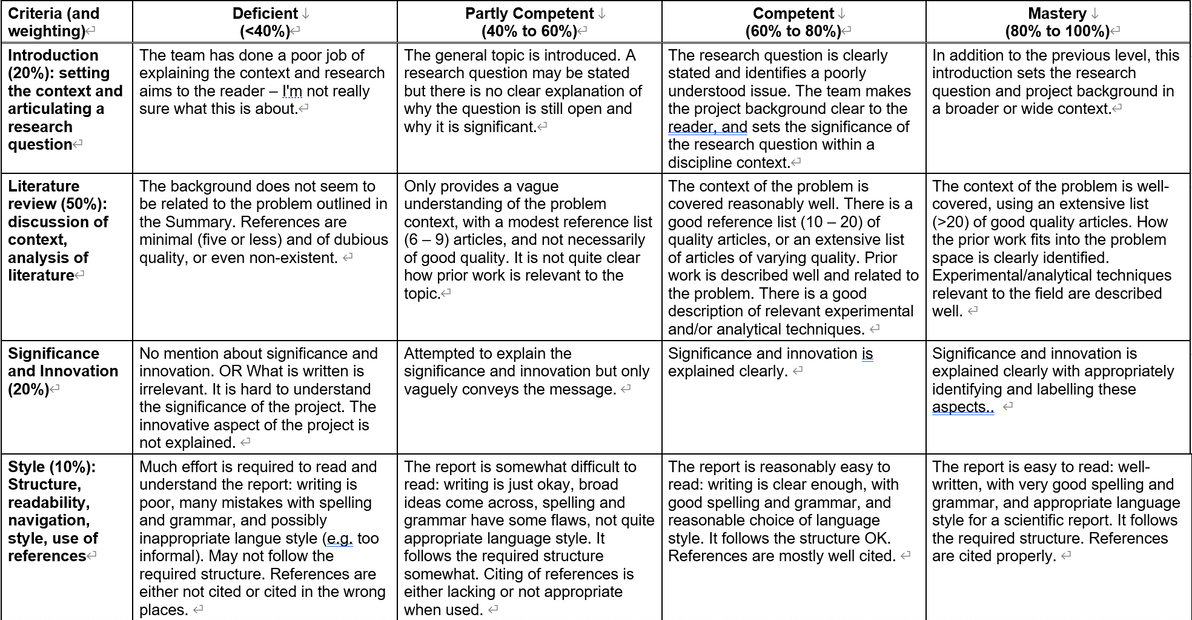
标准 (和权重)
缺陷(<40%)
部分称职(40% 至 60%)
称职 (60%至 80%)
掌握 (80%至 100%)
简介 (20%):设置上下文并 阐明研究问题
团队在向读者解释背景和研究目标方面做得很糟糕——我不太清楚这是怎么回事。
介绍了一般主题。一个研究问题可以说明,但没有明确的解释,为什么这个问题仍然是开放的,为什么它是重要的。
研究问题已明确说明,并确定了一个不为人知的问题。该团队向读者阐明了项目背景,并将研究问题的重要性设定在学科范围内。
除上一级外,本介绍还将研究问题和项目背景置于更广或更广的范围内。
文学研究 (50%):对语境的讨论,对文学的分析
背景似乎与摘要中概述的问题无关。参考是最小的(五 个或更少)和可疑的质量,甚至不存在。
只提供对问题背景的模糊理解,有一个适度的参考列表(6-9)文章,不一定质量好。目前尚不清楚先前的工作与主题的相关性。
这个问题的背景被很好地涵盖了。有一个很好的参考列表(10-20)的质量文章,或各种质量的文章的广泛列表。先前的工作描述良好,与问题相关。对相关的实验和/或分析技术有很好的描述。
问题的背景是良好的海湾红色,使用大量列表(+20)的优质文章。已明确确定先前的工作如何适应问题空间。与该领域相关的实验/分析技术描述得很好。
意义与创新 (20%)
没有提到意义和创新。或者所写的内容无关紧要。很难理解这个项目的意义。项目创新方面没有解释。
试图解释其意义和创新,但只是含糊地传达了信息。
意义和创新被清楚地解释。
意义和创新解释清楚,并适当识别和标记本身 方面。.
风格(10%): 结构, 可读性, 导航, 风格, 参考的使用
阅读和理解报告需要付出很多努力:写作很差,拼写和语法上有很多错误,而且可能不恰当的语言风格(例如太非正式)。不得遵循所需的结构。引用不是在错误的地方引用,就是在错误的地方引用。
报告有些难读:写作只是确定啊,宽广的思路碰到了,拼写和语法有一些缺陷,不太合适的语言风格。它在某种程度上遵循了所需的结构。引用引用不是缺乏,就是使用时不合适。
报告相当容易阅读:写作足够清晰,拼写和语法都很好,语言风格的选择也比较合理。它遵循结构确定。 引用大多引用得很好。
报告易于阅读:写得很好,拼写和语法都非常好,并且语言风格适合科学报告。它遵循所需的结构。引用正确。
最终报告的评分标准
Marking rubric for Final Report
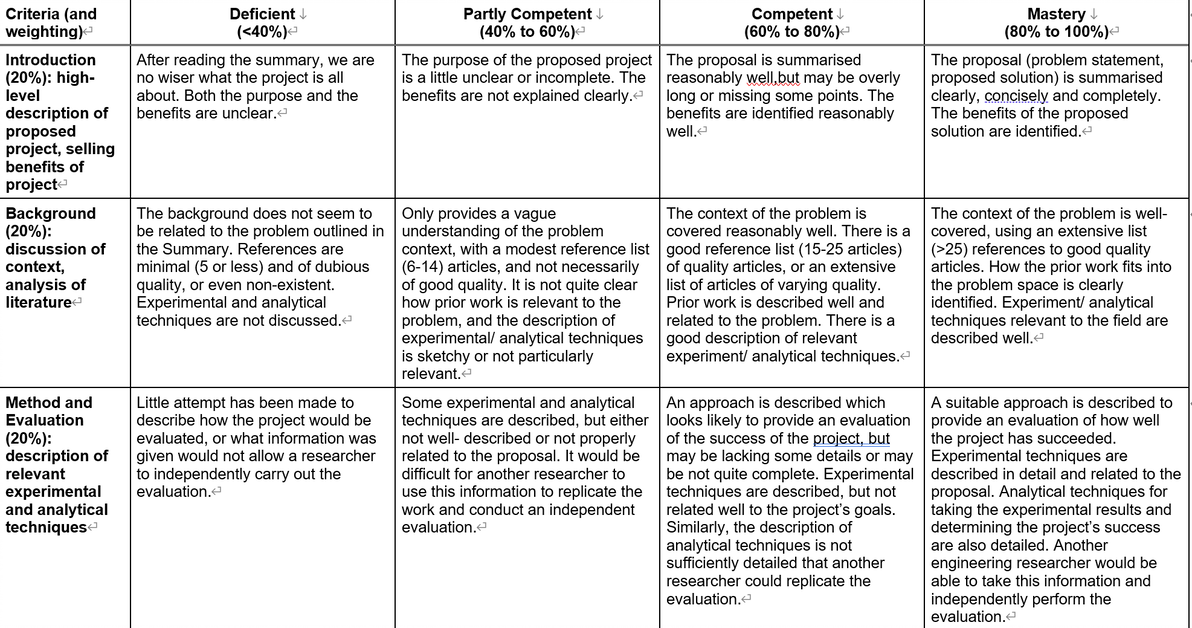
标准 (和权重)
缺陷(<40%)
部分称职(40% 至 60%)
称职 (60%至 80%)
掌握 (80%至 100%)
简介 (20%):拟建项目高层描述,项目销售效益
看完总结后,我们并不明智地了解这个项目的内容。目的和好处都不清楚。
拟议项目的目的有点不清楚或不完整。好处没有解释清楚。
该提案的总结相当好,但可能过 长或缺少一些要点。这些好处被合理地识别出来。
该提案(问题陈述、建议的解决方案)概括清晰、简洁和完整。已确定拟议解决方案的好处。
背景 (20%):讨论背景,分析文学
背景似乎与摘要中概述的问题无关。参考是最小的(5或更少)和可疑的质量,甚至不存在。不讨论实验 和 分析技术。
只提供对问题背景的模糊理解,有适度的参考列表(6-14)文章,不一定质量好。目前尚不清楚先前的工作与这个问题的相关性,对实验/分析技术的描述是粗略的,或者不是特别相关。
这个问题的背景被很好地涵盖了。有一个很好的参考列表(15-25篇文章)的质量文章,或各种质量的文章的广泛列表。先前的工作描述良好,与问题相关。对相关的实验/分析技术有很好的描述。
问题的范围很广,使用大量列表(+25)引用高质量的文章。已明确确定先前的工作如何适应问题空间。与该领域相关的实验/分析技术描述得很好。
方法和评价(20%):相关实验和分析技术的描述
几乎没有试图描述如何评价该项目,或者提供哪些信息不允许研究人员独立进行评价。
描述了一些实验和分析技术,但要么描述不当,要么与提案没有适当关系。另一位研究人员将很难利用这些信息来复制工作并进行独立评估。
描述的方法可能提供对项目成功的评估,但可能缺乏一些细节或可能不太完整。实验技术被描述,但与项目的目标没有很好的关系。同样,分析技术的描述不够详细,以至于另一个研究人员可以复制评估。
描述一种合适的方法,以评估项目的成功程度。详细描述了实验技术,并与提案有关。此外,还详细介绍了获取实验结果和确定项目成功的分析技术。另一位工程研究人员将能够获取这些信息并独立进行评估。
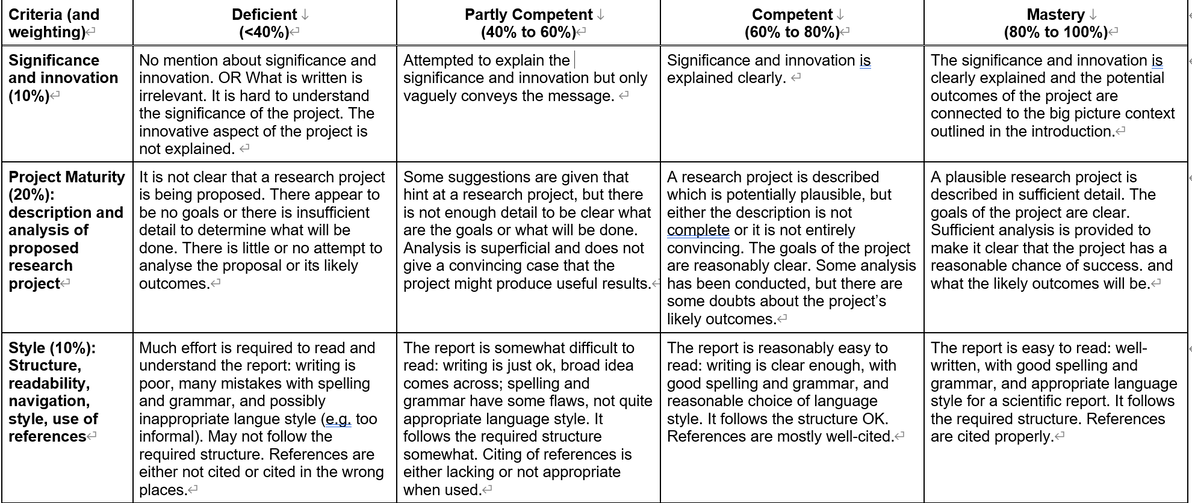
意义与创新 (10%)
没有提到意义和创新。或者所写的内容无关紧要。很难理解这个项目的意义。项目创新方面没有解释。
试图解释其意义和创新,但只是含糊地传达了信息。
意义和创新被清楚地解释。
明确解释了项目的意义和创新,项目的潜在成果与介绍中概述的大局有关。
项目成熟度(20%):对拟议研究项目的描述和分析
目前尚不清楚是否正在提出一个研究项目。似乎没有目标,或者没有足够的细节来确定将要做什么。很少或根本没有试图分析该提案或其可能的结果。
有些建议暗示了一个研究项目,但没有足够的细节来明确目标是什么或将要做什么。分析是肤浅的,没有给出一个令人信服的理由,该项目可能会产生有用的结果。
研究项目被描述为可能合理,但要么描述不完整,要么不完全令人信服。该项目的目标相当明确。已经进行了一些分析,但对该项目的可能结果存在一些疑问。
一个合理的研究项目被描述得足够详细。项目的目标很明确。提供了充分的分析,以表明该项目有合理的成功机会。以及可能的结果是什么。
风格 (10%):结构, 可读性, 导航, 风格, 参考的使用
阅读和理解报告需要付出很多努力:写作很差,拼写和语法上有很多错误,而且可能不恰当的语言风格(例如太非正式)。不得遵循所需的结构。引用不是在错误的地方引用,就是在错误的地方引用。
报告有些难读:写作还行,思路宽泛:拼写和语法有一些缺陷,不太适合的语言风格。它在某种程度上遵循了所需的结构。引用引用不是缺乏,就是使用时不合适。
报告相当容易阅读:写作足够清晰,拼写和语法都很好,语言风格的选择也比较合理。它遵循结构确定。 参考大多引用得很好。
报告易于阅读:写得很好,拼写和语法都很好,并且语言风格适合科学报告。它遵循所需的结构。引用正确。
Conclusion
Include a brief conclusion to draw together the key points of your proposal (100 words).
References
Collect the sources of all sections of your proposal here. Format your sources consistent with the style of a research journal appropriate to your selected area of research and cite that journal choice at the top of this section.
Appendices
In the final version of the Proposal (including the research question) you should, as a minimum, document the changes you made in response to the feedback you received on your draft version.
IMPORTANT CHANGE: Note that, for this Term, we expect you to submit your draft and final versions as Word documents. Based on feedback from your peers (through peer review) and/or feedback from the teaching team, you must mark up your final submission with the comments made by those people, at an appropriate point (if not immediately obvious), and show, in your final submission, how you have acted upon that feedback. This process aligns with grant funding processes, among others, so it has strong professional value. Failure to do this can result in penalty of up to 10% of the Final Proposal mark.
Additional appendices may be included as appropriate. Use appendices for any large figures or data sets that would interrupt the flow of your text. Appendices do not count towards word or page limits, but do not use Appendices to pad out the body of your Proposal.
Submission
Research Question and ERC Selection
Submit, through the dedicated portal in Moodle, the question for which your team intends to develop a research proposal aimed at providing an answer. You will have been asked to consider already the broad category of Challenge, and the specific, numbered ERC, as part of the team formation process and your team should have agreed the category and ERC, if there was any dissent.
Remember that your research question should not be something that can be answered by simply retrieving existing data but rather points to a gap in knowledge that your project will (help) fill. Answering the research question should not just require you to assemble a set of facts/data but require the development and testing of theories that can predict or explain phenomena – research to be conducted.
As highlighted already above, your research question should be concise, ultimately producing some kind of ’yes/no’ answer to which the outcome of research can point, and focused enough that it is answerable in a 12-month research project.
Draft Proposal
For the Draft, you should submit, at least, the first stage of your Proposal, consisting of Title, Introduction, Literature Review, and Significance and Innovation, though if your team makes good progress, you can submit additional sections.
You need to submit a copy of the Draft Proposal to three portals, a PDF version to the “Draft Research Proposal submission for similarity check (Turnitin)”, a Word version to the “Draft Research Proposal submission for peer review (Workshop)” and a Word version to the “Draft Research Proposal submission for TA feedback (Assignment)” activities on Moodle. The closing date and time for all submissions is the same.
Final Proposal
For the final submission, you must provide the definitive version of all sections specified in the Final Proposal structure given above.
While preparing your final version, you should consider the comments/suggestions you received for the Draft, from teachers and peers. As highlighted above, the final version for marking by TAs must be a marked-up version, showing how you have improved your work from draft to final. You can also include an Appendix if you have dealt with more general comments, requiring changes or improvements in multiple places.
You need to submit a PDF copy of the final version of the Research Proposal to both the “Final Research Proposal submission for similarity check (Turnitin)” and “Final Research Proposal submission for TA feedback (Assignment)” activities on Moodle. The closing date and time for both submissions is to be negotiated, but they will be the same.
Working in a team
Students will be assigned to and, as much as possible (circumstances permitting), must work in a team of 4-6 members, aligned with one of the course learning outcomes, around teamwork. The number of members has been chosen to create a team dynamic, while not being so large that logistic problems are likely to arise and also, not creating too many groups (as a logistic issue in the course). Working alone is completely unacceptable, and requesting to working in a pair or trio (2-3), is typically unacceptable except under exceptional circumstances, as this, particularly solo work, does not meet the learning outcome requirements of the course. Teams will be formed by me, the Course Coordinator, based on characteristics of team members derived from questions asked of you in an online survey (details to be advised separately, through Moodle). The survey questions have been negotiated between staff and students, with the aim to create groups that have key similarities and differences. Online facilities will be provided to facilitate your interaction, but your team may need to find further, creative solutions to enable your team work (collaboration). As part of a team, you will complete an evaluation of your team members, along with submission of the final version of the Research Proposal, and that evaluation may, and indeed has been be used to adjust marks to reflect individual student contributions to the team outcome. All of these processes reflect the professional world, seeing people working in teams, at times remotely from one another, and being accountable or responsible for effort and outcomes of a team project.
Calculation of your final mark for each submission
1. Preliminary total mark out of 100%
· The mark for the draft Proposal will be given by a teaching staff member. The marks and comments given during peer review may be used to moderate the staff mark, but they will not be used to calculate the initial mark. We have found that, while comments from peers are typically very useful, the marks assigned, especially when students are new to assessment, can be either overly generous, or unusually harsh, but often unfair. This has led to modification of this aspect of this assessment task, based on consideration of student feedback and our own observations.
· The teacher mark, with any moderation based on peer feedback, or moderation between staff members, will give you a preliminary mark out of 100%.
· Failure to complete your peer review assignments results in a loss of marks.
2. Similarity deductions
· TurnItIn will generate a percentage similarity score for your assignment. It is not a realistic goal to achieve 0% similarity, however, below 15% is a reasonable expectation (excluding the bibliography).
· Therefore, and after due consideration of evidence, 2% may be deducted for each similarity score percentage point exceeding 15%. Note that this is not imposed automatically – it will be checked by your staff assessor to determine the nature of the similarity, and whether it constitutes plagiarism. Further, in significant instances of plagiarism, a mark of 0 (zero) may be imposed immediately, and, as this is a graduate course, more significant penalties may be imposed. Read on…
· For example, if your preliminary mark is 70%, but your similarity score is 20%, you may be awarded only 60%. This is calculated as follows: 70 – 2x (20-15) = 60%.
· However, blatant plagiarism is simply not acceptable. If your submitted proposal is found to be in breach of university academic conduct policy, then a range of penalties may be imposed. You may be allowed and required to rewrite and resubmit the proposal, with a substantial mark penalty imposed (to be decided, based on the extent of the misconduct). You may be awarded zero for the task and, in very severe cases, this could have serious implications for your ability to pass the course. In fact, given this is a graduate course, a blatant and cynical case of plagiarism can result in failure in the course itself! Reporting of such cases can also see the university impose further and more severe penalties.
· It is very important, given that this is a team task, that you work together to ensure plagiarism is avoided, and that each of you, individually, consider your responsibility to your teammates.
3. Late penalties
· Under UNSW3+, with compressed teaching periods, timely submission is essentially for timely provision of feedback, including that from peers, and, especially at the end of term, finalisation of marks and grades. Thus, the submission dates and times are adhered to very strictly. Notwithstanding legitimate reasons for lateness, penalties will be applied.
· If the proposal is submitted less than 24 hours late, 0.5% per hour will be deducted.
· If the proposal is submitted more than 24 hours late, in addition to the penalties above, 20% per day (or partial day) late will be deducted.
4. Team member evaluation
· Each member of the team will complete a peer evaluation of their team mates for each submission – it is to be negotiated as to whether this is anonymous or not.
· If evidence is consistent that a team member has failed to contribute sufficiently to the team task, the commentary evidence will be considered, along with the suggested mark reduction, and the Course Coordinator will then impose an appropriate reduction in marks. Note that this process is taken very seriously; students have received reductions of up to 90% (typically 20-50%). Not taking full responsibility for your role as a team member is considered a serious problem, not just in this course, but also by the university, as UNSW receives complaints about teamwork primarily about team members receiving marks that they have not earned. I would rather deal with team members who have been marked down, than active team members who feel they have worked with ‘freeloaders’. I also wish to note though that it is hard for team members to make absolutely equal contributions; in the assignment ad completion of work in the team task, please consider whether effort has been equitable, rather than equal. I also expect, if there are difficulties with team members, that you, as graduate students, will attempt to rectify the situation as soon as possible. If this is not possible, then the situation must be reported to the Course Coordinator as early as possible, so the situation may be rectified. If the problems continue, then this will be dealt with through the final team evaluation.
· Failure to complete the team member evaluation will result in a loss of marks for that task.
5. Incorporation of review feedback
· While not a formal part of the marking rubric (criteria have to be developed), feedback from Teaching Assistants suggests strongly that Final Proposals from previous cohorts could have been improved by better and explicit integration of feedback. To drive this process, each team must provide a rejoinder following peer review of the Draft Proposal. A rejoinder is a reply to feedback, how you have dealt with (or not) feedback provided by peers and/or TAs. This is typically a document, as dot points or a table, that states whether or not you used a piece of feedback, why or why not, and how you used it. As highlighted above, this time in the course, we require a marked-up submission of the final proposal, showing where ideas, comments questions as feedback have been integrated into the final proposal. More general feedback can be included in a document or table, as an Appendix.
· By driving better focus on feedback, the teaching team feel the quality of the final version of the Research Proposal will be lifted. Marks (up to 10% of the mark awarded) will be deducted if the markers cannot see clearly how feedback has been received and dealt with.
Marking rubrics for the Research Proposal
Marking rubrics for the various parts of this assessment are given on the following pages. Note that these are provided as a guide to criteria and standards that help you produce an appropriate piece of work. Marking takes these to consideration and they are applied, but typically a rich assessment task is marked holistically and with qualitative feedback, while taking all criteria into account. Typically it is not atomistic and not a simple sum of marks for parts.
