
“简单商品生产”的迷思(1)
克里斯多夫·阿瑟
1987年出版的《新帕尔格雷夫经济学大辞典》代表了整个经济学界智慧的结晶。其中有关“卡尔·马克思”的文章是由当时著名的马克思主义理论家欧内斯特·曼德尔所编写的。这部多卷本著作涵盖了大量关于马克思主义的文章,足够单独出版独立的一卷,即1990年出版的《新帕尔格雷夫:马克思经济学》,其中,曼德尔的概述占据了主要的篇幅。在这里,他提到了“马克思所说的‘简单商品生产’——‘einfache Waren-produktion’”[1]。在这篇文章中,这一极富有生命力的马克思学迷思得到了准官方的表述。
曼德尔所遵循着的这一传统有着非常悠久的历史。保罗·斯威齐在他所编写的通行经典教科书《资本主义发展论》中这样写道:“马克思是从分析‘简单商品生产’开始的……”[2](2)(注意引号,但与曼德尔一样,斯威齐并没有指出原文出处。)更早些时候,在三十年代,奥斯卡·兰格在解读马克思的价值理论时说,马克思是从这样一个概念开始的:“马克思将之称为‘einfache Warenproduktion’”[3]。后来的权威,R. L.米克在他1967年出版的《卡尔·马克思的经济学方法》中声称马克思有一个“他称之为‘简单’商品生产”的模型[4](3)。
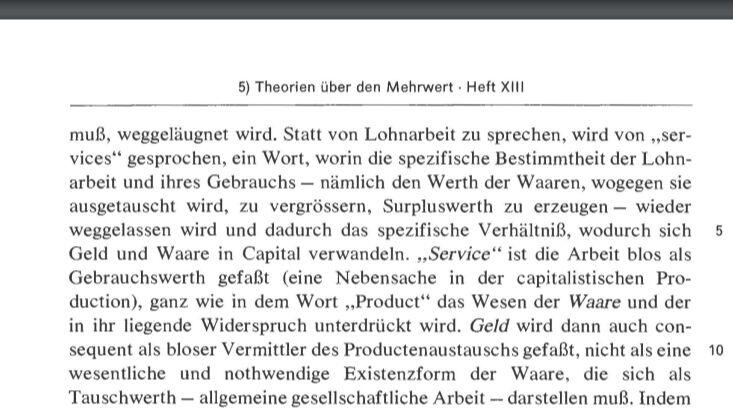
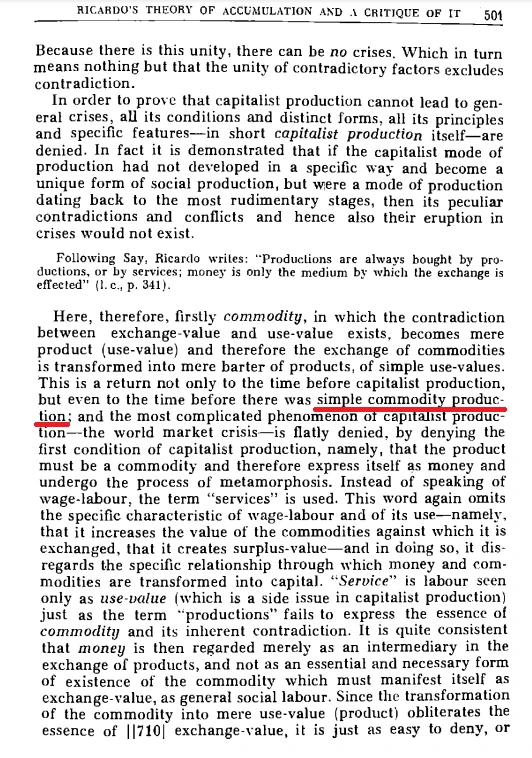
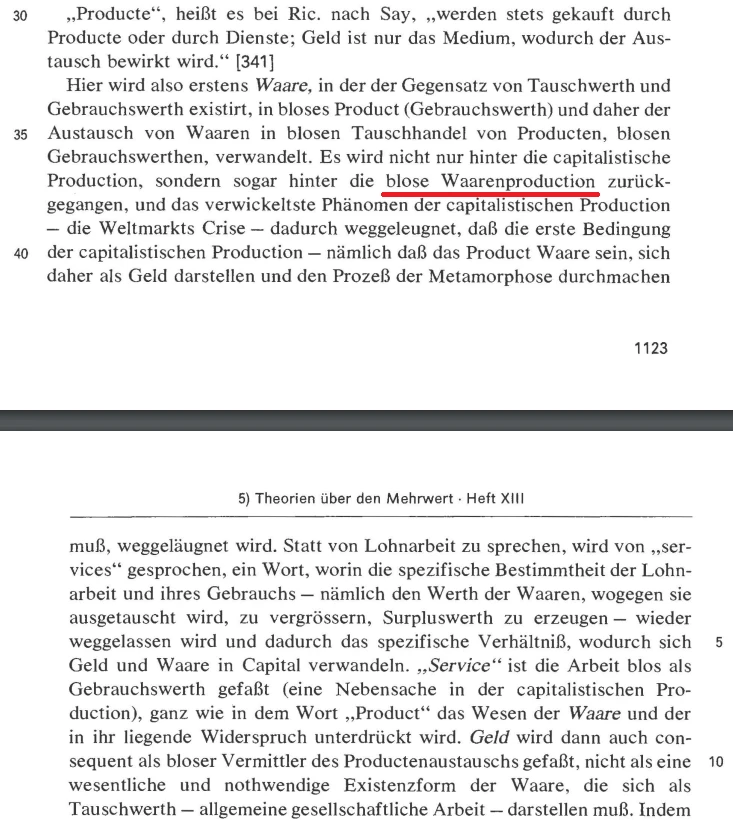
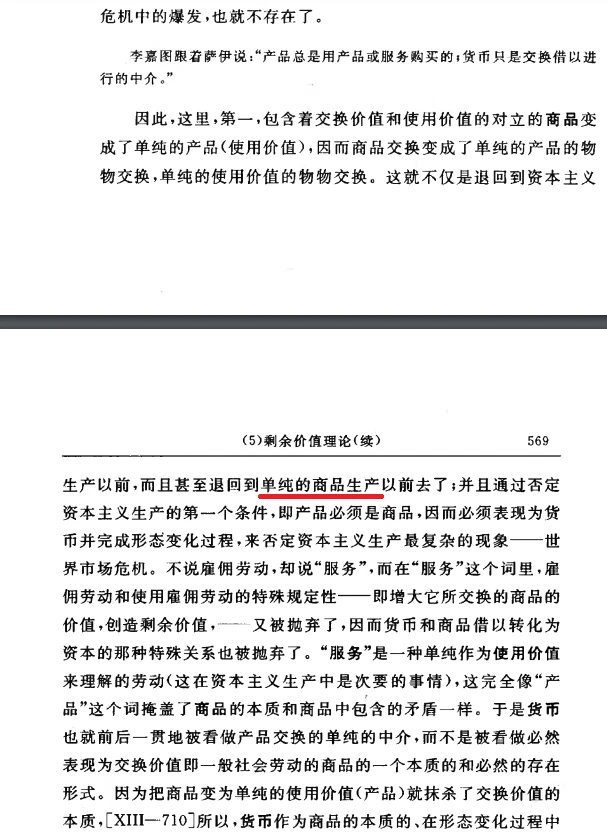
但事实却是马克思从未将任何东西称为‘einfache Warenproduktion’过;这一术语在他的著作中从未出现过。[5]
那么,是谁引入的这一术语呢?这个术语出现在恩格斯所编辑的《资本论》第三卷序言和增补中,并由他插入到马克思的文本中(敏锐的读者可以从那些包含这一术语的段落周围的编辑括号中发现这一点)。
恩格斯在序言中称, “马克思在第一册的开头从被他当做历史前提的简单商品经济出发,然后从这个基础进到资本”:这样做的好处是,他可以“从简单商品出发,而不是从一个概念上和历史上都是派生的形式,即已经在资本主义下变形的商品出发。”[6](4)这实际上是一种误导:马克思从未在《资本论》中使用过“简单商品生产”这一表述。同样,可以肯定的是,他也从未将资本主义生产的商品称为派生形式[7]。马克思当然也没有在“简单商品生产”概念应当得到讨论的地方,即前几章中,叙述这一概念。相反,正如第一卷的第一句话所表明的那样,在前几章中所讨论的简单流通只是资本主义经济的流通。
在整个三卷《资本论》中,术语“简单商品生产”只出现在第三卷中一次,而且还是在恩格斯编辑过的段落中,正如他本人在脚注中所提醒我们的一样[8](5)。现在我们已经有办法将其与原手稿进行核对了,原手稿已在新版Marx-Engels Gesamtausgabe (MEGA)中出版。很显然,整段话都是恩格斯插入的(事实上,下一页关于资本的“历史使命”的一段也是如此)[9]。
在这之后,恩格斯还在文本中插入了“以及商品生产一般”[10](6)。
作为编辑者,将自己的见解强加在原作者的文本上是十分不寻常的。那么,恩格斯为什么要这样做呢?这一原因或许可以在一定程度上得到确定。首先,我们可以注意到,恩格斯的思想主要是历史的。在他对马克思1859年《政治经济学批判》的评论中,他提出了那个后来被称之为“逻辑—历史”的方法(顺便说一句,马克思也从未使用过这一术语)。在他对《资本论》第一批印张的回复中,他提议对价值形式做出一些补充论述,并用历史来证实这些论述。[11](7)(马克思无视了这一建议)。然而,在1883年、1886年和1890年恩格斯编写《资本论》第一卷的序言时,他并没有表明《资本论》的前几章是历史的。在第二卷序言中,他也没有提到过“简单商品生产”。直到1894年,在第三卷序言中,他才在评判所谓的“有奖论文竞赛”的时候提出了这一想法(恩格斯在第二卷序言中发出了一个挑战,邀请学者解决如何在价值规律的基础上形成统一的利润率的问题)。这为我们理解恩格斯为何将自己的见解强加在原文中提供了必要的来龙去脉。
恩格斯之所以引入“简单商品生产”的讨论,是因为马克思在《资本论》第三卷中似乎放弃了价值规律,转而支持了另一种价格决定理论。当然,在马克思的步骤中,价值只不过是形成第三卷的“生产价格”中的一个阶段。但是,如果由于被生产价格所取代,价值失去了其经验表现,那价值不就是纯粹的虚构吗?恩格斯对这种可能性做出了激烈的反应,选择从历史角度解读马克思叙述中的各个阶段,以确保价值可以得到经验上的观察,但是,当然,只能在过去,在资本主义“改变”这些关系之前得到观察。
因此,在康拉德·施米特回应《资本论》第三卷,提出第一卷中所讨论的“价值”只是一种“必要的虚构”时,恩格斯回复道,在“简单商品生产”阶段,价值对于实际目的来说是完全真实的。[12](8)在给施米特回复的前一天,恩格斯也以同样的方式回复威纳尔·桑巴特,称“在交换之初”,“价值……有其直接的、现实的存在”,但由于“资本主义生产形式下的价值……隐藏得很深”,“价值的这种直接存在就停止了”[13](9)。恩格斯对此有着强烈的信念,因此他专门写了一篇关于这一主题的文章,作为《资本论》第三卷第二版的增补。他在这篇文章中竭力消除所有对“这里所涉及的,不仅是纯粹的逻辑过程,而且是历史过程”的质疑。在详细阐述了他的观点以后,恩格斯总结道:“只要经济规律发生作用,马克思的价值规律对于整个简单商品生产时期来说便是普遍适用的,也就是说,直到简单商品生产由于资本主义生产形式的出现而发生变形之前是普遍适用的。”[14](10)
恩格斯确实能够在第三卷手稿中找出一段类似的话,马克思在其中提到了类似于简单商品生产阶段的内容。恩格斯如同抓到了救命稻草,声称:“如果马克思来得及把这个第三册再整理一遍,他毫无疑问会把这段话大大加以发挥。”[15](11)然而,马克思也有可能认为这是一条错误的取径而选择删去它!当然,《资本论》中对前资本主义生产的少量提及,并不意味着马克思在其中有着任何系统性的意图。
恩格斯、斯威齐以及米克,所有人都(错误地)认为《资本论》始于“简单商品生产”,无论他们如何看待这一生产。对于斯威齐来说,“简单商品生产”的优点在于它可以作为逻辑推导的起点,使理论更加清晰,而不是像恩格斯那样,将其视作“修正历史”中的经验现实。米克选择了一个模棱两可的中间立场:他认为“简单商品生产”不是迷思,而是迷思方法论[16](12)。但不论是何种立场,所有认为马克思是从某种“他称之为简单商品生产”的东西起步的观念都是真正的迷思!
一代又一代的学生们在划分出资本主义生产与“简单商品生产”的基础上学习马克思经济学。然而,这种方法来源于恩格斯,而不是马克思。现在,让我们看一下马克思经济学目前最广为流传的通俗读物:本·法因的《马克思的〈资本论〉》。自1975年以来,这本书已经出版了四个版本,并多次重印。直到1989年第三版,依然出现了“马克思将这一情形称为简单商品生产”的描述[17]。直到2003年的第四版,才将其修改为“通常将之称为简单商品生产”[18]。今天通行的《资本论》英文版附带有曼德尔编写的导言,其中写道马克思不能从资本主义生产,即“普遍商品生产”开始,因为从逻辑和历史来讲,它源自于“简单商品生产”[19]。
这一迷思是如何产生的呢?难道从来没有人真的看过马克思是否在第一篇中提到过简单商品生产吗?从表面上来看,如此异乎寻常的学术失败实在难以找到任何解释。真正的解释是,在这一迷思背后还隐藏有另一个更大的迷思:马克思与恩格斯是同一个人!(最有力的证据就是整整50卷的《全集》中从未出现过两人合著的作品。)米克在他的所有著作中绝对是不自觉地将马克思和恩格斯看作是同一个人了。自始至终,当他宣称要给出马克思的观点时,全都不自觉地引用了恩格斯的话。例如:
我仍然觉得,我特别强调马克思的“逻辑的、历史的方法”,这样做是很正确的:的确,如果我觉得我低估了什么的话,那就是马克思的经济学著作被这种方法所指导的程度……马克思把《资本论》中的逻辑过渡(从商品关系本身过渡到这一关系的“经资本主义修改的”形式)看作是历史过渡(从“简单的”商品生产到资本主义的商品生产)的一种镜像……[20](13)
这段话中的“马克思把……看作……”完全是虚构的,因为这段话中引用的所有材料都不是马克思的,而是恩格斯的。
然而,如果说恩格斯理所应当地在序言中认为马克思是从简单商品生产开始的,那么每个人都理所应当地如此认为的起源则可能是卡尔·考茨基的小书《卡尔·马克思的经济学说》[21](14)。这本书出版于1887年,并立即取得了成功,直接售出了5000册[22]。这本书中第一次出现了“简单商品生产”[23]。在最后一章中再次提到了这一术语。毫无疑问,考茨基的解读产生了长远的影响;因为这本书重印了非常多次。但如果认为是考茨基发明了这个词,那就太草率了。恩格斯早在1884年6月26日的信中就要求考茨基注意“简单商品生产”的重要性[24](15)。因此,依然是恩格斯发明的这一术语。
长久以来,标准教科书都重复了恩格斯对这一问题的看法,这足以证明恩格斯作为马克思思想的诠释者所拥有的巨大权威。
可怜的名目索引编写者。既然恩格斯是这样说的,那么《资本论》第一卷的第一篇中肯定存在与简单商品生产有关的内容:但却没有提到它。这并没有阻止Dona Torr胡乱编写名目索引,例如,她在第一卷中给索引“商品生产,简单”标注了不少于20页之多——如果真的找不到原始出处,那就创造原文!这就是基于恩格斯再版版本的1938年版《资本论》。现如今,任何试图进一步深入检索“简单商品生产”术语的人都会发现这样一个奇怪的事实。在Marx-Engels Collected Works中,三卷本《资本论》在第37卷末尾编入了名目索引。而当查阅这一索引时,人们可以发现有一个直接指向了“简单商品生产”,而另一个则与资本主义生产有关。两者都指向第一卷中的部分页码,但对应页码里什么也找不到。相反,前文所提及过的第三卷中出现过三次的术语全都没有在索引中列出。(怎么会有人在这样一个基础上进行研究!)这一谜团的答案是,这个名目索引只不过是将莫斯科之前出版的独立各卷的索引归拢在了一起;一些错误的条目被删除,但没有尝试实现一致性。第二卷和第三卷的索引是苏联外国文书籍出版局编制的。编制第三卷索引的人显然认为“简单商品生产”一词不值一提(这本身就是一个有趣的事实)。1954年出版的第一卷则根本没有名目索引;但当Progress Publishers重新出版三卷本《资本论》时,为第一卷编写了索引;这一次,编者填入了几组虚构的条目。
令人遗憾的是,新版MEGA的第一卷也向“简单商品生产”的迷思让步了。在第一版(1867)中,MEGA列出了‘Warenproduktion – einfache’,并提供了三个页码。但这些页码中都没有出现过‘einfache Warenproduktion’一词,在我看来,也没有出现过与其含义对应的内容。然而,在MEGA给出第三卷的原始手稿时,它并没有在索引中列出这一术语——这是非常正确的。
这里我所解决的是一个严格意义上的文献学问题。这背后隐藏着解释性问题和实质性问题。我认为恩格斯在这两方面都被严重地误导了。然而,任何人都可以在一个或两个方面赞同恩格斯的解读。但在以后,我希望这些支持者不要再讲“马克思所称的简单商品生产”,而是讲“恩格斯所称的简单商品生产”。
我在其他地方也讲过,恩格斯对《资本论》的解读是错误的[25](16)。但是,如果确实如此的话,那为什么这一迷思在如此长的时间里都没有受到过质疑呢?虽然恩格斯的权威在这方面发挥了重要的作用,但《资本论》的读者同样一定也具有某种倾向,才能认为“简单商品生产”的概念是合理的。我有三种想法来解释这一点。
a) 第一代马克思主义者,例如恩格斯和考茨基(他们同样也热衷于达尔文),认为马克思对政治经济学批判作出了独特且有力的贡献,因为他在历史的基础上系统性地区分了生产方式。资本主义是一种在历史上特殊的社会形态。但他们将马克思的这一真知灼见与从历史起源与发展的角度解释事物的方法论原则混为一谈,尽管后者进行了适当的辩证化。这就忽略了这样一种可能性,马克思采用的不是历史辩证法,而是黑格尔逻辑中的那种体系辩证法,从抽象的起源开始按照序列逐渐具体化,来严格地建立概念的逻辑序列。
b) 接下来的几代马克思主义者包含了那些在“经济学”系接受过教育的人,他们吸收了一种不同的方法论,即建立模型。他们在《资本论》中自然地“发现”了几种从“简单商品生产”开始的“模型”。他们将《资本论》看作是一系列越来越复杂、越来越接近现实的模型。
c) 当《资本论》出版时,黑格尔已经被当作是一条“死狗”,以至于没有人能够理解和估计马克思所接受到的微妙影响。《资本论》中那种辩证思想已经不再为人们所熟悉,甚至对于学者们来说也是如此。即使马克思在方法论介绍中适当地提供更多的指引,读者也会发现这些内容非常难以理解。而没有了这些指引,读者们就立即失去了方向。马克思在第一卷第二版跋中提出了比这篇文章所解决了的更多的问题。这表明,马克思本人并不清楚这些问题。体系辩证方法在论证中的“隐蔽性”可能不仅仅是出于通俗化的目的;在某种程度上,马克思本人也没意识到它。任何恢复体系辩证法的尝试都必须重构《资本论》中的论证。
但这部分内容就远远超出了本文所要讨论的范围了。
作者注:
[1] Mandel “Karl Marx”, p.4.
[2] Sweezy Theory of Capitalist Development p. 23.
[3] Lange “Marxian Economics and Modern Economic Theory” in Review of Economic Studies Vol. II 1934-35, p. 195, p. 198. 他在文章的其余部分不断使用着同样的表述。但奇怪的点正在于此:a)他从来不对这一短语进行翻译;因此文章中并未出现过“简单商品生产”的说法;b)这是文中唯一的德文表述;就好像这是马克思所使用的一个独一无二且无法翻译的技术性术语;但它既不是无法翻译的,也不是马克思所使用过的。
[4] Meek, Studies in the Labour Theory of Value, (2nd ed. 1973) Appendix p. 303.
[5] 在英文版中,我们可以在Theories of Surplus Value, Part II, p.501, Marx-Engels Collected Works (MECW) Vol. 32 p.132.中找到这样一个词。但在德文原文中,它是‘blose Waarenproduction’,即单纯的商品生产:Marx “Zur Kritik…” Marx-Engels Gesamtausgabe (MEGA) Abt. II Band. 3.3 p 1123.(见文末附图)
[6] Marx Capital Volume III, Preface by Engels p. 103.
[7] 有这样一段话,马克思以工人占有自己的产品为前提(Marx Capital Volume I, pp. 729-30)(《马克思恩格斯全集》中文第二版第44卷,第673-4页)。但这段话是以假设的方式写的,我在Arthur The New Dialectic and Marx’s “Capital” Chapter 6(克里斯多夫·阿瑟,《新辩证法与马克思的〈资本论〉》,北京师范大学出版社,第六章)中就认为这段话实际上是反事实的。
[8] Marx Capital Volume III, p. 370 and p. 371n.
[9] 将第三卷的两个版本即Marx-Engels Werke, Band 25, pp. 271-73与1863-65手稿MEGA Abt.II Band 4.2 pp. 334-36进行对照后即可发现。
[10] Marx Capital Volume III, p. 965.
[11] Engels letter to Marx of June 16th 1867 in Marx and Engels Selected Correspondence, p.186.
[12] Letter to Schmidt of March 12th 1895; in Marx and Engels Selected Correspondence, p.481-85.
[13] Letter of March 11th 1895; in Marx and Engels Selected Correspondence, p.481.
[14] Marx Capital III, Supplement by Engels pp.1033 & 1037.
[15] Marx Capital III, Supplement by Engels p. 1034; 马克思的完整原文在pp. 277-78.
[16] Meek Studies 2nd ed 1973 Appendix p.304.
[17] Fine Marx’s “Capital”, third edition, p. 11.
[18] Fine Marx’s “Capital” (fourth edition with A. Saad-Filho) p. 22. 这是我一再揭露这一迷思的结果,首先是“Engels as Interpreter of Marx’s Economics”, 1996;然后是“Against the Logical-Historical Method: Dialectical Derivation versus Linear Logic”, 1997(克里斯多夫•阿瑟,《新辩证法与马克思的〈资本论〉》,北京师范大学出版社,第二章).
[19] Marx Capital I, Introduction by Mandel pp. 13-14. “普遍商品生产”这一补充表述也可能是由曼德尔所提出的。
[20] Meek Studies in the Labour Theory of Value, Introduction to the Second Edition, (1973) p. xv.
[21] Paul Hampton提醒我注意考茨基的著作。
[22] 按照Engels in a letter to Sorge of September 16th 1887 in Engels 1887-90, MECW Vol. 48 p. 104所说。
[23] Kautsky Economic Doctrines of Karl Marx, p. 19-20.
[24] Marx and Engels Selected Correspondence, p. 377.
[25] Arthur The New Dialectic and Marx’s “Capital” chapter 2.
译者注:
(1) “迷思”一词对应的原文为‘myth’,具有两种含义:1)神话传说;2)流行但错误的观念。本文取后一个含义,台湾地区通常将采用后一种含义时的‘myth’音译为“迷思”,本文采用这种译法。
(2) 保罗·斯威齐,《资本主义发展论》,商务印书馆,1997年版,第40页。
(3) 由商务印书馆翻译出版的《劳动价值学说的研究》中译本是根据英文第一版翻译的,并没有这部分内容。
(4) 《马克思恩格斯全集》中文第二版第46卷,第17页。
(5) 《马克思恩格斯全集》中文第二版第46卷,第290页及第292页脚注37。
(6) 《马克思恩格斯全集》中文第二版第46卷,第936页。无论是第一版还是第二版中译本,都没有与‘and commodity production in general’中的‘in general’对应的内容;这似乎是英文版的问题,德文版中对应的部分为‘und selbst der Waarenproduktion’,其中应当是‘selbst’被翻译为了‘in general’,但‘selbst’在此处的含义应为“甚至”而非“本身”,翻译为‘in general’是毫无道理的。但结合这一句话中恩格斯将资本主义生产与商品生产并列的表述,这一翻译问题并不影响本文的论证。
(7) 《马克思恩格斯全集》中文第一版第31卷A,第308页。
(8) 《马克思恩格斯全集》中文第一版第39卷A,第408-9页。
(9) 《马克思恩格斯全集》中文第一版第39卷A,第406页。
(10) 《马克思恩格斯全集》中文第二版第46卷,第1013页和第1018页。
(11) 《马克思恩格斯全集》中文第二版第46卷,第1015页。马克思的完整原文在第197-8页。
(12) ‘mythodology’是米克将‘myth’与‘methodology’两词合成得到的,即迷思方法论,按照阿瑟对此词的理解,这一单词意指“虽然迷思是错误且虚构的,但它作为一种方法论来说是有效的,有助于理解的,因此是可以接受的”。同样的,这一单词出现在《劳动价值学说的研究》英文第二版中,目前的中译本中并不存在这部分内容,见译者注(3)。
(13) 米克,《劳动价值学说的研究》,商务印书馆,2014年版,第20页。
(14) 又称为《资本论导读》,中译本由戴季陶翻译。
(15) 《马克思恩格斯全集》中文第一版第36卷,第169页。
(16) 克里斯多夫·阿瑟,《新辩证法与马克思的〈资本论〉》,北京师范大学出版社,第二章。
参考文献
Arthur, Christopher J. ‘Engels as Interpreter of Marx’s Economics’ in Engels Today: A Centenary Appreciation edited by C. J. Arthur (Basingstoke: Macmillan Press) 1996.
Arthur, Christopher J. ‘Against the Logical-Historical Method: Dialectical Derivation versus Linear Logic’ in New Investigations of Marx’s Method edited by F. Moseley and M. Campbell (New Jersey: Humanities Press) 1997.
Arthur, Christopher J. The New Dialectic and Marx’s ‘Capital’ ( Leiden: Brill) 2002.
Engels, Frederick Letters 1887-90, Marx, Karl and Frederick Engels Collected Works Volume 48, (London: Lawrence & Wishart) 2001.
Fine, Ben Marx’s ‘Capital’, third edition, (Basingstoke: Macmillan Education) 1989.
Fine, Ben (with A. Saad-Filho) Marx’s ‘Capital’, fourth edition, (London: Pluto Press) 2003.
Kautsky, Karl Economic Doctrines of Karl Marx, English trans. H. J. Stenning, (London: A. & C. Black Ltd) 1936.
Lange, Oskar ‘Marxian Economics and Modern Economic Theory’ in Review of Economic Studies Vol. II 1934-35.
Mandel, Ernest ‘Karl Marx’ in The New Palgrave: Marxian Economics, edited by J. Eatwell et al, (Basingstoke: Macmillan) 1990.
Marx, Karl Capital Volume I, trans. B. Fowkes, (Harmondsworth: Penguin) 1976.
Marx, Karl Capital Volume III, trans. D. Fernbach, (Harmondsworth: Penguin) 1981.
Marx, Karl Capital Volume I in Marx, Karl and Frederick Engels Collected Works Volume 35, (London: Lawrence & Wishart) 1996.
Marx, Karl Capital Volume III in Marx, Karl and Frederick Engels Collected Works Volume 37, (London: Lawrence & Wishart) 1998.
Marx, Karl Das Kapital: Dritter Band, Karl Marx und Friedrich Engels Werke, Band 25, (Berlin: Dietz Verlag) 1964.
Marx, Karl Das Kapital. Drittes Buch. Die Gestaltungen des Gesamtprozesses, in Karl Marx und Friedrich Engels Gesamtausgabe (MEGA) Abteilung II, Band 4.2 (Berlin: Dietz Verlag) 1992.
Marx, Karl Das Kapital Erster Band 1867: Karl Marx und Friedrich Engels Gesamtausgabe (MEGA), Abteilung II Band 5, (Berlin: Dietz-Verlag) 1983 .
Marx, Karl ‘Economic Manuscript of 1861-63’: Marx, Karl and Frederick Engels Collected Works Volume 32, (London: Lawrence & Wishart) 1989.
Marx, Karl Theories of Surplus Value Part II (London: Lawrence & Wishart) 1969.
Marx, Karl Zur Kritik der politischen Ökonomie (Ms. 1861-63), Karl Marx und Friedrich Engels Gesamtausgabe (MEGA), Abteilung II Band 3.3, (Berlin: Dietz-Verlag) 1978.
Marx, Karl and Frederick Engels Selected Correspondence, (Moscow: Progress) 1965.
Meek, Ronald L. Studies in the Labour Theory of Value, 2nd ed. (London: Lawrence & Wishart) 1973.
Sweezy, Paul M. The Theory of Capitalist Development, [1942] (New York: Monthly Review Press) 1970.
THE MYTH OF ‘SIMPLE COMMODITY PRODUCTION’
The New Palgrave: A Dictionary of Economics of 1987 represented the distilled wisdom of the economics profession. The article on ‘Karl Marx’ was written by the leading Marxist theorist of the day, Ernest Mandel. This multi-volume work included enough articles on Marxism to enable a separate volume on it to be extracted and published, The New Palgrave: Marxian Economics, 1990, in which Mandel’s overview had pride of place. He referred to ‘what Marx calls “simple commodity production” – “einfache Waren-produktion”.’[note]Mandel “Karl Marx”, p.4.[/note] In this, quasi-official expression was given to the most enduring myth of Marxology.
For Mandel was following a very long tradition. Paul Sweezy in his much-used classic textbook The Theory of Capitalist Development stated ‘Marx begins by analysing “simple commodity production”…’[note]Sweezy Theory of Capitalist Development p. 23.[/note] (Notice the quotation marks, but, as with Mandel, unsupported by any actual reference.) Earlier, in the thirties, Oskar Lange, in explaining Marx’s theory of value, said Marx starts with such a notion: ‘Marx calls it “einfache Warenproduktion”.’[note]Lange “Marxian Economics and Modern Economic Theory” in Review of Economic Studies Vol. II 1934-35, p. 195, p. 198. He continually uses the same expression in the rest of the article. But there is something strange about it: a) he never translates the phrase; so the words “simple commodity production” do not appear; b) this is the only German expression in the article; as if it were a peculiarly untranslatable technical term of Marx’s; but it isn’t untranslatable, and it isn’t Marx’s.[/note] A later authority, R. L. Meek, in his 1967 essay on ‘Karl Marx’s Economic Method’ alleged Marx had a model ‘he called “simple” commodity production’[note]Meek, Studies in the Labour Theory of Value, (2nd ed. 1973) Appendix p. 303.[/note].
But the simple truth is that Marx never called anything ‘einfache Warenproduktion’; the term cannot be found in his writings.[note]In English we find one reference to it in Theories of Surplus Value, Part II, p.501, Marx-Engels Collected Works (MECW) Vol. 32 p.132. But in the German original it is “blose Waarenproduction”, ie. pure commodity production: Marx “Zur Kritik…” Marx-Engels Gesamtausgabe (MEGA) Abt. II Band. 3.3 p 1123.[/note]
Who, then, introduced it? The term occurs in Engels’s Preface and Supplement to his edition of Capital Volume III, and it was interpolated by him into the text itself (as keen-eyed readers can deduce from the editorial brackets surrounding the passage containing it).
In his Preface Engels claimed that at the beginning of Volume I of Capital ‘Marx takes simple commodity production as his historical presupposition, only later, proceeding on this basis, to come on to capital’: the advantage of this was that he could proceed ‘from the simple commodity and not from a conceptually and historically secondary form, the commodity as already modified by capitalism’.[note]Marx Capital Volume III, Preface by Engels p. 103.[/note] This is in fact a misreading: Marx never used the expression ‘simple commodity production’ in Capital. Likewise, it is certain he never referred to the capitalistically produced commodity as a secondary derivative form.[note]There is a passage in which Marx presupposes the worker owned his own product (Marx Capital Volume I, pp. 729-30). But that passage is written in hypothetical mode. I argue it is counter-factual in character in Arthur The New Dialectic and Marx’s “Capital” Chapter 6.[/note] Marx certainly does not develop the idea of ‘simple commodity production’ at the point where it was supposed to be under discussion, namely the first few chapters. Rather, as the first sentence of Volume I makes clear, the simple circulation discussed in the first few chapters is that of the capitalist economy.
The only occurrence of the term ‘simple commodity production’ in the whole three volumes of Capital occurs in Volume III, but this is in a passage given to us subsequent to Engels’s editorial work, as he himself warns us in a note.[note]Marx Capital Volume III, p. 370 and p. 371n.[/note] It is now possible to check this against the manuscript itself, which has been published in the new Marx-Engels Gesamtausgabe (MEGA). It is clear that the entire paragraph was inserted by Engels (as, indeed, was the one on the next page about capital’s ‘historical mission’).[note]Compare the version of Volume III in Marx-Engels Werke, Band 25, pp. 271-73, with the 1863-65 manuscript of it in MEGA Abt.II Band 4.2 pp. 334-36.[/note]
Later in the text Engels also inserted the phrase ‘and commodity production in general’.[note]Marx Capital Volume III, p. 965.[/note]
It is not very usual for an editor to impose his own reading on the text. Why, then, did Engels do it? The reason can be established with some precision. However, first let us note that Engels’s cast of mind was primarily historical. In his review of Marx’s 1859 Contribution to the Critique of Political Economy he put forward what came to be known as the ‘logical-historical’ method (another term Marx never used, by the way). When he responded to the first proofs of Capital, he reacted to the proposal to add a special appendix on the value-form by urging that this take the shape of a proof from history.[note]Engels letter to Marx of June 16th 1867 in Marx and Engels Selected Correspondence, p.186.[/note] (Marx ignored this advice.) However, when Engels came to write Prefaces to Capital I in 1883, 1886, and 1890 he did not suggest that the first part was historical. Nor did he refer to ‘simple commodity production’ in his Preface to Volume II. It was only in 1894 in the Preface to Volume III that he came up with the idea in the context of judging what has been called ‘the prize-essay competition’ (in which people had been challenged by Engels, in his Preface to Volume II, to solve the problem of generating a uniform rate of profit on the basis of the law of value). This gives us the requisite context for understanding Engels’s intervention.
Engels became involved in the discussion of ‘simple commodity production’ because it seemed that in the third volume of Capital Marx abandoned the law of value in favour of another principle of price determination. Of course, in Marx’s procedure values are a stage in the process of generating the Volume III ‘prices of production’. But, if such values are not empirically present because they are superseded by these prices of production, are they not merely fictitious? Engels reacted to this possibility by interpreting the stages of Marx’s presentation historically in order to ensure that the values were indeed empirically visible, but, of course, in the past, before capitalism ‘modified’ the relationships involved.
Thus, when in response to Capital Volume III Conrad Schmidt put forward the thesis that the ‘value’ discussed in Volume I is a ‘necessary fiction’, Engels wrote to him arguing that value is real enough for practical purposes at the stage of ‘simple commodity production’.[note]Letter to Schmidt of March 12th 1895; in Marx and Engels Selected Correspondence, p.481-85.[/note] The day before writing to Schmidt, Engels had written to Werner Sombart in much the same vein, arguing that ‘value had a direct and real existence’ at the time ‘when commodity exchange began’, but ‘this direct realisation of value … no longer happens’, for ‘the value of the capitalist mode of production … is so thoroughly hidden’.[note]Letter of March 11th 1895; in Marx and Engels Selected Correspondence, p.481.[/note] So strongly did Engels feel about this that he wrote a special paper on the subject, which was placed as a Supplement to the second edition of Capital Volume III. He was there concerned to dispel any doubt that ‘what is involved is not just a logical process but a historical one’. After developing the point at length, he concluded that ‘Marx’s law of value applies universally, as much as any economic laws do apply, for the entire period of simple commodity production, i.e. up to the time at which this undergoes a modification by the onset of the capitalist form of production.’[note]Marx Capital III, Supplement by Engels pp.1033 & 1037.[/note]
It is true that Engels was able to cite a passage from the manuscript of the third volume in which something like the content of the idea of a stage of simple commodity production was mentioned by Marx. Seizing enthusiastically on this, Engels claimed that ‘if Marx had been able to go through the third volume again, he would undoubtedly have elaborated this passage significantly’[note]Marx Capital III, Supplement by Engels p. 1034; the full passage from Marx is on pp. 277-78.[/note]: however, it is just as possible he would have decided it was a false trail and eliminated it! Certainly, odd references in Capital to pre-capitalist production are not used with any systematic intent.
Engels, Sweezy, and Meek, all (wrongly) believed Capital starts with ‘simple commodity production’, however they characterised its status. For Sweezy the virtue of ‘simple commodity production’ was its theoretical clarity as the starting point for a logical derivation, not its supposed empirical reality as part of a ‘corrected history’ as it was for Engels. Meek went for an ambiguous middle position: ‘simple commodity production’ was not a myth he argued but mythodology.[note]Meek Studies 2nd ed 1973 Appendix p.304.[/note] But the belief Marx began with something ‘he called simple commodity production’ is the real myth!
Generations of students have been taught Marxist economics on the basis of a distinction between capitalist production and ‘simple commodity production’. Yet this approach descends from Engels, not Marx. To turn to the present, let us look at the most widely read popularisation of Marx’s economics: Ben Fine’s Marx’s ‘Capital’. This has been through four editions since 1975 and has been reprinted many times. As late as the third edition of 1989 there still occurs the flat statement ‘Marx called such a situation simple commodity production.’[note]Fine Marx’s “Capital”, third edition, p. 11.[/note] Only in the fourth edition of 2003 is this modified to ‘often termed simple commodity production’.[note]Fine Marx’s “Capital” (fourth edition with A. Saad-Filho) p. 22. This was a result of publications of mine exposing the myth, starting first with “Engels as Interpreter of Marx’s Economics”, 1996; and then again with “Against the Logical-Historical Method: Dialectical Derivation versus Linear Logic”, 1997.[/note] The most commonly used English edition of Capital today has an Introduction by Mandel which says that Marx could not start with capitalist production, i.e. ‘generalised commodity production’, because this springs, logically and historically, from ‘simple commodity production’.[note]Marx Capital I, Introduction by Mandel pp. 13-14. Possibly Mandel originated the complementary expression “generalised commodity production”.[/note]
How did it happen no one ever actually looked to see if Marx said Part 1 was about simple commodity production? On the face of it there seems no ready explanation for such an extraordinary failure of scholarship. The explanation is that behind this myth lies another: that Marx and Engels were the same person! (the greatest testimony to which is the absurdity of the Collected Works of 50 volumes devoted to two authors who hardly ever published joint works). Meek, in all his work, was absolutely unselfconscious about treating Marx and Engels as one person. Throughout, he quoted freely from Engels when purporting to give Marx’s views. For example:
‘I still think I was right in laying special emphasis on Marx’s “logical-historical method”: indeed, if anything I think I underestimated the extent to which Marx’s economic work was guided by it…. Marx’s logical transition in Capital (from the commodity relation as such to the “capitalistically modified” form of this relation) is presented by him as the “mirror-image” of a historical transition (from “simple” to “capitalist” commodity production)…’.[note]Meek Studies in the Labour Theory of Value, Introduction to the Second Edition, (1973) p. xv.[/note]
The ‘by him’ in this remark is simply false, because all the quoted material in this passage is not from Marx but from Engels.
However, if Engels in his Preface took it for granted everyone knew Marx started with simple commodity production this may have been because of Karl Kautsky’s little book Economic Doctrines of Karl Marx.[note]Paul Hampton drew my attention to Kautsky’s work.[/note] This appeared in 1887, and was an immediate success selling 5000 copies straightaway.[note]According to Engels in a letter to Sorge of September 16th 1887 in Engels 1887-90, MECW Vol. 48 p. 104.[/note] In this, “simple commodity production” is mentioned in the first chapter.[note]Kautsky Economic Doctrines of Karl Marx, p. 19-20.[/note] There are also references to it throughout the last chapter. Undoubtedly Kautsky’s interpretation had a continuing influence; for the book was reissued many times. But it would be hasty to assume that Kautsky invented the term. Engels drew Kautsky’s attention to the importance of ‘simple commodity production’ as early as a letter of June 26th 1884.[note]Marx and Engels Selected Correspondence, p. 377.[/note] So priority lies with Engels.
It is evidence of the enormous authority of Engels, as interpreter of Marx’s meaning, that the standard textbooks for so long repeated his view of the matter.
Now, pity the situation of the ‘orthodox’ indexer. Since Engels said so, it must be true that Part 1 of Capital I deals with simple commodity production: but there is no mention of it! This did not prevent Dona Torr, for example, indexing no less than twenty pages of Volume I under the head ‘Commodity Production, Simple’ —if there are no references invent fictitious ones! This was in a 1938 edition of Capital based on a reissue of Engels’s edition. Anyone today who attempts to follow up my remarks about ‘simple commodity production’ themselves will discover a very strange fact. In the Marx-Engels Collected Works the three volumes of Capital are indexed together at the end of volume 37. When consulting this index one finds that there is one reference to ‘simple commodity production’ directly and another in relation to capitalist production. Both of these are to pages of Volume I, but nothing of the kind appears there. By contrast, the three occurrences of the term in Volume III, mentioned above, are not listed. (How can anyone conduct research on this basis!) The solution to this mystery is that this index has been compiled simply by zipping together the existing indexes of the separate volumes previously put out by Moscow; a few false entries have been deleted, but no attempt has been made to achieve concordance. The indexes to Volumes II and III were compiled in the fifties for the Foreign Languages Publishing House. The person who compiled the index for Volume III evidently thought the term ‘simple commodity production’ not worthy of mention (an interesting fact in itself). Volume I, published in 1954, did not have a subject index at all; but when the three volumes were brought out again by Progress Publishers Volume I was supplied with an index later; this time the person responsible put in a couple of fictitious entries.
It is to be regretted that the indexes of the new MEGA editions of Volume One also make concessions to the myth of ‘simple commodity production’. For the first edition (1867), MEGA lists ‘Warenproduktion – einfache’ and gives three page references. But on none of these pages does the term ‘einfache Warenproduktion’ appear, and in my opinion nothing corresponding to its meaning appears either. However when MEGA gives the original manuscript of Volume Three it does not list the term in its index – very rightly.
Here I have dealt with a strictly philological issue. Behind that lie interpretative issues, and substantive ones. I believe in both Engels is seriously misguided. However, it is open to anyone to support Engels’s reading in one or both respects. But in future I hope such people will not refer to ‘what Marx called simple commodity production’, but to ‘what Engels called simple commodity production’.
I have argued elsewhere that Engels’s reading of Capital is wrong-headed.[note]Arthur The New Dialectic and Marx’s “Capital” chapter 2.[/note] But, if so, how did it happen that the myth went unchallenged? While the authority of Engels was important in this, there must have been a predisposition present in readers of Capital to find the concept of ‘simple commodity production’ congenial. There are three considerations I offer to explain this.
a) The first generation of Marxists, such as Engels and Kautsky (who were also enthusiastic about Darwin), believed that Marx made a uniquely powerful contribution to the critique of political economy insofar as he systematically differentiated between modes of production on a historical basis. Capitalism was a historically specific social formation. They confused this genuine insight of Marx’s with a methodological imperative to explain things in terms of historical origins and development, albeit suitably dialecticised. What this missed was the possibility that Marx intended a rigorously logical ordering of concepts, employing not a historical dialectic but a systematic dialectic of the kind found in Hegel’s logic, wherewith an abstract beginning is sequentially concretised.
b) The following generations of Marxists included those educated in ‘Economics’ departments, who absorbed a different methodology, namely modelling. They naturally ‘found’ in Capital a number of such ‘models’, beginning with ‘simple commodity production’. They read the book as a sequence of more and more complex models, approximating more and more to the real object.
c) By the time Capital appeared Hegel was a ‘dead dog’ to such an extent that nobody was in a position to understand and assess Marx’s somewhat nuanced acknowledgement of his influence. Dialectical thought of the kind found in Capital was no longer familiar, even to scholars. Even if Marx had provided more guidance in a suitably didactic methodological introduction, readers would have found it difficult to fathom. Without it, they were lost. The Afterword Marx put in the second edition of Volume I certainly raises more problems than it solves. This suggests to me that Marx was not himself clear about the issues. The ‘hiddenness’ of the systematic dialectical method in the argument itself may not merely be in the interest of popularisation; to some extent it must have been hidden from Marx himself. Any attempt to recover it may well require some reconstruction of the argument.
But that takes us well beyond the simple point I am making in this article.
