

[胡-8-Language in Use] and [戴-6-Pragmatics]
【名词解释】——「Language in Use/Pragmatics」is the study of meaning in the context of language use[共识]. Then we can say “pragmatics=meaning-semantics”.
I.e. “You are a fool”, I know the structure and the meaning of sentence. But I don’t know why she got angry. And I want to use “What do you mean?” as a answer to express my dissatisfaction.
关键词&意义、语境、微观语言学!
【名词解释】——「Context」&语用学的基本概念
It is general considered as constituted by the knowledge shared by the speaker and the hearer, including the knowledge of the language they use, and the knowledge about the world, the knowledge about the specific situation in which linguistic communication is taking place, etc.
(a). Relation between <Pragmatics> and <Semantics>.
Semantic——the study of the literal meaning of a sentence(without taking context into consideration).
Pragmatics——the study of intended meaning of a speaker(entailing context).
本质在于whether the context of use is considered.
一旦加入<Context>, <Semantics> will spill over into <Pragmatics>.
(b).延伸出The distinction of <Sentence Meaning> and <Utterance Meaning>.
前者是抽象的、脱离语境的;
后者是具体的、依赖语境的;
Girlfriend: “My bag is heavy”, 字面意思和实际意思相独立,可相统一。
你问她重不重,她如实回答,意思相统一。
你让她再抱一个大西瓜,她就说包重,即给出原因表示拒绝。
她主动说包重,她只是想你背她的包。
对照(a). if we think of a sentence as what people actually utter in the course of communication, it becomes an utterance.
「Speech Act Theory=言语行为理论」
起初,Austin把话语分为两类<Performatives施为话语> and <Constatives叙事话语>.
前者&去实施行为、不可证
后者&陈述与描述、可判断真假
&「Performative Function」is primarily to change the social status of person.
As in marriage ceremonies, the sentencing of criminals, the blessing of children, the naming of a ship at a launching ceremony, and the cursing of enemies. The kind of language employed in performative verbal acts is usually quite formal and even ritualized.
For example, in Chinese when someone breaks a bowl or a plate, the present host are likely to say “sui sui ping an” as a means of controlling the invisible forces which the believers feel might affect their lives adversely.
<施为句>体现<施为功能>,其动词为<施为动词>.

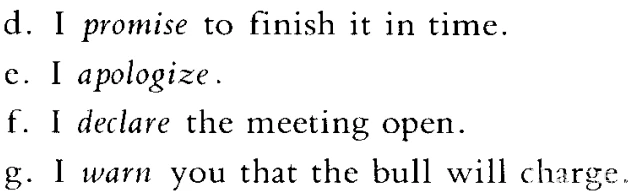
<叙事句>,见字如面,顾名思义!
加个补丁吧,限制限制,不是所有口嗨的<施为>都是正宗的<施为>. 不然随便来一句“我要上太空”不现实。
奥斯丁说了施为句合适的条件:
A. (i) There must be a relevant conventional procedure, and
(ii) the relevant participants and circumstances must be appropriate.
B. The procedure must be executed (i) correctly and (ii) completely.
C. Very often, (i) the relevant people must have the requisite thoughts, feeling and intentions, and (ii) must follow it up with actions as specified.
[口诀]——规约程序、人与环境合适、正确全面执行、必要的思想感受和意图、后续明确规定行为,句句不离must, 该relevant就relevant.
[杂谈]——有些时候,强迫症挺累的,为什么呢?自己品吧!
此话一出,迅速引起世界各地广泛关注,“你确定世界上就这两种句子”,麦克阿瑟表示:“这坑太多了,补丁补不上去”,干脆直接不予评价!
[胡]大师一语道破,<施为句>和<叙事句>的区别很难维持!
再后来,奥斯丁弱化<叙事>和<行事>的区别,而着重<行事>,也是「Speech Act Theory」「Illocutionary Act Theory」的核心。
A speaker might be performing three acts simultaneously when speaking: <Locutionary Act>, <Illocutionary Act> and <Perlocutionary Act>.
「Locutionary Act言内行为/发话行为」is the act of uttering words, phrases, clauses. It is the act of conveying literal meaning by means of syntax, lexicon and phonology.
I.e. “You have left the door wide open”. 传达字面意思!
「Illocutionary Act言外之意/行事行为」is the act of expressing speaker’s intention, and the way we intend hearer to be understand, and it have illocutionary force to make someone to do something depending on the context.
I.e. “You have left the door wide open”表达说话者的意图,表达抱怨,想让听话人关门,具体需要根据语境而定。
「Perlocutionary Act言后行为/取效行为」is the act performed by or resulting from saying something; it is the consequence or change brought about by the utterance.
取效结果可积极亦可消极,
如果听话人抓住说话人的信息,明白了要关门,并且他关门了,那么言后行为就成功地执行了。
有些话 “morning!” 你想要表示友好,重归于好。但对方觉得虚伪,一句问候反而关系更加恶化,这就是不符合预期的结果。
简单理解为三部曲,【说出→想让怎么→实际怎么】,听懂掌声!
然后,「Speech Act」——An utterance as a functional unit in communication, have two kinds of meaning, <Locutionary Meaning> and <Illocutionary Meaning>.
<Locutionary Meaning> is the basic literal meaning of the utterance which is conveyed by particular words and structures.
<Illocutionary Meaning>自己推导!
Searle接手后,又补充了几句,他把言语行为分为五类
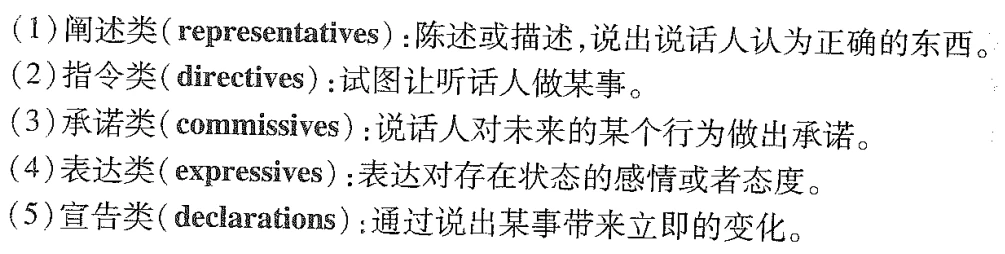
Representatives: stating or describing, saying what the speaker believes to be true.
&陈述、假设
“Je ne le voyais pas.”
“Le Terre tourne autour du Soleil.”
Directives: trying to get the hearer to do something.
&邀请、建议、警告、命令
“Je veux que tu viennes avec nous.”
“Your money or you life!”
Commissives&承诺、担保、发誓
“Je lui promets que je viendrai.”
“Je te apporterai ce livre sans échec”
承诺类就是说话人对未来行为做出承诺的言外行为—目的论。
Expressives&感谢、道歉、祝福
“I’am sorry for the mess I have made.”
表达类的言外之意就是表达话语中特定的心理状态。
Declaration&“Three, two, one, Fire!” “Engage!”
宣告类言后行为的成功执行会带来所述和现实的一致—结果导向。
Searle对接了文学与文化,引出了「Indirect Speech Acts」, 就是说一些话不直截了当,还拐弯抹角,但又有同<直接言语行为>的同等效力。
Searle认为陈述句叙事,祈使句指导他人行为,疑问句搜罗信息。
如果疑问句没有用来搜罗信息,不符合就是间接引语。
“Can you lend me your lecture notes?” it is indirect language.
“The kitchen is in an awful mess”, it is not used to simply state a fact, but to make a request, so the speaker is using language indirectly.
然后拆解了<间接语言>又给了<The Primary Speech Act>与<The secondary Speech Act>, 前者是交际目的,后者是达到这个目的要用到的手段。
A: “Let’s go to the cinema tonight.”
B: “I have to study for an exam.”
请根据Searle的间接言语理论,作答一下!
答:1.根据Searle的理论,B没有正面回答而是间接语言行为。
2.当说话人用间接语言时,他同时使用两种语言行为<The Primary Speech Act>和<The Secondary Speech Act>, the former is the speaker’s goal of communication while the later is the means by which he achieves his goal.
3. With the primary speech act, B’s performance with his utterance is the act of rejecting A’s invitation.
And with the secondary speech act, he performance is the act of making a statement about the fact that he has to study for an exam.
4. [具体问题具体分析] 显然,B不能陪着看电影。
例题赏析一
甲:“上车请买票”
乙:“三天天安门”
甲:“您拿好”
请根据语言行为理论分析。
1.先标答<Locutionary Act><Illocutionary Act><Perlocutionary Act>.
2.我其实很想讲明白,但【天马行空】【天花乱坠】了,主观能动性太大了。
围绕着买票、拿票进站的这件事情,
言内行为就是“Please buy a ticket for admission”.
言外之意就是“Please give me your ticket, and you can enter Tian An Men”.
言后行为就是买好了票,可以进去了,然后售票员说:“您拿好”。
例题赏析二
Customer: Waiter! There’s a fly in my soup.
Waiter: Don’t worry, there no extra charge.
请根据语言理论分析。
1.标答该理论,仨名词解释
2.顾客的言外之意是很生气于汤里有苍蝇,影响就餐。或者请求换餐,或赔礼道歉。
服务员就接受到了言外之意,就免掉了消费作为补偿。
2’ 顾客的言外之意是很生气于汤里有苍蝇,影响就餐。
顾客的取效行为是想让服务员换一碗汤,或赔礼道歉。
服务员的言外之意是“我们餐厅失责,确实存在问题,知道错了,很抱歉”
言后行为是免除小费。
通过例题一二,为什么我说【天马行空】【天花乱坠】,言内行为、言外之意、言后行为三者可针对单个言语,或整体发言!
【具体问题具体分析】【怎么好答怎么灵活答】!
例题赏析三
If you ask somebody “Can you open the door?” and he answers “Yes.” But does not actually do it, what would be your reaction? Why? Try to explain it in the light of Speech Act Theory.
看懂意思,即兴发挥!
你说让对方关门,可能不知道是哪个门呐,对方也不说。
也可能没用礼貌语,试试“Thank, please!”
如何对接<言语行为理论>呢?
你先默写下来,干掉一半考生再说。然后,怎么对接呢?你再把你的话分析分析,再干掉一半考生。
至于怎么对接呢?放过自己,不对接了。
我感觉对接<会话含义理论>关联<含糊歧义><礼貌>影响对方理解,还好一些。
小结——理论是外壳,先贴脸开大,默写后,自行发挥!
