

撰稿:Yifan Xiao, MD; Justin Ling, MD; Evan Debevec-McKenney; Sean Watts;
审稿:Rishi Desai, MD;
翻译:五月|修饰:吕安澜
Osmosis.org/learn/Skin_anatomy_and_physiology
Skins
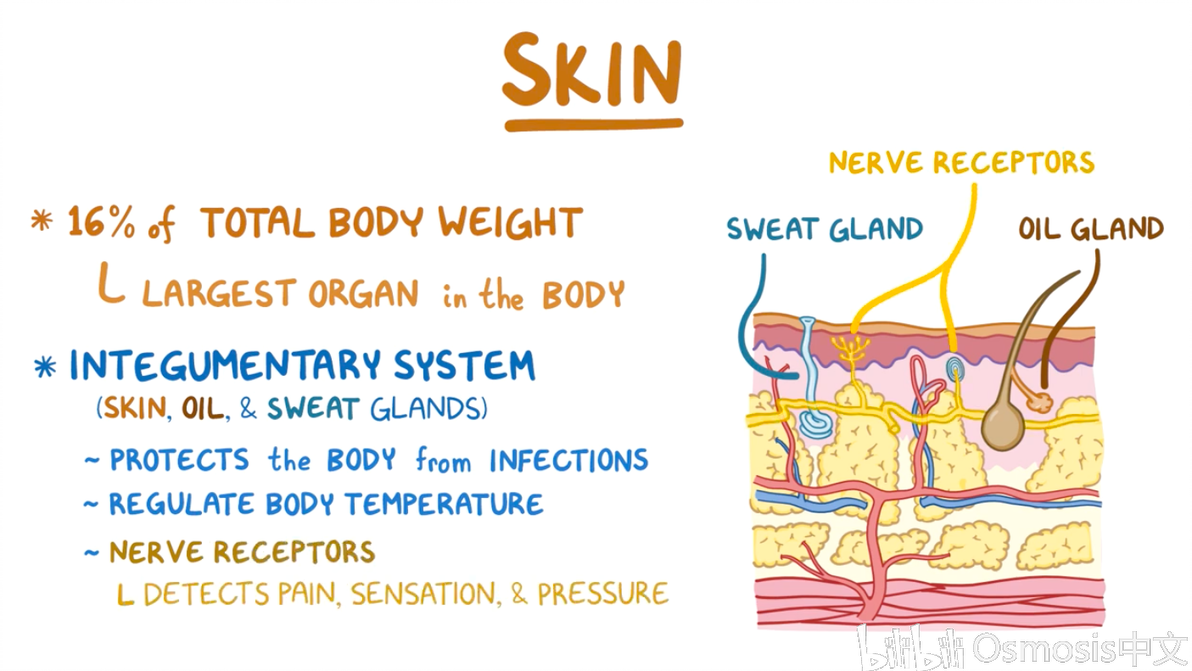
皮肤 是人体最大的器官,约占体重的16% ;尽管很难想象它是一个独立的器官。
The skin makes up around 16% of total body weight, making it the largest organ in the body - although it's hard to imagine it as a single organ.
皮肤及其附属结构(如 油脂 & 汗腺)构成了整个表皮系统。表皮系统保护身体免受感染,帮助调节体温,并有痛觉、感觉和压觉的神经感受器。
The skin along with its accessory structures - like oil and sweat glands - makes up the integumentary system. The integumentary system protects the body from infections, helps regulate body temperature, and contains nerve receptors that detect pain, sensation, and pressure.
皮肤分为3层|Layering
Layers
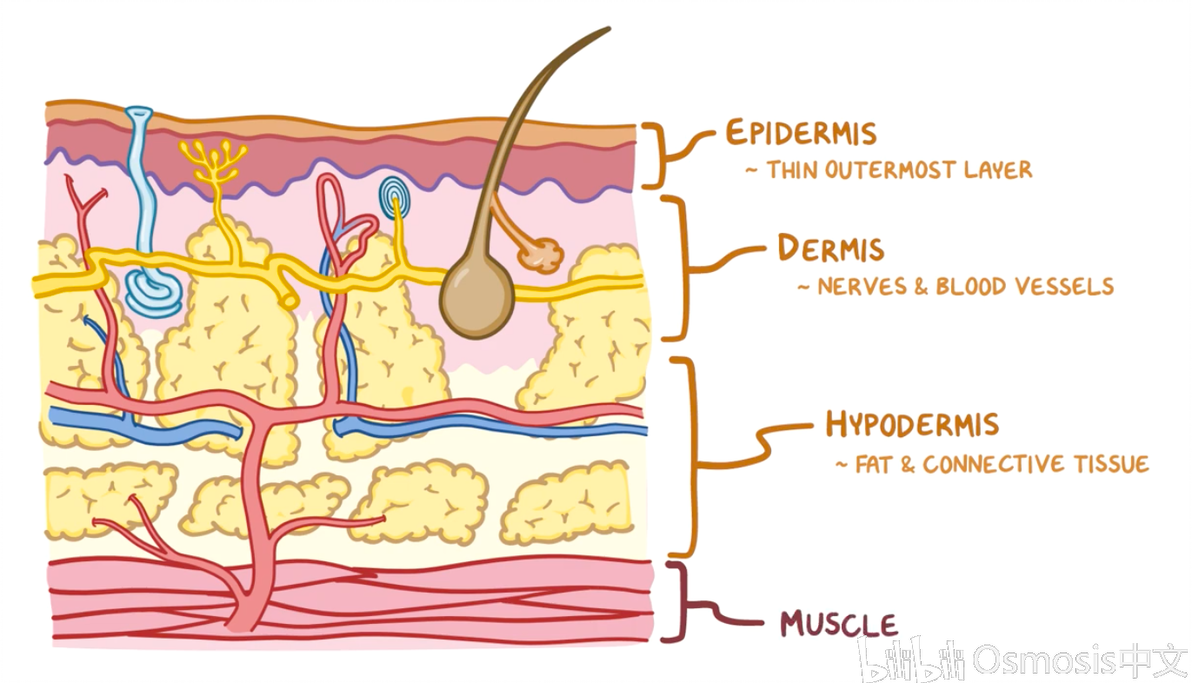
皮肤分为三层:表皮、真皮和皮下。
Now, the skin is divided into three layers - the epidermis, dermis, and hypodermis.
表皮形成薄的、最外层的皮肤。下面是较厚的真皮层,有神经和血管。最下面一层是皮下组织,它是由脂肪和结缔组织构成的,其使附着在下面的肌肉上。
The epidermis forms the thin outermost layer of skin. Underneath, is the thicker dermis layer that contains the nerves and blood vessels. And finally, there’s the hypodermis which is made of fat and connective tissue that anchors the skin to the underlying muscle.
1. 表皮|Epidermis
Epidermis
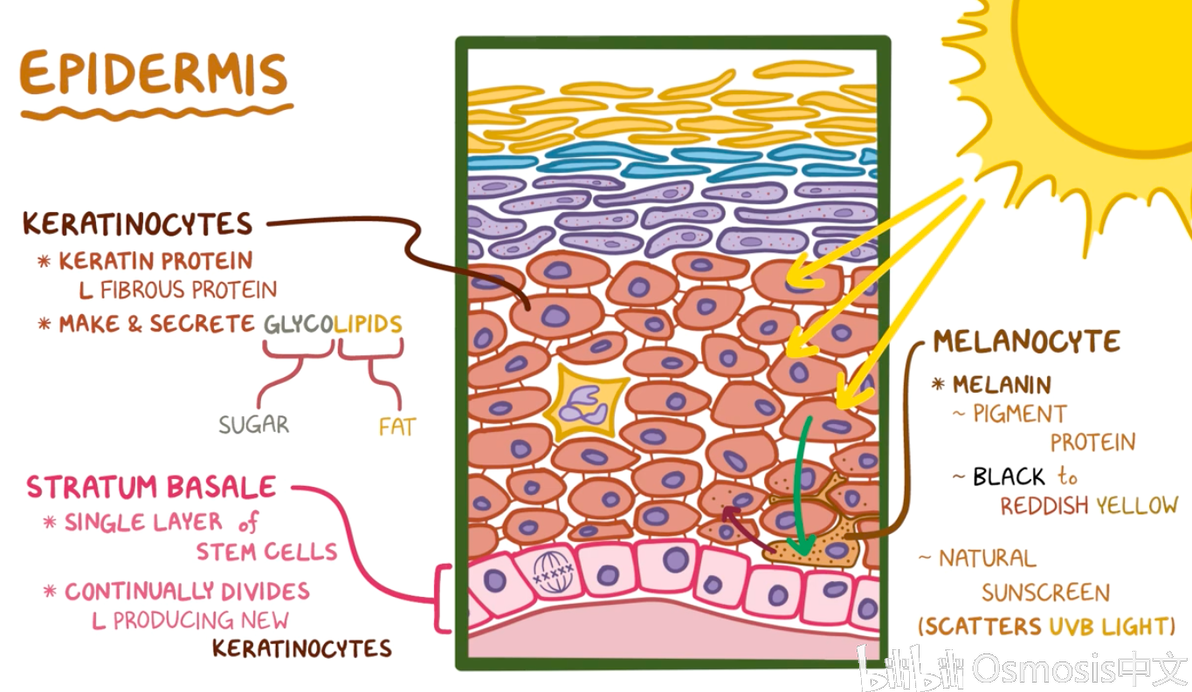
表皮由多层发育中的角质形成细胞组成,这些细胞是扁平的薄煎饼状细胞,因它们充满角蛋白而得名。角蛋白是一种纤维蛋白,比如当你在沙滩上用手摩擦沙子时,其使 角质形成细胞 不被破坏。
The epidermis itself is made of multiple layers of developing keratinocytes - which are flat pancake-shaped cells that are named for the keratin protein that they’re filled with. Keratin is a fibrous protein that allows keratinocytes to protect themselves from getting destroyed when you rub your hands through the sand at the beach.
角质形成细胞也制造和分泌糖脂,“Glyco-”意味着部分糖,“lipid”意味着部分脂肪。糖脂可防止水轻易渗入和流出身体。
Keratinocytes also make and secrete glycolipids, glyco meaning part sugar and lipid meaning part fat. Glycolipids help to prevent water from easily seeping into and out of the body.
1.1. 基底层|Stratum Basale
角质形成细胞从表皮的最里层——基底层 产生;基底层由一层干细胞组成,不断分裂并产生新的角质形成细胞;然后这些新的角质形成细胞向上移动,形成表皮的其他层。
Keratinocytes start their life at the lowest layer of the epidermis called the stratum basale, or basal layer, which is made of a single layer of stem cells that continually divide and produce new keratinocytes. These new keratinocytes then migrate upwards to form the other layers of the epidermis.
基底层还含有另一种细胞:黑素细胞,它分泌一种蛋白质色素(着色物质),称为黑色素。黑色素实际上是一个广义的术语,它构成了在不同肤色的人身上发现的几种类型的黑色素。这些黑色素亚型的颜色范围包括从 黑色到浓黄色,它们的相对数量决定了一个人的肤色。
The stratum basale also contains another group of cells - melanocytes, which secrete a protein pigment, or coloring substance, called melanin. Melanin is actually a broad term that constitutes several types of melanin found in people of differing skin color. These subtypes of melanin range in color from black to reddish yellow and their relative quantity define a person’s skin color.
当 角质形成细胞 暴露在阳光下时,它们会向 黑素细胞 发出化学信号,从而刺激黑素细胞产生更多的黑色素。黑素细胞将黑色素转移到称为 黑素体 的小囊中,这些黑素体被新形成的角质形成细胞所吸收。
When keratinocytes are exposed to the sun, they send a chemical signal to the melanocytes, which stimulates the melanocytes into making more melanin. The melanocytes move the melanin into small sacs called melanosomes, and these get taken up by newly formed keratinocytes.
黑色素就像一种天然的防晒霜,因为它的蛋白质结构会消散或分散UVB光线——若人体没有任何防护,UVB会破坏皮肤细胞中的DNA并导致皮肤癌。
Melanin then acts as a natural sunscreen, because its protein structure dissipates, or scatters, UVB light--which if left unchecked can damage the DNA in the skin cells and lead to skin cancer.
Vitamin D
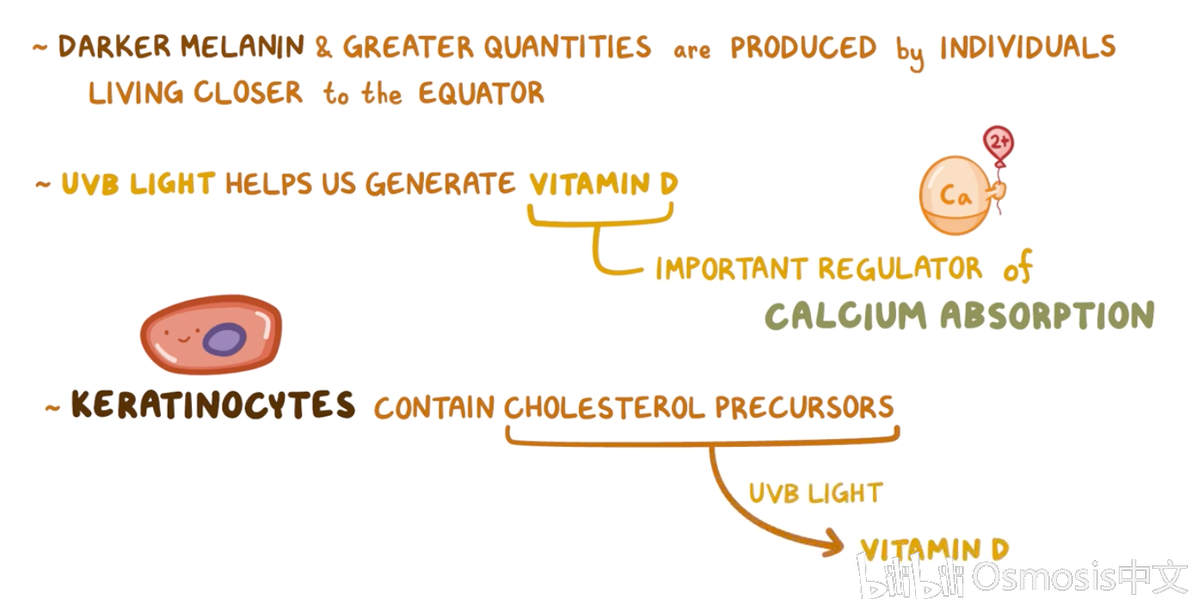
居住在赤道附近的居民有着更深与更多的黑色素,因为他们通常受到更多日照。然而,这是一个很好的平衡,因为UVB促进维生素D生成,维生素D是钙吸收的重要调节因子。
Darker types of melanin and greater quantities of this kind of melanin are produced by individuals living close to the equator because they typically get more sun exposure. However, it’s a fine balance because UVB light helps us generate vitamin D, which is an important regulator of calcium absorption.
角质形成细胞还有胆固醇前体分子,经UVB激活生成 维生素D。
Keratinocytes contain cholesterol precursor molecules that are activated by UVB into Vitamin D.
1.2. 棘层|Stratum Spinosum

Stratum Spinosum
当基底层 角质形成细胞 成熟并失去分裂能力时,它们迁移到下一层,称为棘层,约8~10个细胞层厚。棘层中的角质形成细胞在膜上有微小的蛋白质,看起来像微小的 棘;这有助于细胞彼此粘附。
As keratinocytes in the stratum basale mature and lose the ability to divide, they migrate into the next layer, called the stratum spinosum which is about 8 to 10 cell layers thick. Keratinocytes in the stratum spinosum layer have tiny proteins on the membrane that look like tiny spines; these help the cells adhere to one another.
Dendritic Cells
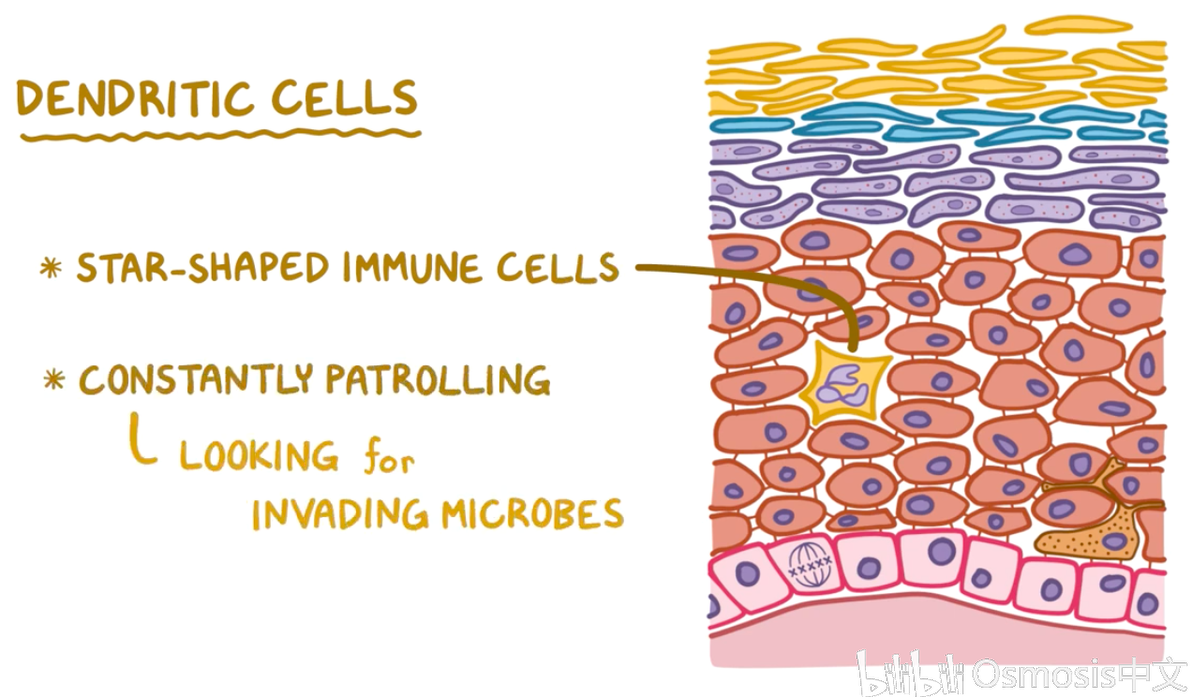
棘层也有 树突状细胞 潜伏在周围——它们是星状免疫细胞,不断巡逻——寻找入侵的微生物。
The stratum spinosum layer also has dendritic cells lurking around - these are star-shaped immune cells, that are constantly patrolling - looking for invading microbes.
1.3. 颗粒层|Stratum Granulosum
Stratum Granulosum
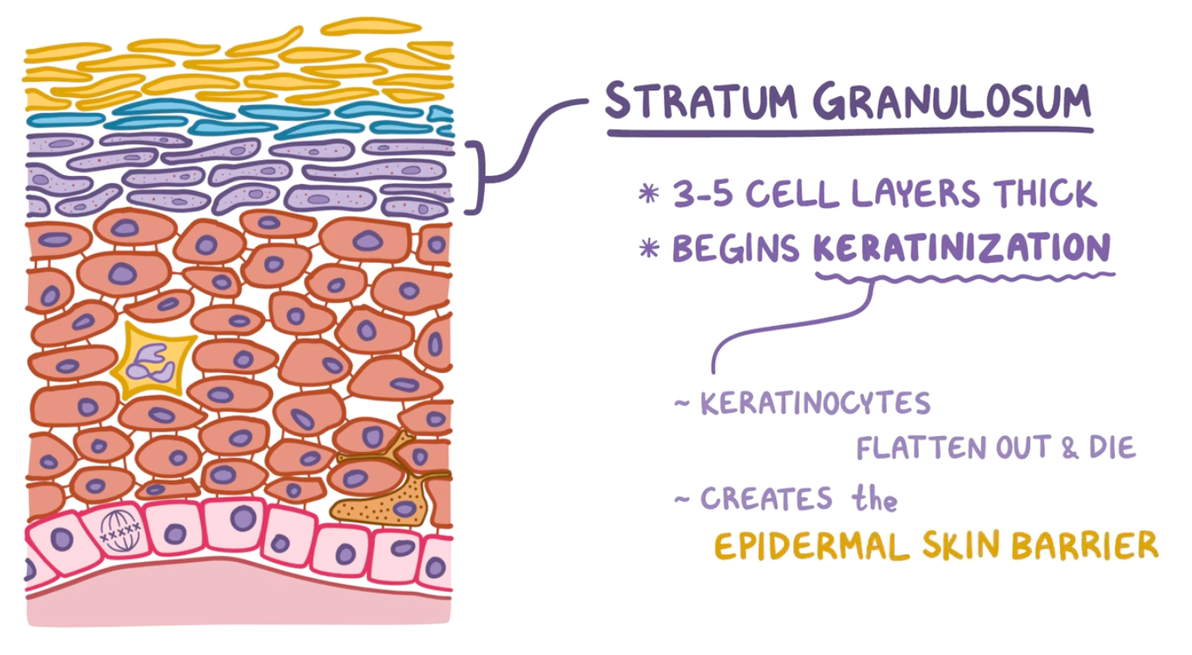
更外一层是3~5个细胞层厚的颗粒层。这一层的角质形成细胞开始角质化,即角质形成细胞变平和死亡的过程,在这个过程中形成表皮皮肤屏障。
The next layer up is the stratum granulosum which is 3 to 5 cell layers thick. Keratinocytes in this layer begin the process of keratinization, which is the process where the keratinocytes flatten out and die, and in the process they create the epidermal skin barrier.
Keratohyalin Granule & Lamellar Granule
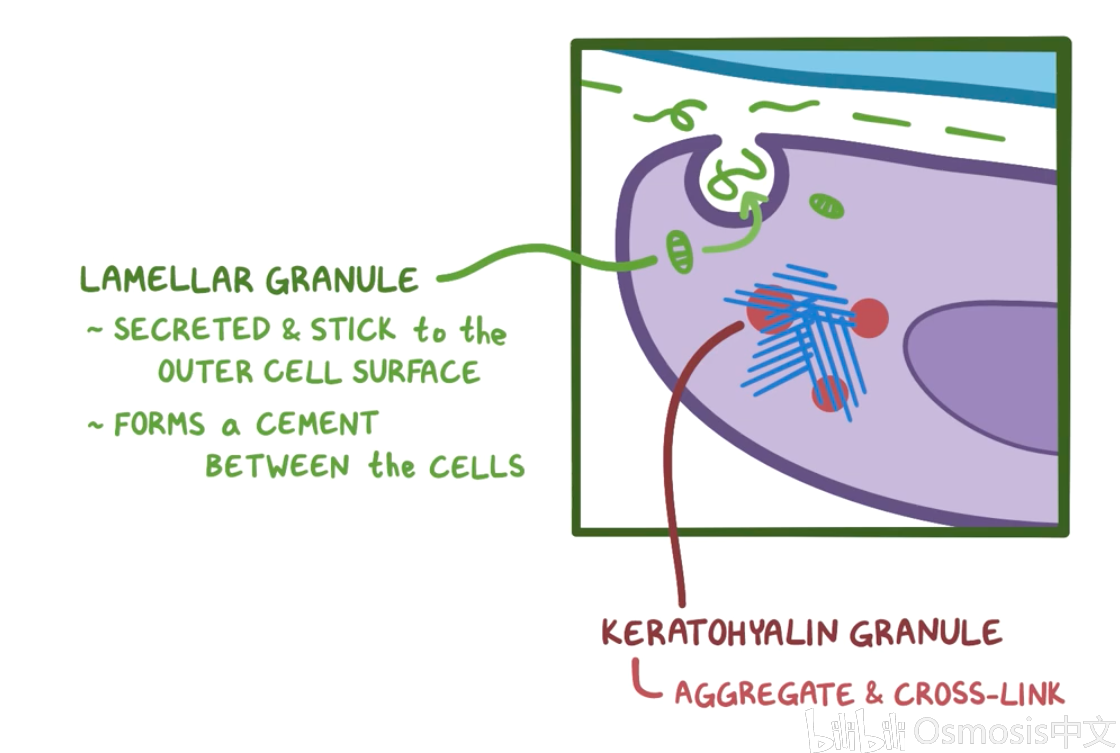
为此,颗粒层角质形成细胞产生大量 角蛋白前体蛋白 & 糖脂,分别存在于角蛋白颗粒和板层颗粒中。
To do this, keratinocytes in the stratum granulosum layer produce large amounts of keratin precursor proteins and glycolipid which remain within granules called keratohyalin granules and lamellar granules, respectively.
角蛋白颗粒 最终开始聚集和交联,在角质形成细胞内形成巨大的 角蛋白束。
Keratohyalin granules eventually start to aggregate and cross-link forming enormous bundles of keratin within the keratinocyte.
另一方面,板层颗粒 分泌并粘附在外层细胞表面。它在细胞之间形成一种 纽带,使它们对外力和水分丢失更有抵抗力。随着时间的推移,细胞内的细胞器分解,使细胞变平并凋亡。
Lamellar granules, on the other hand, get secreted and stick to the outer cell surface. It forms a sort of cement between the cells, making them more resistant to external forces and water loss. Over time, the intracellular organelles disintegrate so the cells flatten out and die.
1.4 透明层|Stratum Lucidum

Stratum Lucidum
角质化导致 透明层 的形成,该层2~3个细胞层厚,有 半透明的 凋亡 角质形成细胞,这些细胞分泌了大部分的板层颗粒。
Keratinization leads to development of the stratum lucidum layer which is 2 to 3 cell layers thick of translucent, dead keratinocytes that have secreted most of their lamellar granules.
透明层只有在厚厚的皮肤中才能找到,如 脚掌 & 脚底,因为这些部位需要更多的保护。其它部位的皮肤薄且缺乏透明层,同样的其他层也更薄。
The stratum lucidum is only found in thick skin like on the palms and soles of the feet, because those are the areas that need extra protection. The stratum lucidum is absent in thin skin, which covers the rest of the body, and the other layers are thinner.
1.5 角质层|Stratum Corneum
Stratum Corneum
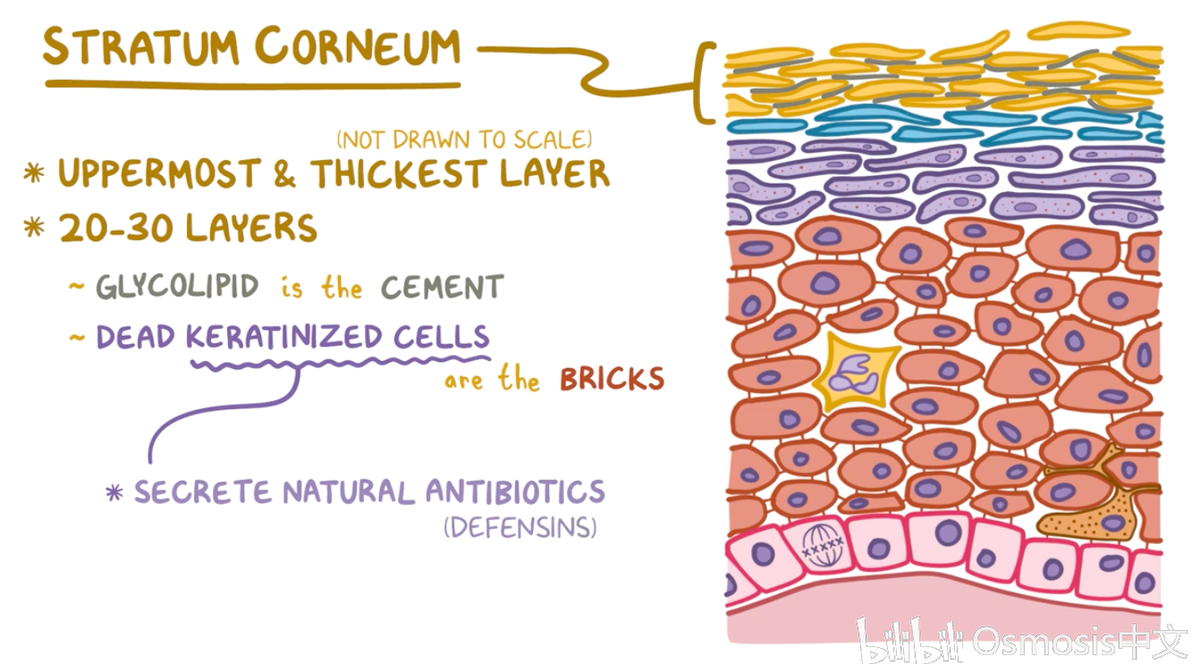
最后是 角质层,也就是表皮最上层和最厚的一层;它就像一堵20-30层细胞的墙:糖脂 的作用就像水泥,凋亡的角质细胞 是砖块。这层凋亡的角质形成细胞分泌天然抗生素,叫做 防御素,有杀菌作用。
Finally, there’s the stratum corneum, or the uppermost and thickest layer of the epidermis, which is like a wall of 20-30 layers, where the glycolipid acts like the cement and the dead keratinized cells are the bricks. The dead keratinocytes in this layer secrete natural antibiotics called defensins which poke holes in bacteria.

Skin Flakes / Dandruff
随着新的角质形成细胞进入角质层,较老的凋亡细胞脱落,形成 皮屑或头皮屑。
As new keratinocytes push up into the stratum corneum older dead cells are sloughed off forming skin flakes or dandruff.
2. 真皮:乳头层|Dermis: Papillary Layer
Papillary Layer
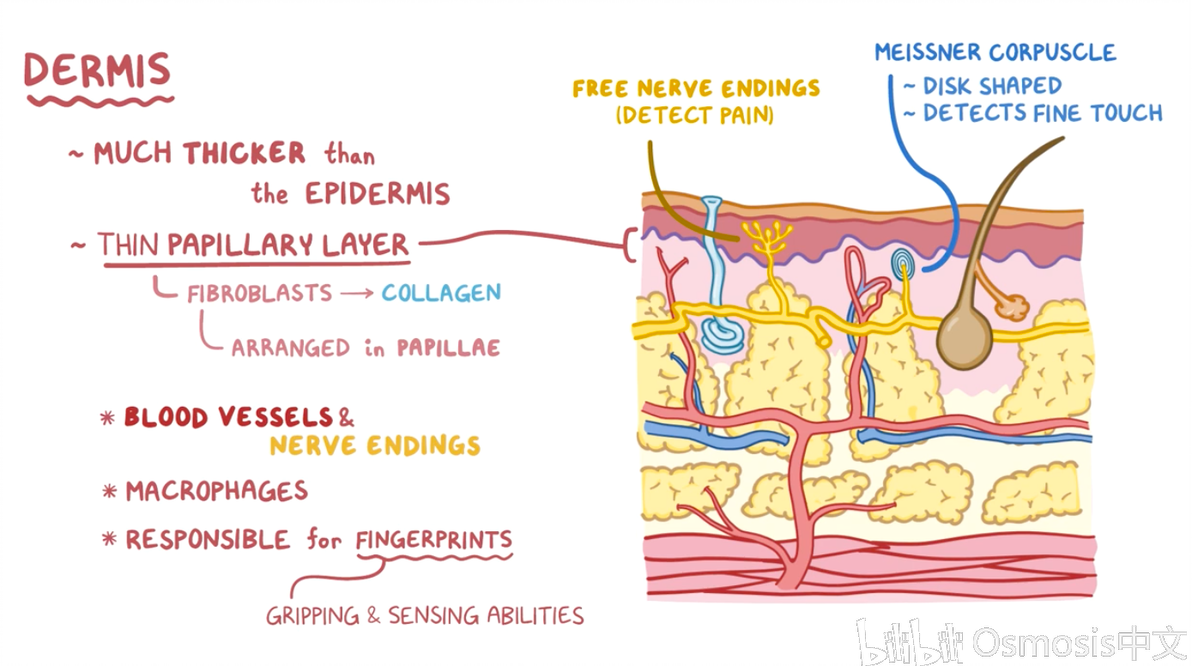
真皮位于表皮基底层下方,比表皮厚得多。真皮分为两层:基底层下薄薄的乳头层、较深的网状层。
Now, the dermis lies below the stratum basale of the epidermis and it’s much thicker than the epidermis. The dermis is divided into two layers - a thin papillary layer below the stratum basale and a deeper reticular layer.
乳头层有成纤维细胞,而成纤维细胞产生一种叫做 胶原 的结缔组织蛋白。成纤维细胞排列在称为 乳头 的 手指状突起中,每个突起都含有血管和神经末梢。
The papillary layer contains fibroblasts which produce a connective tissue protein called collagen. The fibroblasts are arranged in finger-like projections called papillae; each of which contains blood vessels and nerve endings.
这里发现的一种神经末梢叫做 Meissner 小体(触觉小体):是一种圆盘状的结构,能检测到细微的触觉,这让你能够准确地知道羽毛在哪里触碰你的手臂。
One type of nerve ending found here is called a Meissner corpuscle - this is a disk shaped structure that detects fine touch, that’s what allows you to know exactly where a feather touches your arm.
在乳头中发现的另一种神经称为 游离神经末梢,它是痛觉的树突。
Another type of nerve found in the papillae are called free nerve endings, which are dendrites that detect pain.
乳头层还有 巨噬细胞;这些巨噬细胞捕获病原体,使其通过表皮排出。
The papillary layer also contains macrophages which capture pathogens that make it past the epidermis.
乳头层还决定 指纹。它们对手指和脚的抓握和感知能力而言意义非凡;同时使我们每个人都像雪花一样独一无二。
It’s also the papillary layer that’s responsible for fingerprints. These are necessary for gripping and sensing abilities of the fingers and feet - and they make each of us as unique as snowflakes.
2.2. 真皮:网状层|Dermis: Reticular Layer
Reticular Layer
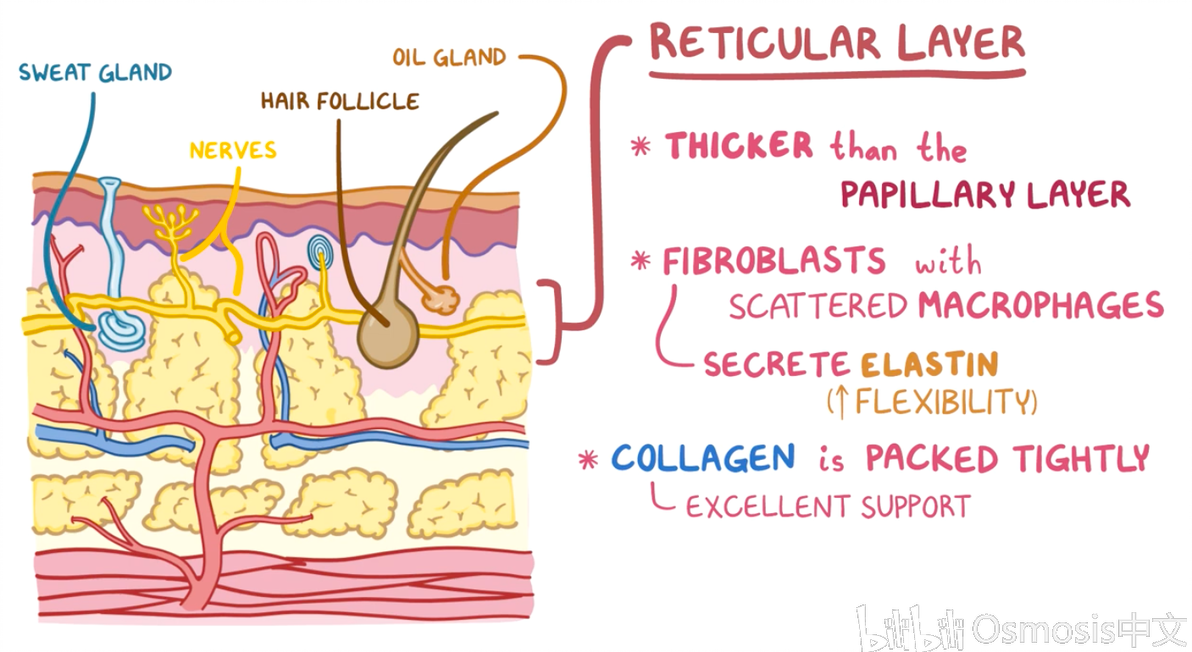
其次是真皮的网状层,它比乳头层更 厚。与乳头层一样,网状层有 成纤维细胞 & 散在的巨噬细胞;但网状层中的 胶原蛋白 被紧密地包裹在一起,使其成为良好的组织支持。
Next is the reticular layer of the dermis - which is even thicker than the papillary layer. Like the papillary layer, the reticular layer contains fibroblasts with scattered macrophages. But the collagen in the reticular layer is packed very tightly together, making it excellent tissue support.
此外,网状层的成纤维细胞分泌 弹性蛋白:这是一种有弹性的蛋白,赋予皮肤弹性。网状层还包含皮肤的附属结构,如油和汗腺、毛囊、淋巴管和神经,以及营养这些组织的血管。
In addition, fibroblasts in the reticular layer secrete elastin--which is a stretchy protein that gives skin its flexibility. The reticular layer also contains the skin’s accessory structures like oil and sweat glands, hair follicles, lymphatic vessels, and nerves - and all of the blood vessels that serve these tissues.
2.2.1. 帕西尼氏小体|Pacinian Corpuscle
Pacinian Corpuscle
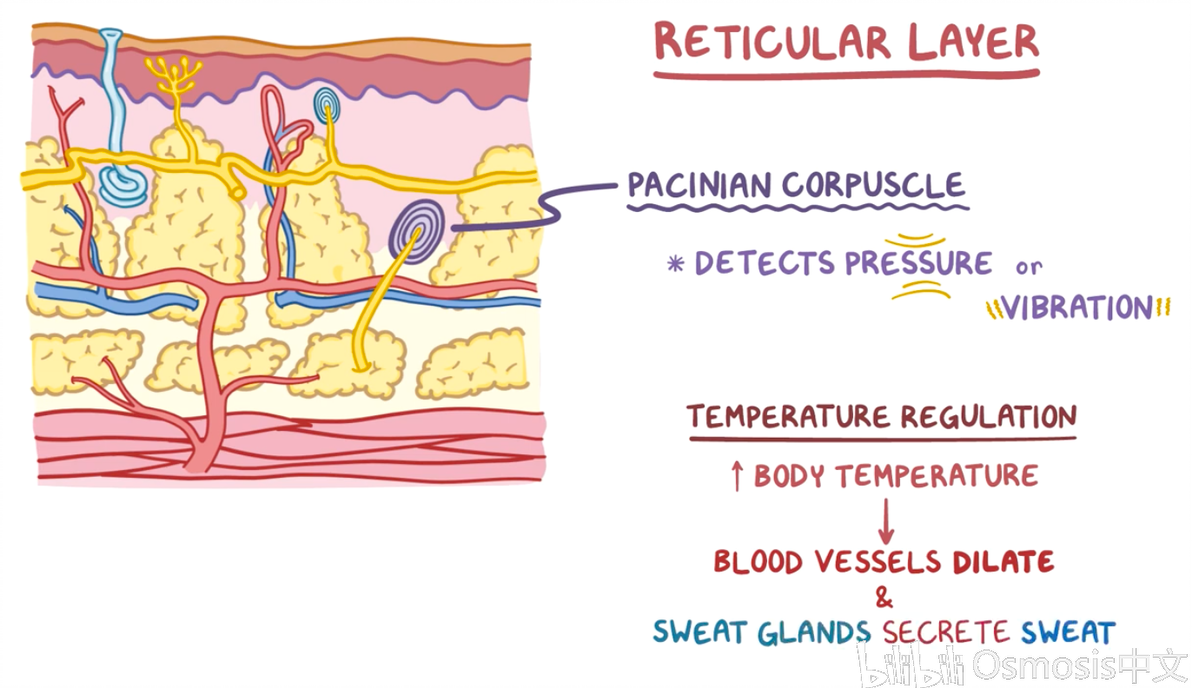
这里有一种神经末梢叫做 帕西尼氏小体 :这是一种洋葱形状的结构,为压觉和振动觉的感受器,这就是让你能感觉到有人抓住你手臂的原因。
One type of nerve ending found here is called a Pacinian corpuscle - this is an onion shaped structure that detects pressure or vibration, that’s what allows you to feel someone grabbing your arm.
由于网状层含有大量的血管和汗腺,它也负责 调节体温。当体温升高,比如在锻炼时,神经系统会使这些血管扩张,促进 汗腺 分泌汗液。
Since the reticular layer contains lots of blood vessels and sweat glands, it's also largely responsible for regulating temperature. When body temperature rises, like during a workout, the nervous system makes these blood vessels dilate, and makes the sweat glands secrete sweat.
血管扩张 会加速皮肤表面血液循环,从而散热。当汗液 覆盖 皮肤表面时,蒸发 需要热量——因此,随着蒸发的每一滴汗水,从皮肤表面逐渐散热。
Dilation of blood vessels brings more blood closer to the skin surface, and that allows heat to get lost to the outside environment. As sweat coats the skin’s surface, it takes heat to evaporate - so heat is slowly lost from the skin surface with every drop of sweat that evaporates away.
相反,当外面很冷的时候,血管就会收缩,皮肤血液循环减少,而且没有汗水;身体的热量就是这样保存下来的。
In the opposite situation, when it’s cold outside, blood vessels constrict and that diverts blood flow away from the skin and there’s no sweat - so body heat is conserved.
3. 皮下组织|Hypodermis
Hypodermis
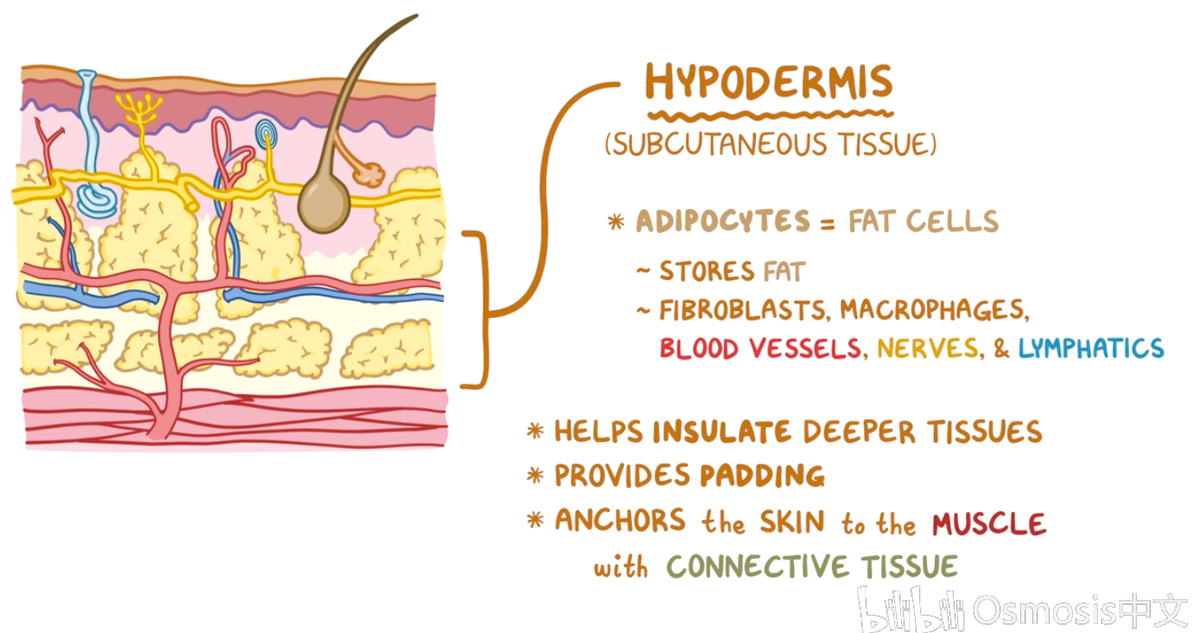
最后,在真皮下面有一层叫做 皮下 或 皮下组织。这一层含有脂肪细胞,帮助储存我们身体中的大部分脂肪,但也包含 成纤维细胞、巨噬细胞、血管、神经和淋巴。
Finally, there’s the layer just below the dermis called the hypodermis or subcutaneous tissue. This layer contains fat cells called adipocytes which help store most of the fat in our body, but also contains fibroblasts, macrophages, blood vessels, nerves, and lymphatics.
皮下有助于 隔离 更深的组织,为身体提供 填充物(受压时供缓冲),并用 胶原 等 结缔组织蛋白 将皮肤固定在肌肉上。
The hypodermis helps insulate deeper tissues, provides padding to the body, and anchor the skin to the muscle with connective tissue proteins like collagen.
小结|Quick Recap
Quick Recap
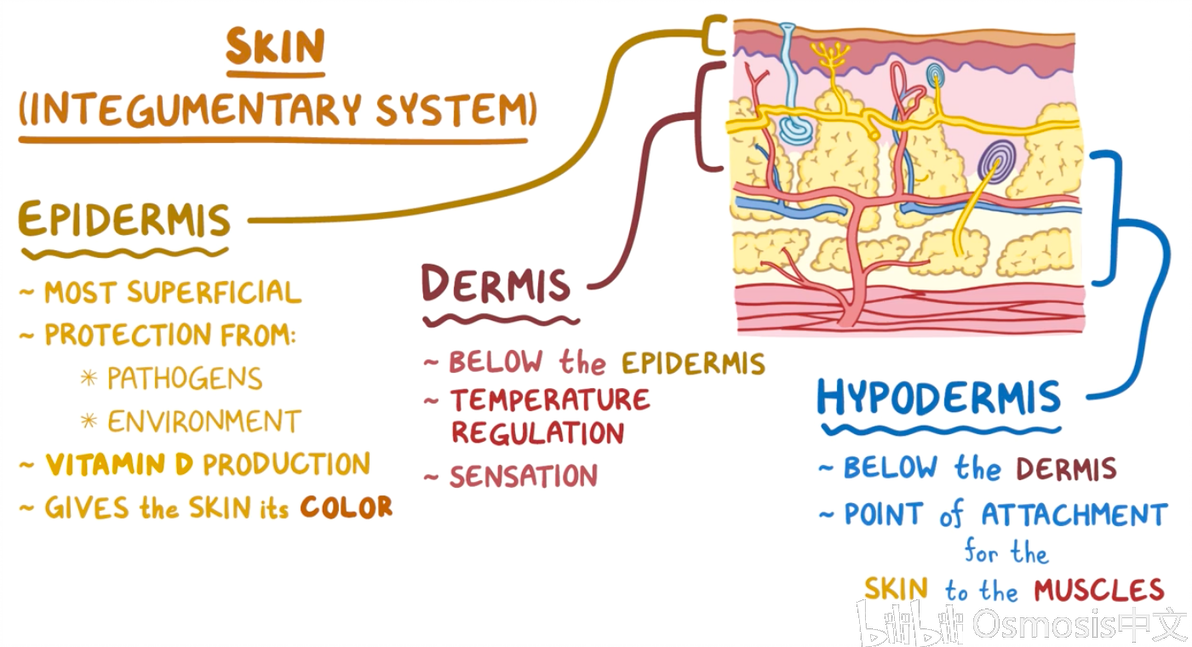
好!快速回顾下:皮肤或体表系统是人体最大的器官,在生理上有许多重要的功能。体表系统分为表皮、真皮和皮下三个主要成分。
Alright, as a quick recap, the skin or the integumentary system is the largest organ of the body that has many important functions in physiology. The integumentary system is divided into three major components including the epidermis, dermis, and hypodermis.
表皮 是最表层,它的功能是防御病原体和隔离外界环境,以及维生素D的生产,并赋予皮肤颜色。
The epidermis is the most superficial layer and it’s responsible for protection from pathogens, the environment, and for vitamin D production and giving the skin its color.
真皮 位于表皮之下,功能是控制温度调节、传导感觉。
The dermis lies below the epidermis and controls temperature regulation, helps with sensation.
皮下组织 位于真皮之下,让皮肤附着于深层肌肉上。
The hypodermis lies below the dermis and provides a point of attachment for the skin to the deeper muscles.
医见【29.1110】现身
比心核糖体、胸腔积液 & 审核大大
Memedr!!!
