
各位读者老爷好,德国梅耶长剑斩击招式系列(以Bjron Rathur为主)视频均已翻译、上传完毕,在此笔者将原著中所有描述斩击的文字及个人翻译并配合插图展示出来,并附上视频链接,方便学习和查阅。
网页链接(High Cut / Oberhauw)
The High Cut is a straight cut direct from above at your opponent's head toward his scalp, for which reason it is also called the Scalp Cut [Scheidelhauw].
下劈即笔直地从敌人头上方,照着头顶向下的劈砍,因此也被称作“头顶击”。
怒击(Warth Cut / Zornhauw)
The Warth Cut is a diagonal cut from your right shoulder at your opponent's left ear or through his face and chest, diagonally through as shown by the two crossed lines that pass through the vertical line. This is the strongest of all cuts, a*************** the might and virility of the combatant aganist his opponent in duelling and combat; therefore it is also called the Strife Cut [Streithauw] or Father Stroke [Vatterstreich] by the combat masters of old. Concerning these lines you will find hereafter, ect.[1] [1]See the diagram on 1.36r; in this case, Meyer is referring to lines H-D and B-F.
怒击是从你右肩打出,砍向敌人左耳或其脸、胸的斜向的斩击,方向如同两条垂直交叉的斜线。这是所有斩击中最强力的一个,完全能体现出使用者在决斗或作战时对敌人表现出的力量与气概;因此过去的剑术大师们也称它为“奋力一斩”或“严父的笞挞”。在后文中你可以看到更多。[1]
[1]见图1.36r;梅耶指图中的H-D和B-F两条线。
网页链接(Middle Cut / Mittelhauw)或平击(Horizontal Cut / Über-zwerchhauw)
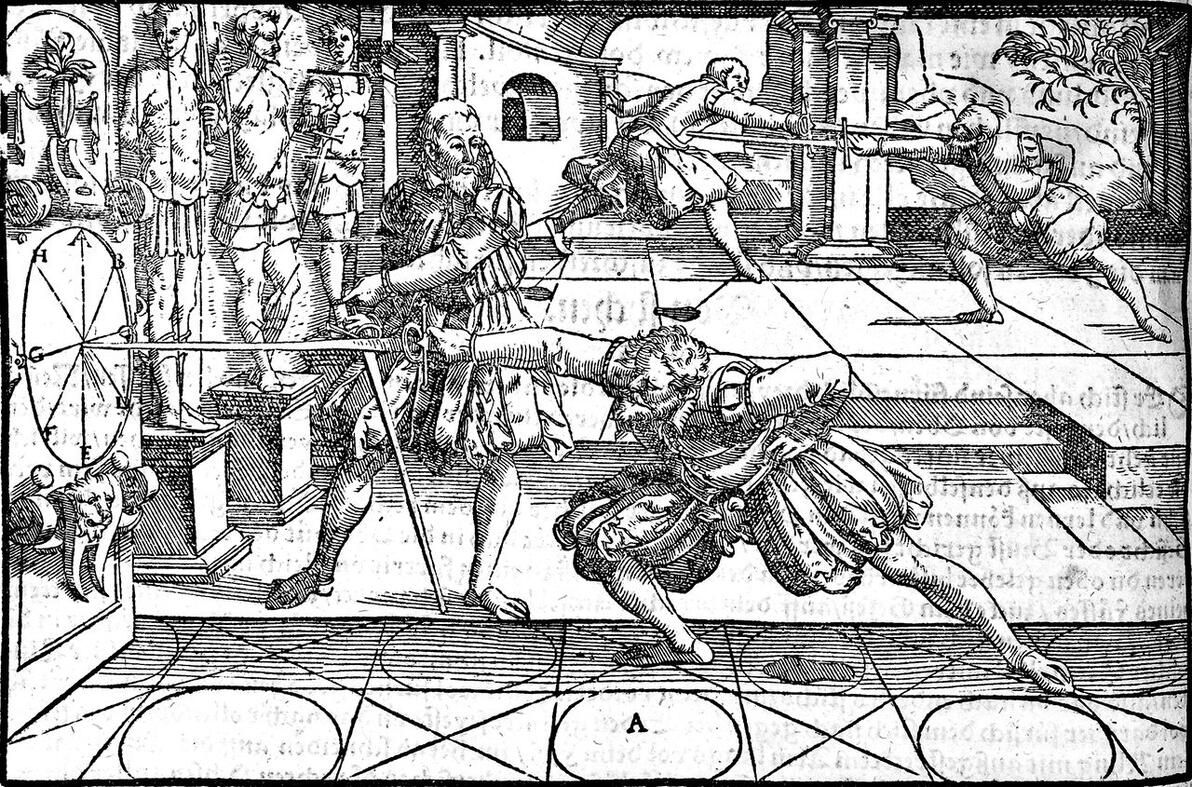
The Middle or Horizontal Cut can in most respects be executed like the Warth Cut; the only difference is that where the Warth Cut is executed diagonally, this is executed across, as can be seen on the horizental line marked G-C; you will find this line later in the section on the dusack.[2] [2]See dusack Image A.
横劈或平击打起来很像怒击;二者之间的唯一不同在于怒击是斜向的劈砍,这个是横向的,如同(梅耶方块上)G到C的水平线所示;随后你在杜萨克那章能找到这条攻击线。[2]
[2]看杜萨克插图A。
网页链接(Low Cut / Underhauw)
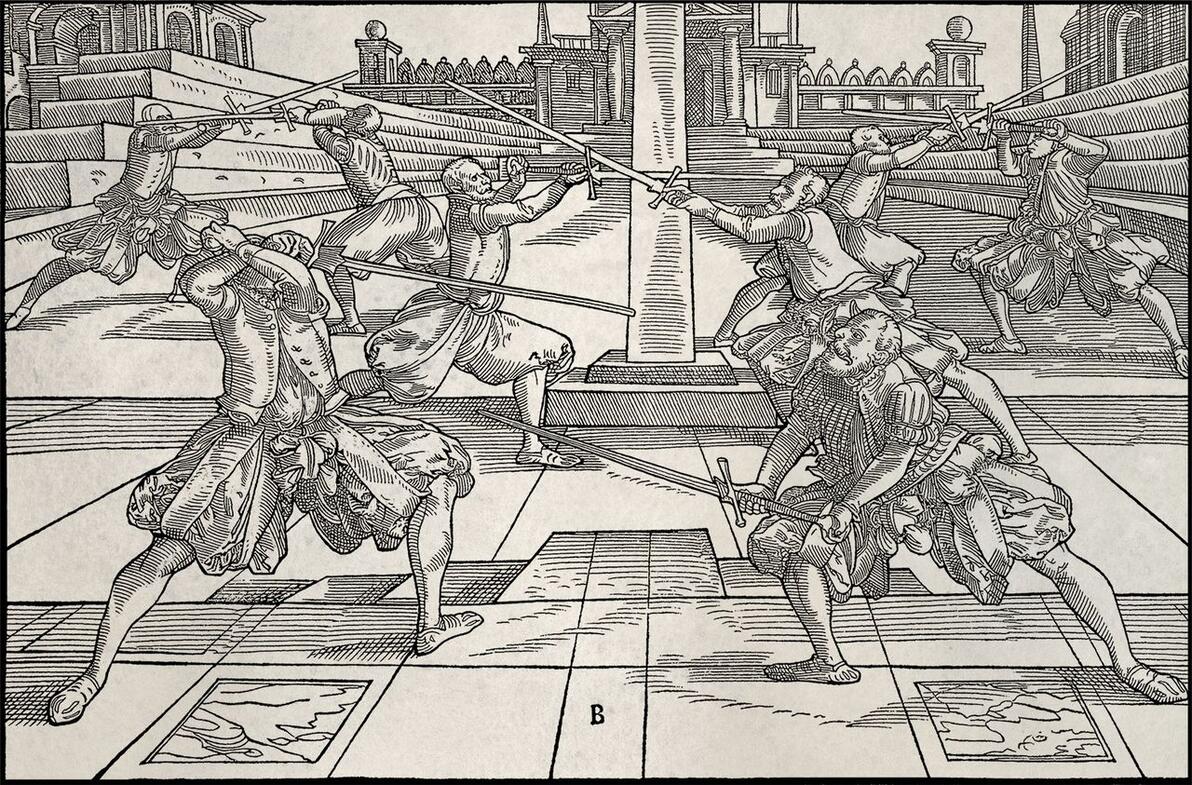
This one you execute thus: cut into the right Ox, concerning which I have spoken in the previous chapter, and as soon as you can reach your opponent, then step and cut across from below at his left arm, so that you come up over your head with your quillons; thus have you executed it. Concerning this see small figure on the Image B.
这招你这样做:挥砍至右侧牛式,如我前章所述,你一接近对手,就上步挥剑从下方斩击他的左臂,这样你用抬起的护手护住了头部,你也完成了上撩。你在插图B的小人上可以看到。
网页链接(Squinting Cut / Schielhauw)
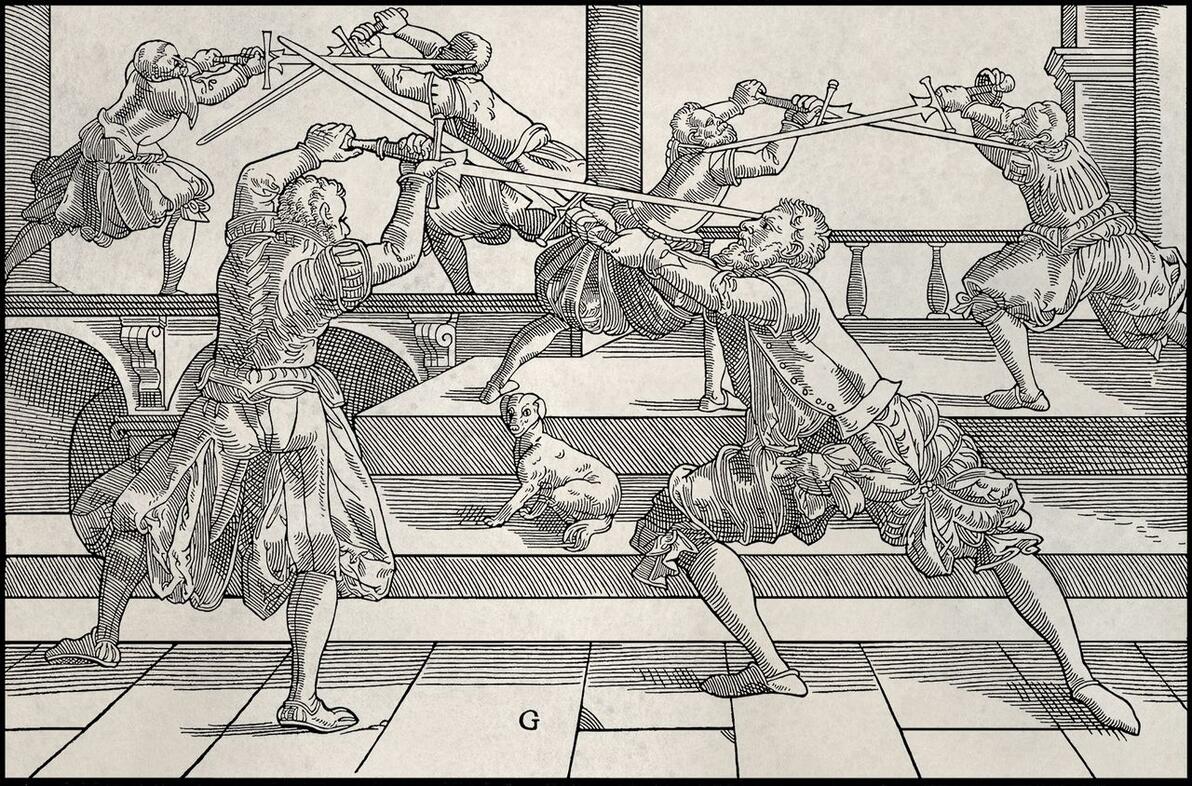
The Squinting Cut is also a High Cut, but is so named because it is delivered as if with a bit of a squint. It is done thus: Position yourself in the guard of the Day or Warth (concerning which I have spoken in Chapter 3), with your left foot forward; when he cuts at you, then cut is return, but in the stroke, in at the same time as your opponent, palm away from his sword; step with your right foot well to his left side, and with this, nimbly take your head out of the way. Thus you have executed it correctly against him, and you stand as shown by the large figure on the left in Image G.
瞥击也是一个高位劈砍,不过它如此命名是因为它用出来时像瞥了一眼似的。动作如下:
摆好顶势或怒式,左脚朝前。当对手进攻你时,你反击回去,但同时转成反刃接剑,同时手翻了过来反击,右脚迈步到对手左边,头稍微偏一点。这样你就正确地反击了他,而且你的站姿就像插图G中左侧的人。
网页链接(Crooked Cut / Krumphauw)
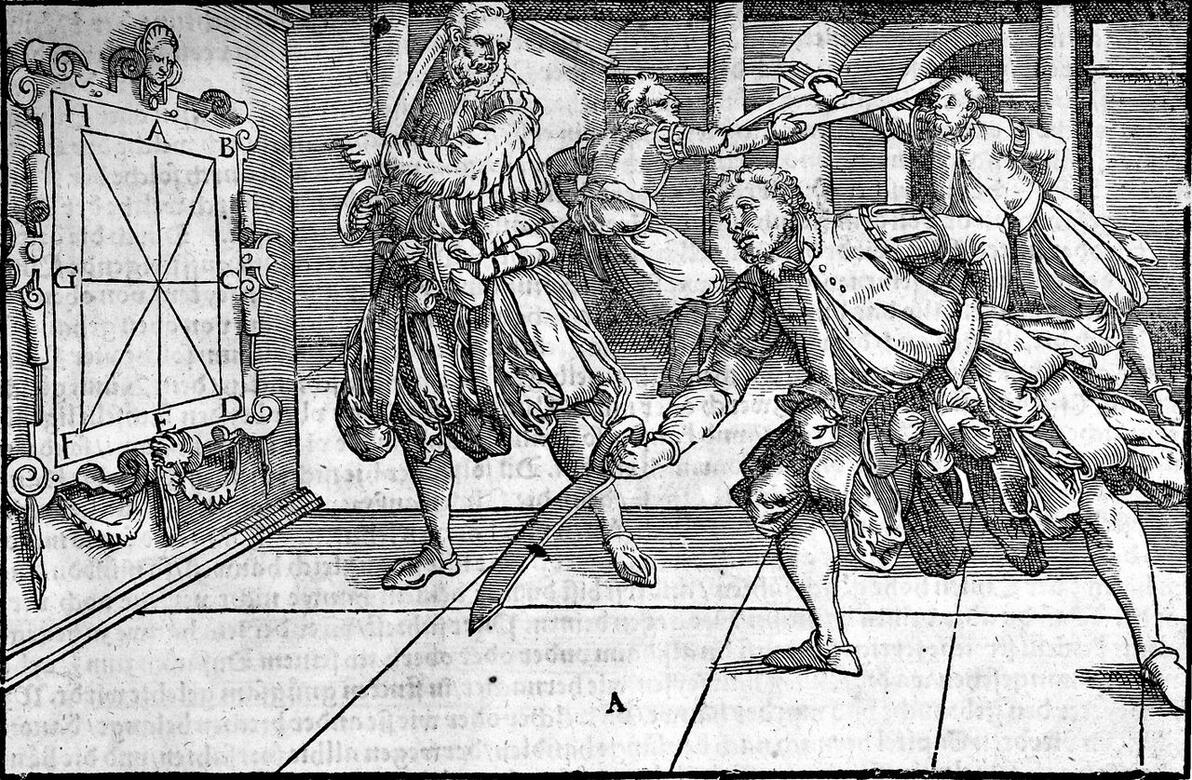
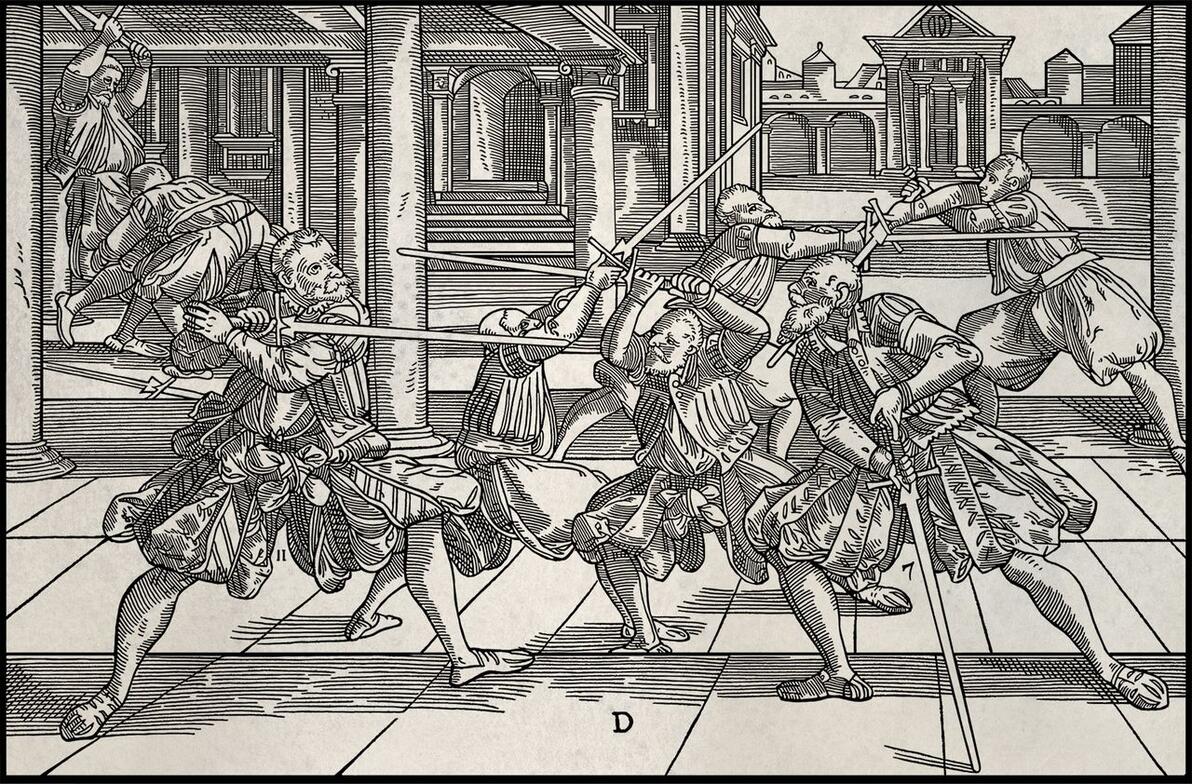
This cut is executed thus: stand in the Wrath Guard with your left foot forward; if your opponent cuts at you, then step with your right foot well out from his stroke toward his left side; cut with the long edge and crossed hands against his cut, or across on his hands between his head and blade, and let the blade shoot well over his arm, as can be seen in Image D in the figures on the upper right.
此招式如下:站姿为左脚在前的怒式,如果你的对手攻击你,则迈出右脚移动到对手的左侧,用正刃斩击同时双手交叉格挡,或者横插在他的剑身和手之间,用反刃攻击对手的肩膀。这可以在插图D的右上角中见到。
网页链接(Thwart/Zwerch)
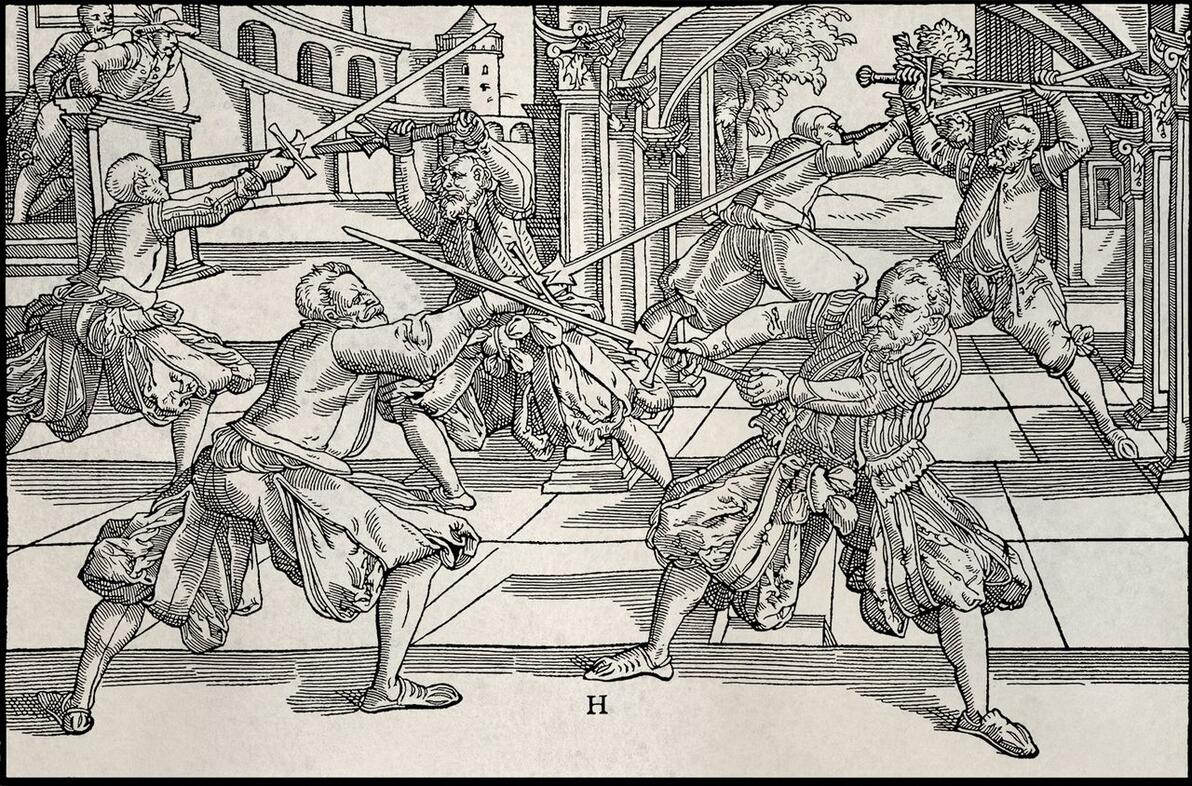
For the Thwart, conduct yourself thus: in the Onset, position yourself in the Wrath Guard on the right (concerning which see the previous chapter), that is, set your left foot forward, and hold your sword on your right shoulder, as if you intended to deliver a Wrath Cut. If your opponent cuts at you from Day or High, then cut at the same time as him with the short edge across from below against his cut; hold your quillons up over your head, as a parrying for your head, and at the same time as the cut, step well to his left side. Thus you parry and hit simultaneously, as shown by the two figures on the left in Image H. As you have done this Thwart on the left, so you shall also do it on the right, excpet that you shall hit with the long edge against his right.
你这样做交击:开始时你摆右侧怒式,左脚在前,剑扛在右肩上,然后打出怒击。如果你的对手从顶势或高位架势还击你,那么同时你用反刃绕过肘部还击,在头上方保持手臂交叉,这也是对头部的防御,挥砍的同时向左迈步。这样你就做到了攻防一体,如图H左侧两人所示。
你能完成左侧的交击,那你也能完成右侧的交击,除非你想用正刃进攻对手右侧。
网页链接(Short Cut/Kurtzhauw)
This is a stealthy action that goes through against your opponent, and is done thus: When your opponent cuts at you from above, then act as if you intended to bind on his sword with the Crooked Cut, this with the short edgr; but forego this, and quickly go through under his sword; strike with the short edge and crossed arms over his right arm at his head; thus you have caught his sword with the long edge and executed the Short Cut, and you stand at the end of it as shoen by the upper left in Image B.
这是一段隐秘的动作,如下所述:
当敌人从上方朝你挥砍时,你仿佛要曲击回应他,然后用半刃粘住他的剑,但不要真的这么做,而是绕到他剑的下方,交叉手臂,用半刃伸到到他右臂侧打头,这样你就用正刃抓住了他的剑,也完成了短击,如插图B上方的较小的人所示。
滑击(Clashing Cut/Glutzhauw)
The Clashing Cut is done thus: if someone cuts at you from above, then strike with the back of your hand against his stroke to the upper left opening; let your blade slip off on his blade with the outside flat so that in the impetus, the short edge hits his palm from his head.
滑击动作如下:如果对手从上方向你劈砍,那么你从相反的方向回击,以左上方的空当为目标,让你的剑刃顺着对手外侧的剑面滑下,这样在这个动作之内你的反刃可以砍到他的手与头。
网页链接(Rebound Cut/Prellhau)
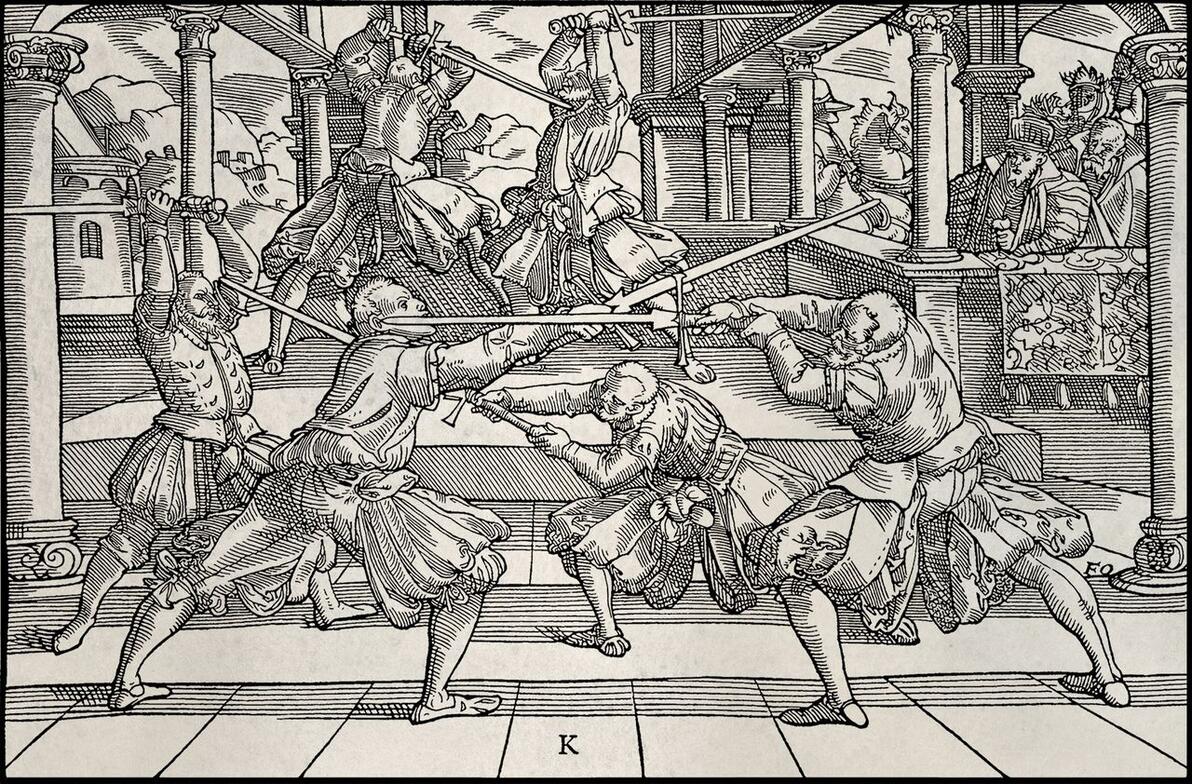
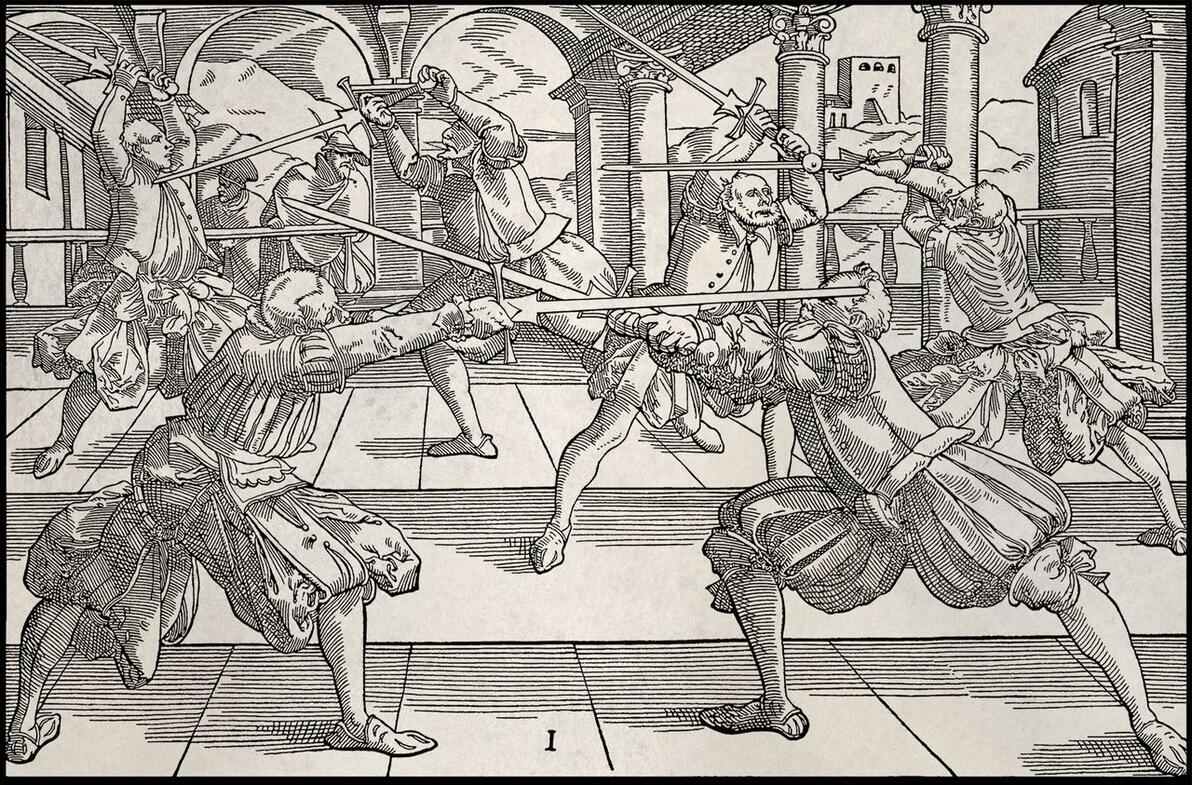
This is of two kinds; one is caIled the single, and the other the doubIe. The singIe is done thus: if your opponent cuts at you from above, then intercept his stroke with a Thwart. As soon as it clashes, pulI the sword around your head and strike from your left with the outside flat at his ear, as shown by the large figure on the right in Image K, so that the sword rebounds back away. Pull it back around your head in the impetus of the rebound; cut with the Thwart to his left; thus it is done. Do the double this way: in the Onset as soon as your opponent brings his sword into the air to work, then position yourself in the right Ox (concerning which see the previous chapter), pull your sword around your head, and cut strongly with the inside flat from your right against his blade, so that in the blow your pommel touches underneath the radius-bone of your forearm, as can be seen in the large figure on the left in Image I, and in the stroke step with your right foot well around his left. And as soon as it clashes or connects, then jerk it upwards and at the same time wrench to the left, and strike quickly outside with the back of your hand, back into the same opening, that is with the outside flat, such that it has rebounded around and right back in; thus you have done it rightly.
此招由两部分组成,其一为单弹击,其二为双弹击。
单弹击如下:当你对手从上方攻击你时,先用交击接住,在接触的同时,绕头转剑,从你的左侧挥击,外侧朝向他的耳朵,如插图K右手侧所示。这样剑又弹了回去,在反弹时再次绕头转剑,向敌左侧打出交击,弹击就完成了。
双弹击如此:当你靠近时对手从空中挥击,你摆出右侧牛势,绕头挥剑,从右侧以内侧剑面强力地对抗他的剑,如此你的柄锤会在击打中碰到你的小臂,如插图I中画得最大的那部分,在左手侧可以看到。然而,在挥击时需要你的右脚向敌左侧迈进,此时击中或交剑,将剑向上拉并扭向你的左侧,用反向的手灵敏地从外侧击打同一空当,当反弹时用相反的剑面,这样你就正确地做到了。
网页链接(Blind Cut/Blendthauw)
Bind your opponent from your right on his sword;in the bind, wind through below with your hilt orhaft toward your left side. When your op-ponent tries to slip after the winding, then nimbly flick the foible, that is the point, at his head fromyour right at his left with crossed hands. Quickly wind back through, or wrench to your left sidewith the short edge; thus you have executed theBlind Cut. This Blind Cut is done in many ways; there will be more about it in the section on devices.
你从右侧出剑粘住对手,粘剑后将你的护手或后半段剑绕至对手左侧,当你对手想要在绕剑后滑下时,机智地轻弹弱剑身,此时手臂交叉你的剑在他头左侧,快速将剑绕回来,或者转回来以反刃朝左侧,这样你就完成了盲击。
盲击的实现有很多种方式,在策略部分中将有更多关于它的内容。
网页链接(Winding Cut/Windthauw)
The Winding Cut is done in the following manner: if your opponent cuts at you from above,then cut from below with crossed hands from your left onto his sword, so that your pommel sticks out under your right arm. And as soon as it clashes, step with your left foot out from him well toward your left side, withdraw your pommel again in a loop back out toward your left side, so that in the impetus, your long edge connects with his head over his right arm behind his blade, or hits over his right arm (concerning which see the large figure on the right in Image H), and so that your sword flies out by your side; and quickly cutback opposite to it with the Cross; thus it is done.
绞击的完成如下所述:如果你的对手从上方进攻,那么你从左下方抬剑架住,手臂交叉,此时柄锤在你的右臂之下,然后剑迅速滑落,左脚向左后方撤,向左方远处移动你剑的柄锤,好似划出弧线,此时剑的正刃也跟着挥向对手柄锤之后的右臂,如插图H右侧所示,随后你挥剑封住自身,也可以再次挥砍对手的手臂,绞击就是这样。
网页链接(Crown Cut/Kronhauw)
This is executed thus: when you stand in the Plow or else lay on up from below from some posture, and your opponent cuts at you from above, then go up with horizontal quillons and catch his stroke in the air on your shield or quillon bar; and as soon as it clashes, push the pommel quickly upward and strike him with the short edge behind his blade on his head; thus have you correctly executed the Crown Cut.
这么做:当你摆出犁式或其他任何可以从下往上刺的起势时,如果你的对手从上方斩击你,你则举剑并横向移动,用护手或柄接住他的攻击,一旦他的攻击动作停止了,迅速抬高的你配重球,同时用前半边的剑刃绕到对手的剑的后面攻击他的头部,这样你就正确完成了顶击。
网页链接(Wrist Cut/Kniechellhauw)
This is so called from the body part to which it is directed. Do it thus: After the initial Onset, when you have come under your opponents sword with your hands up above your head, and he holds his head thus between his arms, then cut with Thwart Cuts under his pommel up toward his wrist-bones or wrist-joints. If he holds his hands too high, then cut with these Thwart Cuts up from below toward the knob of his elbows; thus it is done.
这招的名字来自身体做如下动作:
在首先交剑后,你已经控制住对手的剑并举在你头上方,此时他的头在上举的双臂之间,然后以从下到上的怒击进攻他的手腕或双臂之间的头或手臂,如果他手举太高,自下而上怒击打他的手肘。腕击便是如此。
网页链接(Plunge Cut/Sturtzhauw)
Although this cut is a High Cut, and so considered because there is not much difference between the two, yet this is called the Plunge Cut because in cutting through, it always plunges over above, so that the point comes against the opponents face in the Ox; and it is most used in the Approach or Onset.
这是一个上方的斩击,其实这在二者间几乎没什么不同,它被称为落击是因为:这招始终是从上方打来,牛式剑尖指向对手的脸,而且常用于移动中或先手进攻。
网页链接(Change Cut/Wechselhauw)
The Change Cut is simply to change off before your opponent with your cuts, from one side to another, from above to below, and vice versa, in order to confuse him.
变换击就是简单地在你对手面前改变挥砍方向,从一侧挥砍到另一侧,下劈与上撩交互使用,以此迷惑对手。
网页链接(Flick/Schneller)或随击(Tag-Hit/Zeckrur)
The flick or Tag-Hit is not actually delivered as a cut, but is rather flicked; it is executed in the middle of combat when one has occasion, namely when you make your weapon snap at your opponent from above or from either side or from below with the flat or foible of the blade, or flick it in an arc over or under his blade.
轻击或随击严格说来不像斩击,更像一种轻弹;它是在战斗中使用的,例如有这样一个场景,即当你的武器从上方、或从任何一侧、或从下方用剑面或弱剑身击中你的对手,或者从上方或下方画弧线轻弹对手的剑时。
参考文献
[1]Meyer,J.The Art of Combat: A German Martial Arts Treatise of 1570,[M].2015,(1):57-60.
