
世界是量子
In the glare of hindsight, every student of quantum physics nowadays knows that Bohr’s guess is wrong, that the orbital angular momentum in that state is actually zero. But through a remarkable stroke of luck, Bohr’s erroneous guess led to the correct answer for the measured energy of the hydrogen atom in its lowest energy state.
在事后的光芒中,如今每个量子物理学的学生都知道玻尔的猜测是错误的,那个状态下的轨道角动量实际上是零。但通过一次惊人的幸运,玻尔的错误猜测导致了测量氢原子在其最低能量状态下的正确能量值
Three young guys, one of whom told his idea to the wrong “old” guy and ended up the loser
三个年轻人,其中一个向一个错误的“老”家伙说了他的想法,结果成了输家
I was so dumb when I was young.
小时候我真的很傻。
—Wolfgang Pauli 沃尔夫冈·泡利
1 在发表电子自转的想法之前,克罗尼格犯了咨询著名尖刻批评家沃尔夫冈·泡利的错误。在经典物理学中,电子被估计具有微小的半径,用于各种情境。泡利指出,鉴于电子的微小半径,如果电子要自转,其表面必须比光速移动得更快。
2 友好、鼓舞人心的保罗·埃伦费斯特喜欢乌伦贝克和古德斯密特的旋转电子的想法,并愿意安排发表他们的论文,顺便说一句,那是一封给编辑的一页信。与此同时,荷兰物理学的泰斗洛伦兹已经退休,住在哈勒姆,他访问了莱顿。当年轻的乌伦贝克向年迈的洛伦兹讲述电子自旋时,后者也指出电子的表面移动速度将超过光速。
3Shattered, Uhlenbeck rushed to Ehrenfest to withdraw the paper, but Ehrenfest told him that it was too late, adding, “You and Goudsmit are both young enough to be able to afford a stupidity.”
悲,乌伦贝克急忙去找埃伦费斯特撤回论文,但埃伦费斯特告诉他太晚了,补充说:“你和古德斯密特都还年轻,可以承担得起愚蠢。
A bizarre scarf factory employing elves to sort
To explain the Stern-Gerlach experiment, I resort to the following approach. I will first describe an analogous situation in everyday life and show that the observations corresponding to what Stern and Gerlach saw make no sense. Hardly news to the readers of this book! Quantum physics famously goes against common sense. My task here is to show you how much it goes against common sense.
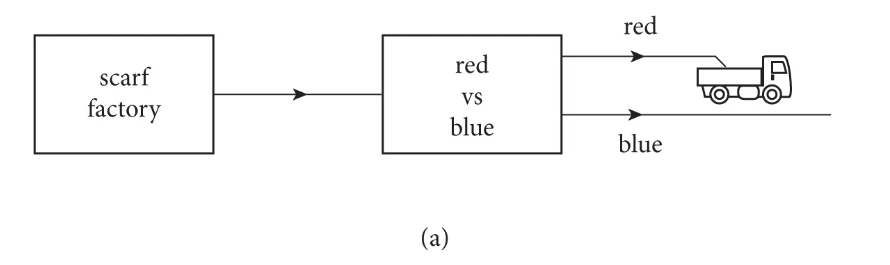
Imagine a scarf factory that makes only red scarves and blue scarves. The output of the factory is conveyed on a belt into a sorting room. We cannot look inside the enclosed room but we are told that an elf inside sorts the scarves according to color and places them on two belts coming out of that room, one belt carrying only red scarves, the other only blue scarves. See figure 2(a). For some reason, perhaps because the factory is located in a so-called blue state in the United States, the red scarves are dumped into a truck and taken away, presumably to a red state.25 (To make sure that our elf did not make a mistake, we can double check by feeding the stream of blue scarves into another room where another elf is also told to sort by color. Sure enough, only blue scarves come out. By the way, this extra “quality check” process is not shown in the figure 2(a); you could draw it on the right of figure 2(a) if you wish.)
Thus far, there is nothing surprising in the slightest about the story. But I do ask you to please remember that all the scarves we have are blue. The red scarves have all been dumped into a truck and carried away.
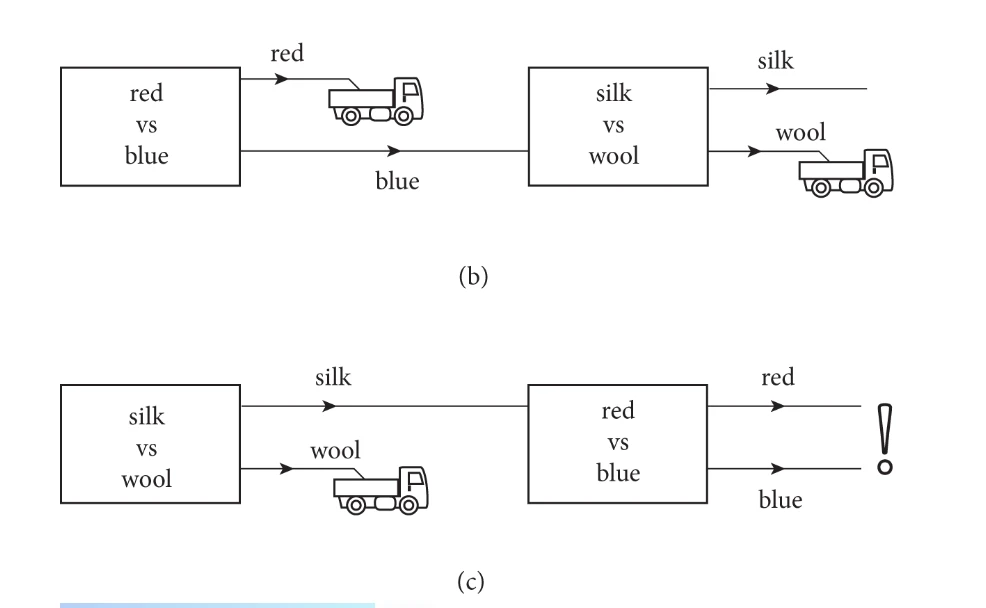
Now we feed the stream of blue scarves into a room with an elf who is totally color blind (or perhaps the room is simply kept in total darkness) and who is instructed to use his sense of touch to separate the scarves into silk and woolen scarves. Again, two conveyor belts emerge, one carrying only silk scarves, the other only woolen scarves. The woolen scarves are taken away in trucks. This is shown in figure 2(b).
Figure 2. A strange scarf factory described in the text. (a) The scarves are sent into a room labeled “red versus blue” and sorted by an elf into two streams, with the red scarves trucked away. (b) The stream of blue scarves coming out of the sorting room in (a) is sent into a room labeled “silk versus wool” and sorted into two streams, silk and wool, with the woolen scarves trucked away. Note that the left side of (b) is just the right side of (a) repeated for your viewing convenience. (c) The stream of blue silk scarves coming out of the sorting room in (b) are sent into another room labeled “red versus blue” and sorted. Surprise surprise, two streams come out, with equal number of red and blue scarves. Where did the red scarves come from? Weren’t they all trucked away?
What is amazing about that? Absolutely nothing.
To underline that absolutely nothing strange or amazing has occurred up to this point in the story, let us imagine you the reader as an eccentric American billionaire. You could set up a scarf factory, hire some elves, buy some trucks, and arrange everything to come out exactly as described. You could even make a (rather dull) movie out of this without resorting to any computer generated special effects.
Next, we feed the stream of silk scarves into a sorting room with an elf capable of separating red scarves from blue scarves. This is depicted in figure 2(c). Guess what? Surprise surprise, two streams of scarves emerge, with one belt carrying red scarves, the other carrying blue scarves. Equal number of red and blue scarves coming out!

Figure 3. Suppose that in figure 2(b) the truck hired to take the woolen scarves away did not show up. So instead of what was depicted in figure 2, both streams, one consisting of silk scarves, the other of woolen scarves, are sent into a room labeled “red versus blue”. Surprise surprise, only blue scarves come out! You might have noticed that this is just figure 2(b) run in reverse.
This totally contradicts common sense! In “real life,” the red scarves had all been trucked away. How in the blessed world can they reappear?
Here is a variant that is perhaps just as astonishing. Suppose in figure 2(b) the trucks did not show up to carry the woolen scarves away. This is shown on the left of figure 3. So, in this alternate version, the blue scarves coming on the right of figure 2(a) are sent into a room where an elf sorts them by touch into silk and woolen scarves. Thus, two streams, one of silk scarves and another of woolen scarves, come out of the sorting room. We then allow both streams to go into a sorting room operated by the elf with color vision but without a sense of touch (or perhaps because the scarves are wrapped in thick but translucent plastic bags). Do you want to pause for a moment to think about the scarves that would emerge?
Yes, only blue scarves!
量子力学的诠释
But there is a remarkable phenomenon that you would not observe in the philosophy department. Two physicists could be arguing vehemently about the interpretation of quantum physics, and yet, if they were told to sit down and calculate what they would predict for a specific quantum process that experimentalists can measure, they would always agree! Physicists could differ on the words attached to the mathematical symbols but yet totally agree on the math. In my more than humble opinion, this ongoing, and some would say never-ending, debate is to a large extent futile, since words necessarily evolved out of everyday life. I truly do not know what it means to say that the universe branches every time an observation is made, as in the so-called many-world interpretation of quantumphysics.
但是有一个显著的现象是你在哲学系不会观察到的。两位物理学家可能会激烈地争论量子物理学的解释,然而,如果让他们坐下来计算一下,他们会对实验家可以测量的特定量子过程做出什么预测,他们总是会同意的!物理学家可能会对附加在数学符号上的词产生分歧,但在数学上是完全一致的。在我看来,这种持续的争论,有些人会说永无止境,在很大程度上是徒劳的,因为词汇必然是从日常生活中进化出来的。我真的不知道,在所谓的量子物理学的多世界解释中,每次进行观察时,宇宙就会发生分支,这是什么意思。
量子物理的哥本哈根诠释
测量就collapse,随机选个状态,后续的测就是保持这个状态了
Bell’s inequalities
P(C=F):颜色和布料属性值相同的概率。这意味着围巾要么是“蓝色+丝绸”,要么是“红色+羊毛”。
P(C=T):颜色和流苏属性值相同的概率。
P(F=T):布料和流苏属性值相同的概率。
文章说,在围巾的经典世界里,下面这个不等式必须成立:
P(C=F)+P(C=T)+P(F=T)≥1
P(C=F)+P(C=T)+P(F=T)≥1是关键
看任何一件具体的围巾。三个属性(C, F, T)都只有两个值(+ 或 -)。
对于这三个值,最多有几个是“不相同”的?
比如,C是“+”,F是“-”,T是“-”。那么
C 和 F 不同。
C 和 T 不同。
F 和 T 相同。
你不可能找到一种组合,让 C、F、T 三者两两之间都不同。因为只有两个选项(+ 和 -),如果 C≠F 且 C≠T,那么 F 和 T 必须相同。
结论就是:对于任何一件围巾,(C,F), (C,T), (F,T) 这三对属性中,至少有一对的属性值是“相同”的。
既然任何一件围巾都至少有一对属性是相同的,那么我们随机拿到一件围巾,它“(C和F相同)或(C和T相同)或(F和T相同)”这件事发生的概率就是 100%。
根据基础概率论,P(A 或 B 或 C) ≤ P(A) + P(B) + P(C)。
把我们的情况代入:
100% ≤ P(C=F) + P(C=T) + P(F=T)
围巾 -> 一对纠缠的光子。
属性 (C, F, T) -> 三个不同的测量角度(比如沿0度、120度、240度方向测量光子的偏振)。
属性值 (+ 或 -) -> 测量结果是“上”还是“下”。
物理学家们在实验室里对大量的纠缠光子对进行这样的测量,然后计算 P(C=F)、P(C=T) 和 P(F=T)。
实验结果发现: 通过巧妙地选择测量角度,可以得到:
P(C=F)+P(C=T)+P(F=T)<1
P(C=F)+P(C=T)+P(F=T)<1
(一个典型的实验结果可能是 0.75,这明显小于 1)
逻辑链条:
前提:如果物理属性是预先确定的(反事实确定性)。
推论:那么贝尔不等式 P(C=F) + P(C=T) + P(F=T) ≥ 1 必须成立。
事实:真实的量子实验打破了这个不等式。
结论:因此,最初的前提是错误的!
将属性分配给一个物体,无论是否进行测量来确定这些属性,都是有意义的。再次,在我们的经典世界故事中,在 Alice 打开她的盒子之前,她(和我们)都不知道里面的围巾是红色还是蓝色。然而,在场的人都坚信围巾的红色或蓝色已经固定,并且不受她打开盒子的影响。颜色不能神奇地改变。换句话说,颜色是真实的(如果你愿意用这个术语),是现实的一部分,常识告诉我们它存在。
我们发现宇宙最底层的逻辑,可能不是关于“东西”的,而是关于“关系”和“信息”的。
桌子(粒子)在你测量之前,根本就没有“长度”这个属性。它是一团可以变成任何长度的“木料”。尺子(测量),是在命令它:“立刻给我呈现出一个长度!” 每次你下命令,它都会给你一个长度,虽然单次给出的值不确定,但它能给出的所有值的平均数和分布,是你完全可以预知的。
